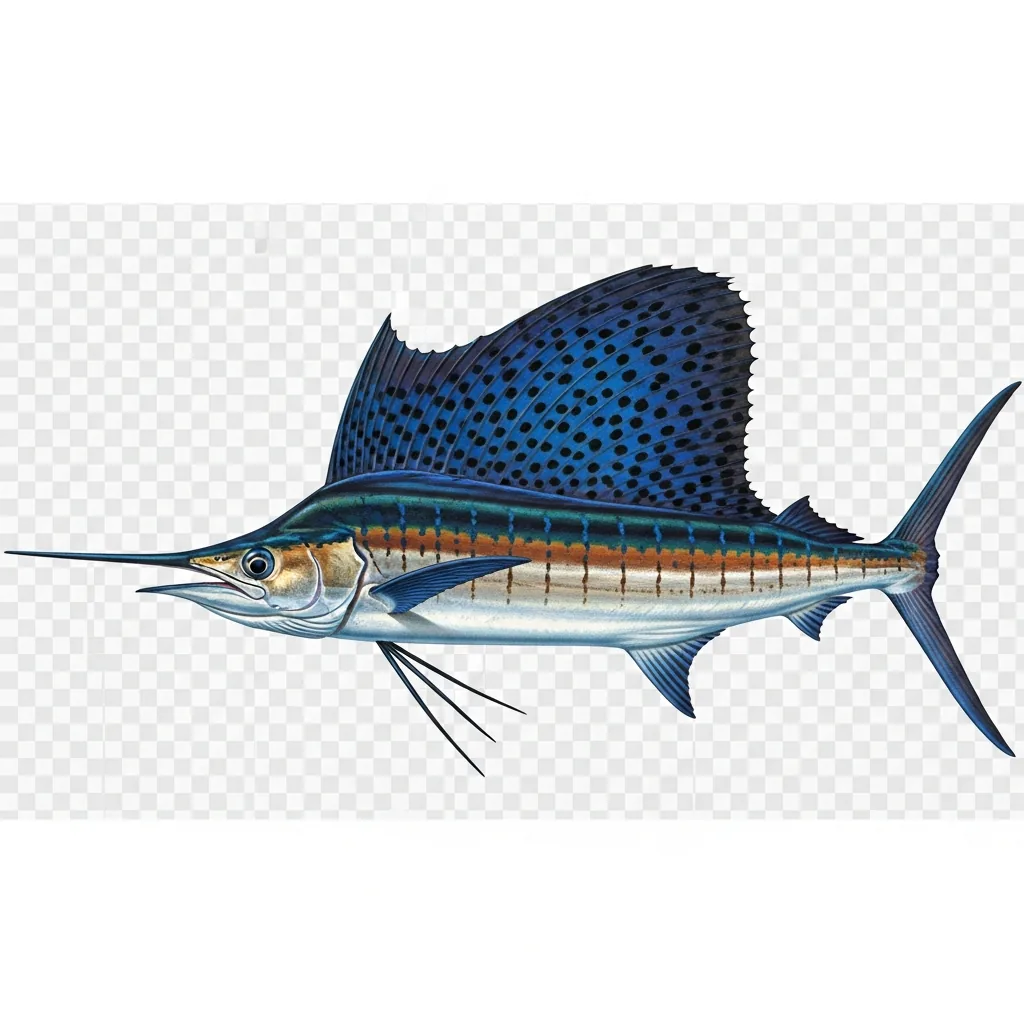

Overview
The fastest fish in the ocean, with its spectacular dorsal sail.
Identification
- Body
- Streamlined and slender body with a long, distinctive dorsal sail.
- Colouration
- Dark blue on the back, silver on the sides, and white on the belly with blue vertical stripes on the fins.
- Sexual dimorphism
- Absent/not pronounced
- Growth
- Fast, reaches maturity in a few years
Taxonomy
- Family
- Istiophoridae
- Order
- Istiophoriformes
- Class
- Actinopterygii
Related species
Habitat & distribution
- Environment
- Open sea, Pelagic
- Preferred bottom
- Open sea
- Geographic distribution
- Found in all tropical and subtropical oceans worldwide.
- Micro-habitat
- Often located near the surface, especially in areas with abundant prey.
Prefers tropical waters rich in prey.
Presence by sea area
Diet
- Primary prey
- flying fish, mackerel, squid
- Secondary prey
- herring, anchovies, plankton
- Occasional prey
- small crustaceans, larger cephalopods
- Feeding behaviour
- Opportunistic and voracious predator that herds prey to the surface using both speed and its sharp bill.
- Natural predators
- mako shark, tiger shark, orca
Often hunts in groups to increase efficiency.
Behaviour
- Activity
- diurnal
- Social behaviour
- small_groups
- Aggressiveness
- medium
- Migration
- Undertakes seasonal migrations in search of food and warmer waters.
- Seasonal behaviour
- More active in warmer waters during summer months when prey is abundant.
- Juveniles
- Young ones tend to stay closer to the shore and in areas with plenty of hiding spots.
- Adults
- Adults inhabit open waters, often in small groups.
Reproduction
- Spawning season
- June, July, August
- Spawning depth
- Between 20 and 60 meters
- Eggs
- Pelagic and transparent eggs, small in size.
- Larval stage
- Larvae are pelagic and develop rapidly in warm surface waters.
- Sexual maturity
- Varies between 2 and 5 years
When to catch Sailfish
Activity calendar
Activity by season
Best times
This species shows peak fishing activity in spring, summer and autumn, when the productivity index (FPI) reaches its highest values.
Fishing activity decreases in winter, when conditions are less favourable.
Ideal conditions
Atmospheric pressure
Hunts in packs on the surface.
Active along currents.
More scattered and deeper.
Water temperature
Where to catch it
Best spots
Bottom preference
Spot type
Fishing techniques
Recommended
Other applicable
Recommended baits
Baits by pressure
How to really catch it
The sailfish is the blue flash of the open ocean: a streamlined body, a sharp bill, and a dorsal fin that opens like a flag in the wind. When it appears just under the surface and lights up its iridescent bars, you immediately understand why it is one of sport fishing’s great dreams.
🐟 Good to know
One well-documented biological trait of sailfish is cooperative hunting in small groups: they compress schools of prey toward the surface and use the bill to strike and disorient fish and cephalopods. That huge dorsal sail, so unmistakable, is one of the species’ most recognizable features.
🌊 Where & when
It lives in tropical and subtropical oceans, in open pelagic water from the surface down to 200 meters, but it is often found high in the water column, close to the skin of the sea, where bait gathers. It becomes more approachable in warm months, with a peak from March to November; in summer, when waters are warmer and prey is abundant, its activity clearly increases.
🎣 How to really catch it
The most concrete approach is offshore trolling in bluewater off tropical coasts, over rises, along continental shelves, and in areas shaped by prevailing currents. Run baitfish or squid at the surface or just below it, with an offshore trolling rod, 50-80 lb main line, fluorocarbon leader, and strong circle hooks, ideally with little or no weight so the bait moves naturally in the upper layer.
💡 The detail that makes the difference
The practical edge is to read the water level, not the bottom: sailfish often feed by forcing prey toward the surface, so it pays to focus where the sea shows suspended life, not necessarily depth. If you find bait activity high in the column, present a clean, mobile bait there; that is where this predator is most likely to pass.
Catch & handling tips
- Fight
- Strong and vigorous fighters, known for their ability to leap out of water.
- Handling
- Handle carefully to avoid damaging the skin or fins.
- Release
- Release quickly into the water, keeping the fish upright to facilitate recovery.
Curiosities & culture
- Record catches
- Maximum documented size: up to about 348 cm and 100 kg (source: FishBase). IGFA All-Tackle record: 100.24 kg (221 lb) for the Pacific (Ecuador, 1947) and 64.6 kg (142 lb 6 oz) for the Atlantic (Angola, 2014).
- In the kitchen
- Flavorful meat, often used for sushi or smoked.
- Cultural notes
- Often featured in marine art and the subject of numerous angler stories.
- Historical notes
- Always valued in sport fishing for its speed and spectacular nature.