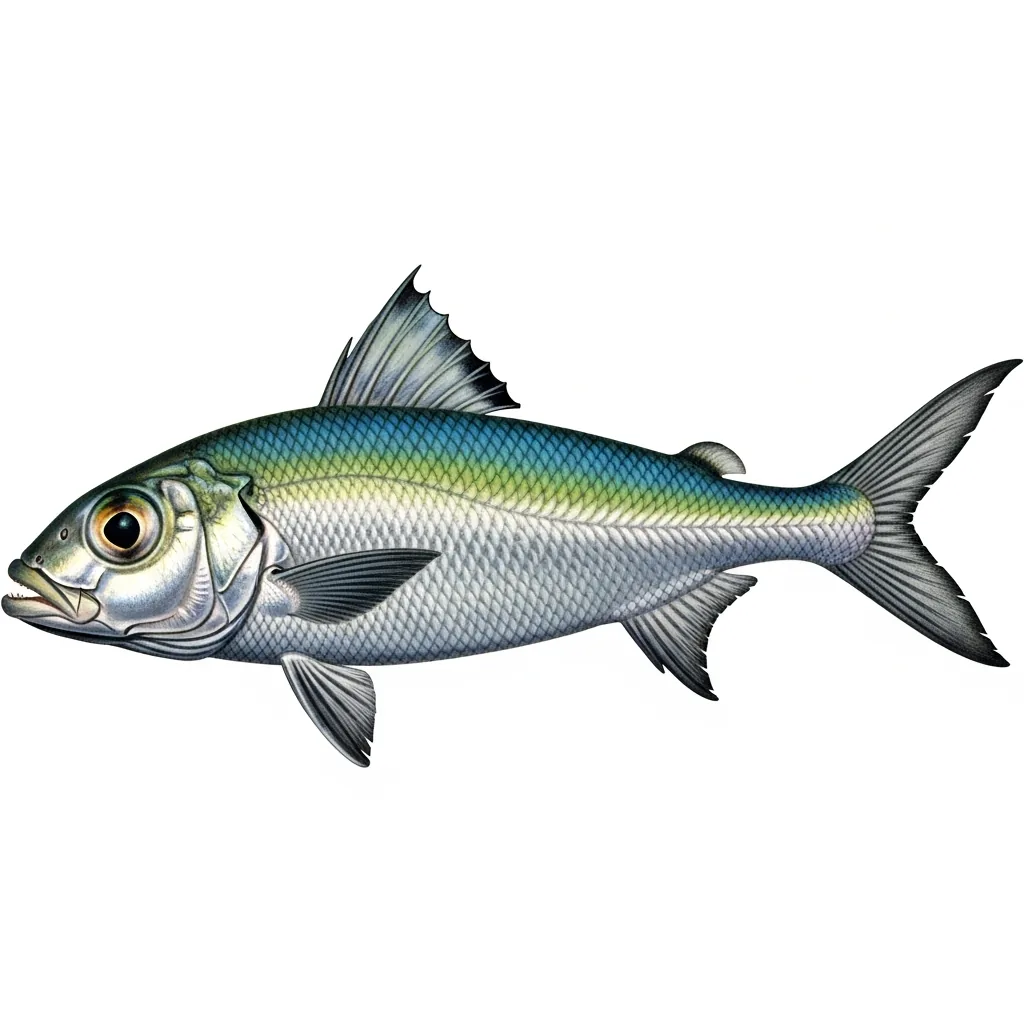

Overview
Ghost of tropical flats, coveted fly fishing quarry.
Identification
- Body
- Streamlined, fusiform body suitable for fast swimming.
- Colouration
- Silver color with blue or green reflections on the back, lighter belly.
- Sexual dimorphism
- Absent/not very evident
- Growth
- Medium; grows rapidly in the first years of life.
Taxonomy
- Family
- Albulidae
- Order
- Albuliformes
- Class
- Actinopterygii
Related species
Habitat & distribution
- Environment
- Coast, Reefs, Estuarine, Brackish
- Preferred bottom
- Sand, Seagrass
- Geographic distribution
- Distributed in the coastal tropical and subtropical waters of the western Atlantic Ocean and the Indian Ocean.
- Micro-habitat
- Often found in sandy bottoms of lagoons and tidal areas.
Prefers the clear, warm waters of coastal lagoons.
Presence by sea area
Diet
- Primary prey
- crustaceans, shrimp, squid
- Secondary prey
- annelids, small fish, mollusks
- Occasional prey
- algae, plankton
- Feeding behaviour
- Opportunistic predator that primarily feeds on crustaceans by digging in the sand to catch its prey.
- Natural predators
- sharks, barracuda, coastal carnivores
Predation facilitated by the ability to detect and uncover hidden prey.
Behaviour
- Activity
- diurnal
- Social behaviour
- small_groups
- Aggressiveness
- medium
- Migration
- Undergoes local migrations between feeding and spawning areas.
- Seasonal behaviour
- In some areas, increased activity is observed during the rainy season.
- Juveniles
- Juveniles tend to stay in shallower, protected waters.
- Adults
- Adults may move to deeper waters to spawn.
Reproduction
- Spawning season
- November, December
- Spawning depth
- between 20 and 60 meters
- Eggs
- Pelagic eggs, small and transparent.
- Larval stage
- Pelagic larvae, rapidly developing in open waters.
- Sexual maturity
- 3-4 years
When to catch Bonefish
Activity calendar
Activity by season
Best times
This species shows peak fishing activity in spring, summer and autumn, when the productivity index (FPI) reaches its highest values.
Fishing activity decreases in winter, when conditions are less favourable.
Ideal conditions
Atmospheric pressure
Actively hunts on flats.
Good activity in shallow areas.
Moves to deeper areas.
Water temperature
Where to catch it
Best spots
Bottom preference
Spot type
Fishing techniques
Recommended
Other applicable
Recommended baits
Baits by pressure
How to really catch it
The bonefish is a silver blade over the coastal flats: sleek, fast, and always moving above sand and seagrass. When it slides into skinny clear water and noses into the bottom, it becomes one of the most compelling fish to target with light tackle and sharp eyes.
🐟 Good to know
An important biological detail is its spawning in deeper water: adults may move out to 20 to 60 meters to release small, transparent pelagic eggs, while the larvae remain pelagic and develop in open water before returning to coastal environments.
🌊 Where & when
Look for it on sandy beaches, lagoons, mangroves, and river mouths, especially where the bottom mixes sand and submerged grasses in coastal, estuarine, or brackish water. It is active by day and often travels in small groups; in many areas it is most approachable from March to November, with activity that may increase during the rainy season, while from November to December adults may shift into deeper water to spawn.
🎣 How to really catch it
The most concrete way to fish for it is to stay light and clean on shallow flats: a light spinning rod, 8-12 lb line, 10-15 lb fluorocarbon leader, #4-6 hooks, and only a light sinker if needed. The most convincing offerings are artificial shrimp and feather flies, presented over sand and seagrass with short, restrained retrieves, often letting the lure track close to the bottom where the fish digs for crustaceans.
💡 The detail that makes the difference
The tip that changes the day is to read the bottom before the fish: bonefish feed by digging in sand, so the best zones are shallow, bright areas with clean sand next to seagrass or tidal channels. If the lure rides too high it loses realism; if it stays near the bottom, it enters the fish’s real feeding lane.
Catch & handling tips
- Fight
- Agile and fast fighter, tries to escape to open water.
- Handling
- Handle carefully to avoid injuring the delicate fins.
- Release
- Release quickly and gently into the water to ensure survival.
Curiosities & culture
- Record catches
- Maximum documented size: up to about 104 cm in length (source: FishBase). IGFA All-Tackle record: 7.26 kg (16 lb), caught by Jerry Lavenstein at Bimini (Bahamas) in 1971.
- In the kitchen
- Not commonly eaten due to numerous bones, but sometimes used in local dishes.
- Cultural notes
- Often celebrated in sport fishing for its strength and speed in combat.
- Historical notes
- A favorite species in fly fishing, celebrated by enthusiasts worldwide.