
Overview
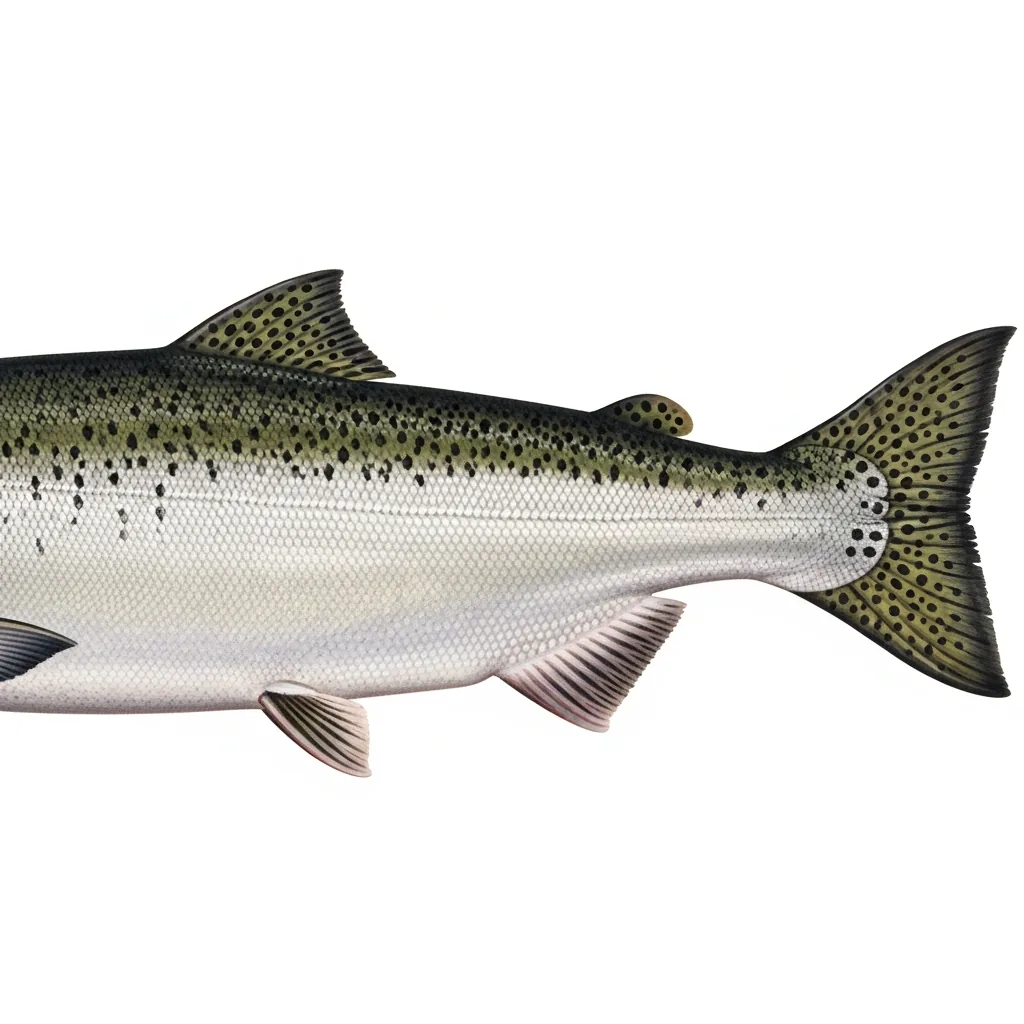
The largest Pacific salmon, a highly prized migratory species.
Identification
- Body
- Fusiform and powerful body, suited for long migrations.
- Colouration
- Silvery coloration with bluish sheen, darkening during spawning.
- Sexual dimorphism
- Present, males develop a hump and brighter colors during spawning.
- Growth
- Fast, quickly grows to adult size.
Taxonomy
- Family
- Salmonidae
- Order
- Salmoniformes
- Class
- Actinopterygii
Related species
Habitat & distribution
- Environment
- Coast, Open sea, Estuaries
- Preferred bottom
- Gravel, Rock
- Geographic distribution
- Found in the North Pacific, from California's coast to Alaska and the Aleutian Islands. Present also in Pacific Northwest rivers.
- Micro-habitat
- Uses rivers and streams for spawning, seeking gravel or rocky substrates.
Uses rivers for spawning and marine waters for feeding.
Presence by sea area
Diet
- Primary prey
- small fish, krill, squid
- Secondary prey
- shrimp, crustaceans, zooplankton
- Occasional prey
- aquatic insects, larvae, annelids
- Feeding behaviour
- Active predator, hunts both in open sea and near coasts. Primarily feeds during the day.
- Natural predators
- bears, otters, eagles, seals, orca
In the sea, opens mouth wide to catch fast prey and some filter-feeding substances.
Behaviour
- Activity
- diurnal
- Social behaviour
- solitary
- Aggressiveness
- medium
- Migration
- Undertakes long migrations from the sea to freshwater for spawning.
- Seasonal behaviour
- Migrates to rivers in fall for spawning. Often found in rivers during winter.
- Juveniles
- Young stay in rivers for a period before migrating to the sea.
- Adults
- Adults mainly live in the sea until reaching sexual maturity.
Reproduction
- Spawning season
- September, October, November
- Spawning depth
- between 12 to 79 inches
- Eggs
- Large, spherical, pink, benthic eggs.
- Larval stage
- Larvae emerge as fully formed fry ready to disperse.
- Sexual maturity
- 3-4 years
When to catch Chinook salmon
Activity calendar
Activity by season
Best times
This species shows peak fishing activity in spring, summer and autumn, when the productivity index (FPI) reaches its highest values.
Fishing activity decreases in winter, when conditions are less favourable.
Ideal conditions
Atmospheric pressure
Very active on surface.
Hunts at mid-water.
Deeper and less reactive.
Water temperature
Where to catch it
Best spots
Bottom preference
Spot type
Fishing techniques
Recommended
Other applicable
Recommended baits
Baits by pressure
How to really catch it
Chinook salmon is the elegant power of the North Pacific: a strong, streamlined fish built to cover huge distances between sea and river. When it turns to feeding or begins its freshwater run, every encounter feels serious, alive, and memorable.
🐟 Good to know
It is an anadromous salmonid: it grows mainly at sea, then returns to freshwater to spawn. During this phase its coloration changes noticeably, a real sign of the transition from pelagic life to river life, as it seeks gravel or rocky bottoms for spawning.
🌊 Where & when
You’ll find it along coasts, in open sea, estuaries, and then in rivers of the northeastern Pacific, from California to Alaska and the Aleutians. The most reliable window runs from spring into autumn, with especially interesting movement near river mouths; in fall it enters rivers to spawn and is often still found there through winter.
🎣 How to really catch it
If you want to fish it for real, trolling is the most solid approach at sea and in travel corridors: a medium-heavy spinning or casting rod, 9-13 kg main line, 6-8 kg fluorocarbon leader, circle or J hooks, and sardines or herring working naturally along deep channels, rocky coasts, around islands, and near river mouths. Drift fishing and beach casting become very credible in estuarine water, while fly fishing makes sense in river sections.
💡 The detail that makes the difference
The most defensible tip is simple: focus on daylight and moving water near a river mouth. Chinook feeds mainly during the day and is an active predator; presenting a bait that suggests forage fish or shrimp right along those travel lines makes your offering much more consistent with its biology.
Catch & handling tips
- Fight
- Fights vigorously with spectacular jumps and powerful runs.
- Handling
- Use gloves or wet material to prevent skin damage.
- Release
- Ensure it recovers before gently releasing it back into the water.
Curiosities & culture
- Record catches
- Maximum documented size: up to about 150 cm (source: FishBase). IGFA All-Tackle record: 44.11 kg (97 lb 4 oz), caught by Les Anderson at the Kenai River, Alaska (USA), in 1985.
- In the kitchen
- Used for sushi preparation, smoking, and grilling.
- Cultural notes
- Symbol of tenacity and homecoming in Pacific indigenous cultures.
- Historical notes
- Traditional food source for Pacific North American indigenous tribes, revered in many local mythologies.