
Overview
One of the most challenging quarries for sight fishing on tropical flats.
Identification
- Body
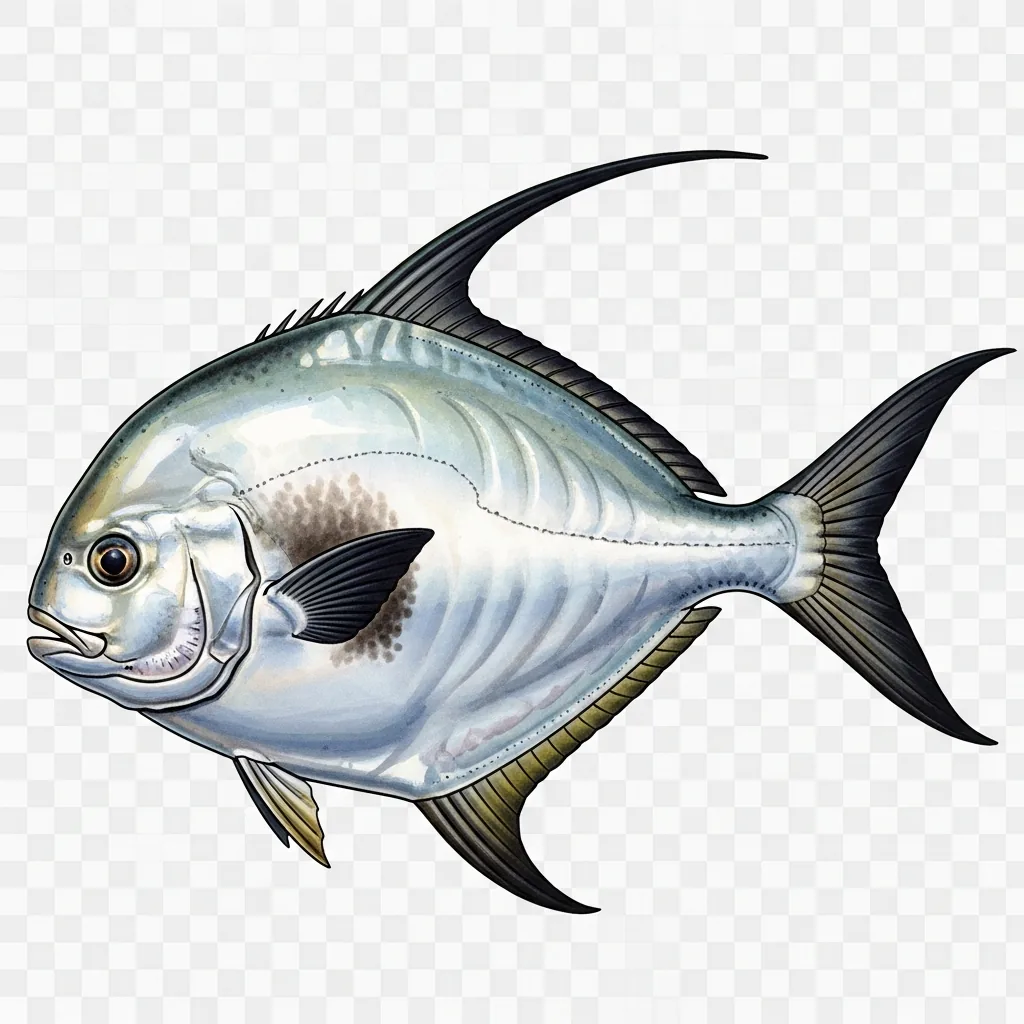
- Oval-shaped body, laterally compressed, with a deeply forked tail.
- Colouration
- Silver body with golden reflections, black dorsal and anal fins.
- Sexual dimorphism
- Absent/little evident
- Growth
- Medium, with steady and progressive growth in early life stages.
Taxonomy
- Family
- Carangidae
- Order
- Perciformes
- Class
- Actinopterygii
Related species
Habitat & distribution
- Environment
- Coast, Reefs, Estuarine
- Preferred bottom
- Sand, Reef, Seagrass
- Geographic distribution
- Primarily found in the tropical waters of the western Atlantic, from Massachusetts south to Brazil.
- Micro-habitat
- Prefers swimming over sandy bottoms and seagrass, in lagoons and among coral reefs.
Prefer sandy bottoms and seagrass, often approaching coasts and islands.
Presence by sea area
Diet
- Primary prey
- crustaceans, shrimp, crabs
- Secondary prey
- small fish, mollusks, echinoderms
- Occasional prey
- algae, detritus
- Feeding behaviour
- Feeds mainly in shallow areas, using sharp vision to locate prey.
- Natural predators
- sharks, barracuda, bluefish
Opportunistic feeders often relying on sight to capture prey.
Behaviour
- Activity
- diurnal
- Social behaviour
- small_groups
- Aggressiveness
- medium
- Migration
- Resident, with limited seasonal movements for feeding and breeding areas.
- Seasonal behaviour
- During breeding season, moves closer to shores and shallow lagoons.
- Juveniles
- Juveniles form large schools in shallow waters, providing shelter and abundant food.
- Adults
- Adults tend to move in small groups, often along reefs searching for prey.
Reproduction
- Spawning season
- April, May, June
- Spawning depth
- between 20 and 60 meters
- Eggs
- Pelagic eggs, small and transparent.
- Larval stage
- Larvae drift freely in open water, feeding on plankton until they develop adult features.
- Sexual maturity
- 3-4 years
When to catch Permit
Activity calendar
Activity by season
Best times
This species shows peak fishing activity in spring, summer and autumn, when the productivity index (FPI) reaches its highest values.
Fishing activity decreases in winter, when conditions are less favourable.
Ideal conditions
Atmospheric pressure
Actively hunts on flats.
Present but selective.
Very difficult to catch.
Water temperature
Where to catch it
Best spots
Bottom preference
Spot type
Fishing techniques
Recommended
Other applicable
Recommended baits
Baits by pressure
How to really catch it
The permit is one of the great tests in tropical inshore fishing: silver-bright, deep-bodied, always moving between pale sand, seagrass, and reef edges. When it slides into shallow water to hunt crustaceans, everything looks easy for a moment, then every detail of the cast and presentation starts to matter.
🐟 Good to know
A real and useful trait to understand is its strong reliance on sight: it feeds mainly in shallow water, visually locating prey on the bottom. That is why permit can be highly selective, especially over sand and seagrass where profile, posture, and how the bait lands truly matter.
🌊 Where & when
It lives along coasts, estuaries, lagoons, reefs, and sandy or seagrass bottoms, from the surface down to about 50 meters, in the western Atlantic from Massachusetts to Brazil. Adults often move in small groups along reefs, but it is more fishable from March to November; during the breeding season, from April to June, it tends to come closer to shorelines and shallow lagoons.
🎣 How to really catch it
The most concrete way to target it is fly fishing or, alternatively, a very clean presentation with live shrimp or pieces of crab over sandy flats, lagoon mouths, and reef cut-outs. A fast 2.5-3 meter rod, 20-30 lb braid, a 30 lb fluorocarbon leader, and 1/0-2/0 circle hooks fit the job: the goal is to place the offering ahead of fish feeding in daylight without disturbing the water.
💡 The detail that makes the difference
The tip that truly makes a difference is to read the bottom before the fish: permit feed heavily on crustaceans in shallow areas, so sandy flats and seagrass edges are more reliable than water that looks "empty" but too uniform. If the bait lands clean and stays believable near the bottom, you have already done the hardest part.
Catch & handling tips
- Fight
- Fights vigorously with powerful runs and sudden changes of direction.
- Handling
- Use wet gloves and keep the fish in water as much as possible.
- Release
- Gently release back into the water, ensuring it can swim off on its own.
Curiosities & culture
- Record catches
- Maximum documented size: up to about 122 cm and 36 kg (source: FishBase). IGFA All-Tackle record: 27.21 kg (60 lb), caught at Paranaguá (Brazil) in 2002.
- In the kitchen
- Permit is less valued in cuisine compared to other species but appreciated in some Caribbean dishes.
- Cultural notes
- Celebrated in fishing lore for their challenge and fighting ability.
- Historical notes
- Historically cherished by sport fishermen for their challenging nature and elusive behavior.