
Overview
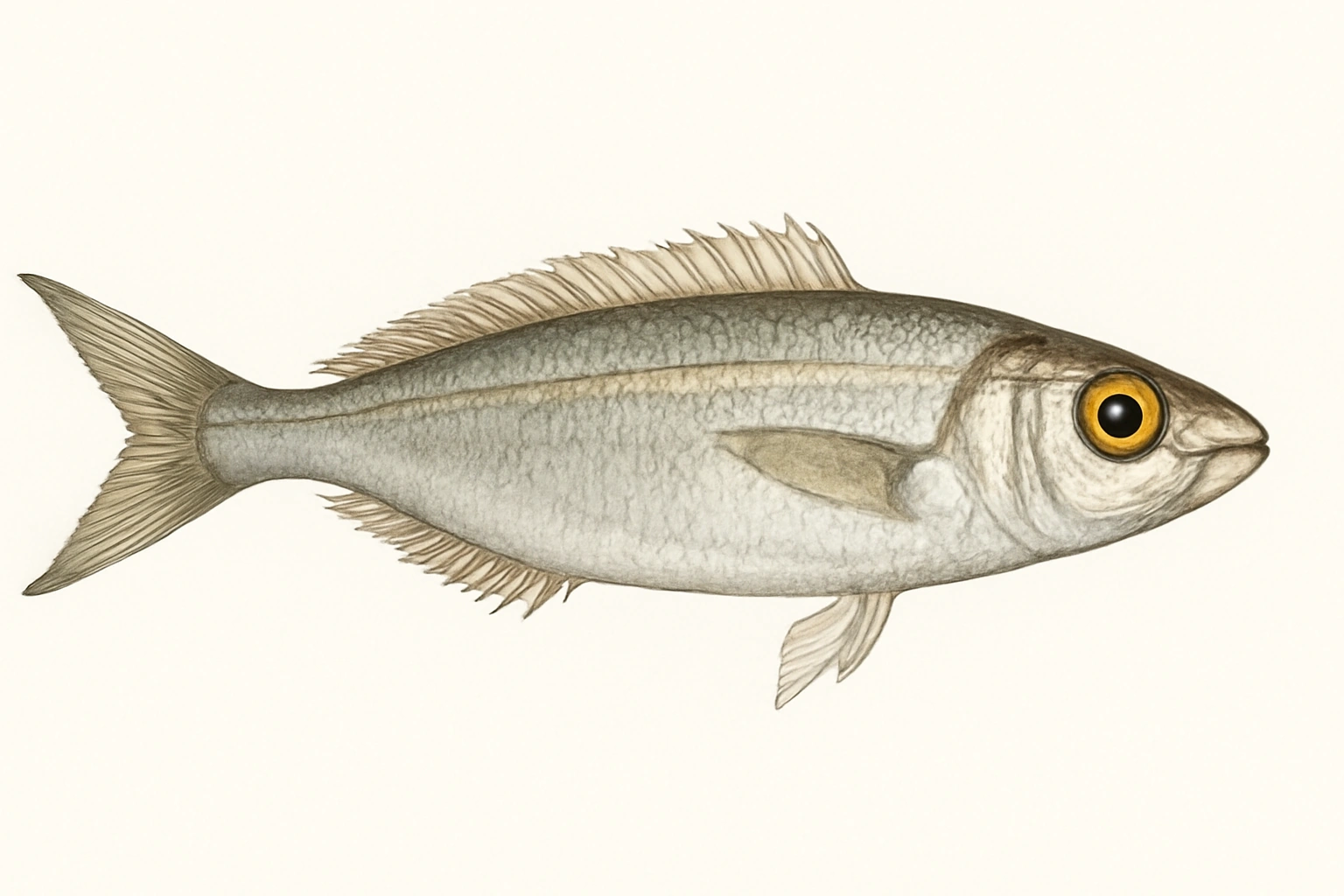
Small gregarious fish, among the most common in the Mediterranean. Swims in enormous schools and feeds on plankton and small organisms.
Identification
- Body
- Elongated and laterally compressed body.
- Colouration
- Silver with golden hues and green or blue tones on the back.
- Sexual dimorphism
- Absent/not very pronounced
- Growth
- Medium; grows quite rapidly in the early years of life.
Taxonomy
- Family
- Sparidae
- Order
- Perciformes
- Class
- Actinopterygii
Related species
Habitat & distribution
- Environment
- Coast, Open sea, Reefs
- Preferred bottom
- Seagrass, Reef, Sand
- Geographic distribution
- Widespread in the Mediterranean Sea, northeastern Atlantic from the British Isles to Senegal.
- Micro-habitat
- Often found near sandy and rocky bottoms, forming large schools near the surface.
Prefers coastal areas with good food availability and clean waters.
Presence by sea area
Diet
- Primary prey
- plankton, small crustaceans, algae
- Secondary prey
- fish larvae, mollusks, zooplankton
- Occasional prey
- organic debris, small invertebrates
- Feeding behaviour
- Feeds by swimming in groups, filtering water with its mouth for plankton and small organisms.
- Natural predators
- tuna, groupers, dolphins, squid, seagulls
Diet varies significantly depending on the seasonal availability of plankton and small invertebrates.
Behaviour
- Activity
- diurnal
- Social behaviour
- large_schools
- Aggressiveness
- low
- Migration
- Short distances, follows currents and food. Tends to be resident in large areas of the Mediterranean.
- Seasonal behaviour
- During the warm season, it moves to shallower waters, while in winter it retreats to deeper waters.
- Juveniles
- Juveniles form small schools for protection and tend to stay in shallow coastal waters.
- Adults
- Adults form large schools and can travel greater distances in search of food.
Reproduction
- Spawning season
- May, June, July
- Spawning depth
- between 10 and 50 meters
- Eggs
- Small transparent pelagic eggs.
- Larval stage
- Planktonic larvae that grow in the plankton until reaching juvenile size.
- Sexual maturity
- 3-4 years
When to catch Bogue
Activity calendar
Activity by season
Best times
This species shows peak fishing activity in spring, summer and autumn, when the productivity index (FPI) reaches its highest values.
Ideal conditions
Atmospheric pressure
Active schools near surface.
Regular activity.
Goes deeper.
Moves deeper.
Normal surface activity.
Very active, compact schools.
Water temperature
Where to catch it
Best spots
Bottom preference
Spot type
Fishing techniques
Recommended
Other applicable
Recommended baits
Baits by pressure
How to really catch it
The bogue is a small schooling pelagic, silvery and restless in the light, with large eyes and a laterally compressed body that flashes between the surface and midwater. It looks easy, but to catch it consistently you need to match its rhythm: tight schools, a small mouth, and fine, constant feeding.
🐟 Good to know
One lesser-noticed biological trait of the bogue is how it feeds: it swims in groups, filtering water with its mouth to retain plankton and small organisms. That helps explain why it often appears in numbers, active and mobile, yet not always committed to baits that are too bulky.
🌊 Where & when
You find it along the coast over sand, rock, seagrass beds and near reefs, often in large schools close to the surface. From spring into autumn it becomes more approachable because in the warm season it moves into shallower water; between May and July it spawns between 10 and 50 meters, while in winter it tends to withdraw deeper.
🎣 How to really catch it
To really catch it, the most practical route is a light, tidy presentation close to the schools in harbors, around artificial rock structures, or over seagrass and coastal reefs. A light 2-3 meter rod, 6-10 lb main line, 4-6 lb fluorocarbon leader, small size 8-12 hooks and light split shot let bread crumb, shrimp pieces or larvae work naturally, which fits its small mouth and feeding on tiny organisms.
💡 The detail that makes the difference
The practical secret is simple: if you see the school high and active but get few takes, reduce bait bulk before adding weight. The bogue feeds on plankton, small crustaceans and larvae, so a tiny, natural presentation held suspended or allowed to fall slowly is often more convincing than a large bait that drops too fast.
Catch & handling tips
- Fight
- Low resistance when hooked, moves in small circles in the water.
- Handling
- Handle carefully to avoid skin injuries and not damage the transparent fins.
- Release
- Quickly release back into the water to increase survival chances.
Curiosities & culture
- Record catches
- Maximum documented size: up to about 40 cm in length (source: FishBase). There is no IGFA All-Tackle record for this species.
- In the kitchen
- Used in typical dishes such as soups and mixed fried foods. The flesh is appreciated for its delicacy.
- Cultural notes
- Considered a common fish in Mediterranean fishermen's tales. Present in popular culture as a symbol of abundance.
- Historical notes
- Known since ancient times as one of the main fishing resources of the Mediterranean due to its large schools.