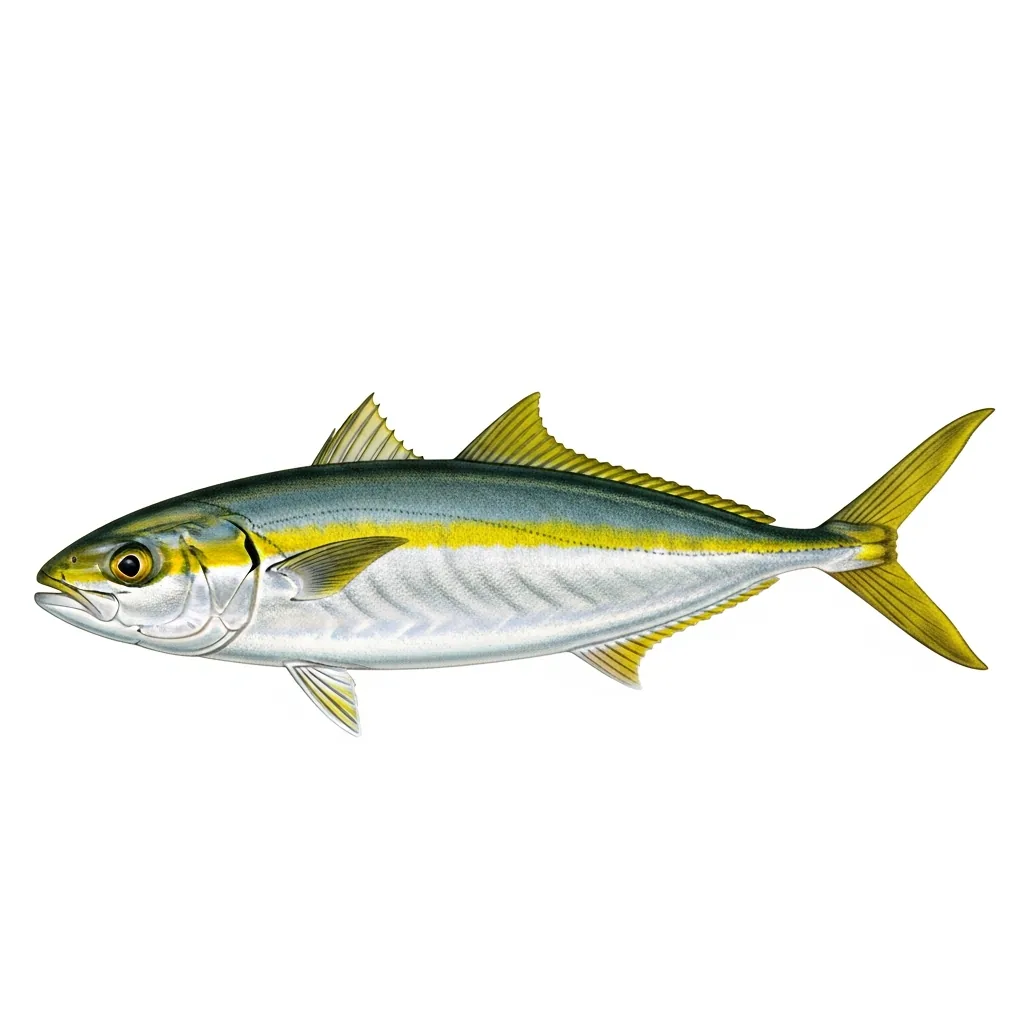

Overview
THE quintessential sportfish of Southern California. Fierce fighter and highly sought-after by anglers.
Identification
- Body
- It has an elongated body with a sickle-shaped tail.
- Colouration
- Characterized by a bright yellow on the lateral line and a blue-green shade on the back, white on the belly.
- Sexual dimorphism
- Absent/weakly evident
- Growth
- Fast, especially in the first years of life.
Taxonomy
- Family
- Carangidae
- Order
- Carangiformes
- Class
- Actinopterygii
Related species
Habitat & distribution
- Environment
- Coast, Reef, Open sea
- Preferred bottom
- Rock, Reef
- Geographic distribution
- Found mainly in Southern California and Baja California, but can be spotted along the entire eastern Pacific coast.
- Micro-habitat
- Prefers to live near rocky beds and coral reefs, where it can find shelter and abundant prey.
Often moves near the shore during the warmer months to seek abundant food.
Presence by sea area
Diet
- Primary prey
- blue fish, rings, squid
- Secondary prey
- crabs, shrimp, ostics
- Occasional prey
- algae, plankton
- Feeding behaviour
- An active predator that hunts its prey with quick strikes. It uses speed and cunning to capture smaller fish and cephalopods.
- Natural predators
- sharks, tunas, orcas
Takes advantage of schools of fish and cephalopods in the coral reefs.
Behaviour
- Activity
- diurnal
- Social behaviour
- small_groups
- Aggressiveness
- medium
- Migration
- Makes seasonal migrations along the coast for spawning and foraging.
- Seasonal behaviour
- Becomes more active in the warm months when it approaches the shore to feed and spawn.
- Juveniles
- Juveniles tend to form larger schools near the shore for protection.
- Adults
- Adults often form small groups or live solitary while hunting.
Reproduction
- Spawning season
- July, August
- Spawning depth
- between 20 and 60 meters
- Eggs
- The eggs are pelagic, spherical, and transparent, measuring about 1-2 mm.
- Larval stage
- The larvae are planktonic, transparent with rapid growth in the first weeks.
- Sexual maturity
- varies between 2 and 5 years
When to catch California Yellowtail
Activity calendar
Activity by season
Best times
This species shows peak fishing activity in spring, summer and autumn, when the productivity index (FPI) reaches its highest values.
Fishing activity decreases in winter, when conditions are less favourable.
Ideal conditions
Water temperature
Where to catch it
Best spots
Bottom preference
Spot type
Fishing techniques
Recommended
Other applicable
Recommended baits
Baits by pressure
How to really catch it
California yellowtail is a fast, powerful pelagic fish, with a streamlined body, sickle-shaped tail, and the yellow lateral line that often gives it away in clear water. When it moves in to hunt near rock and reef, everything speeds up: that is when an attentive angler can truly meet it.
🐟 Good to know
The eggs of California yellowtail are pelagic, spherical, and transparent, and the larvae live in the plankton during their earliest stage. It is an important biological detail: it shows how strongly the species depends on both productive coastal habitats and the open water column during the first part of its life cycle.
🌊 Where & when
It is found mainly from Southern California to Baja California, around rocky coasts, reefs, offshore islands, and even near harbors, from the surface down to 100 meters. It becomes more active in warm months, and the most favorable period runs from March to November, when it moves closer to shore to feed and spawn; spawning takes place in July and August between 20 and 60 meters.
🎣 How to really catch it
To really fish for it, the most concrete method is coastal trolling along rocky edges, reefs, and shallow high spots near islands, tracking lively water and bait presence. Sardines and cephalopods are the most consistent baits with its diet; alternatively, spinning and jigging work with solid tackle: a robust spinning rod, 20-30 lb braid, 40-50 lb fluorocarbon leader, and 5/0-7/0 hooks. When it takes off, expect quick bursts and deep pulling runs.
💡 The detail that makes the difference
The most defensible practical tip is to work spots in full daylight, focusing on the edges between open water and structure. This species is diurnal, hunts with quick strikes, and adults often move in small groups or alone: that is why it pays to cover the edge of a reef or rocky bottom carefully, where it can suddenly break out to hit baitfish or squid.
Catch & handling tips
- Fight
- A vigorous fighter that exhibits quick bursts and powerful pulls.
- Handling
- Use gloves to avoid cuts from the spines and hold firmly.
- Release
- Ensure it is released into oxygenated water to reduce post-catch stress.
Curiosities & culture
- Record catches
- Maximum documented size: up to about 155 cm and 36 kg (source: FishBase). IGFA All-Tackle record: 49.5 kg (109 lb 2 oz), caught in Japan in 2009.
- In the kitchen
- Highly prized in cooking, especially roasted or grilled, it is also used for sushi and sashimi.
- Cultural notes
- Significant for sport fishing competitions, it is a species that attracts many fishing enthusiasts.
- Historical notes
- Fishing for this species has a long tradition in Pacific coastal culture.