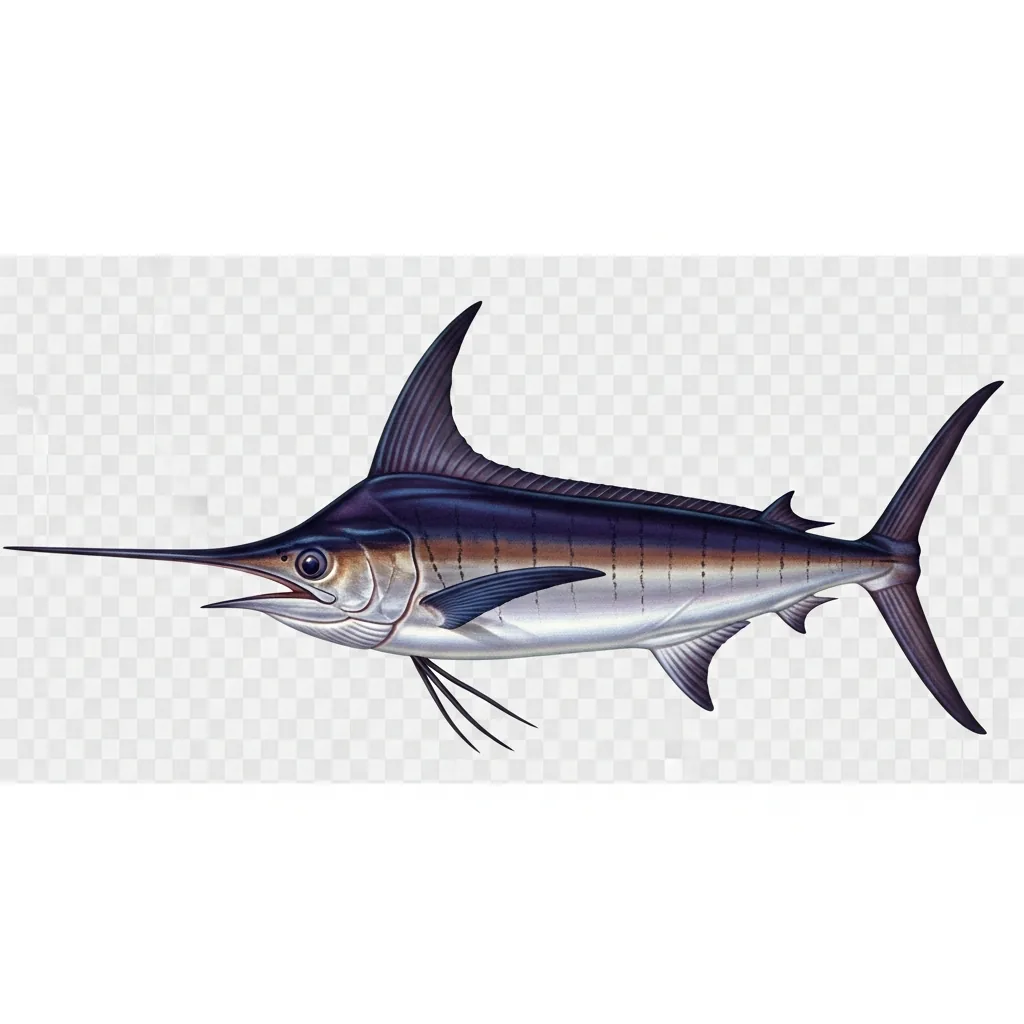

Overview
One of the largest ocean predators, a solitary deep-water hunter.
Identification
- Body
- Fusiform, streamlined, robust body with a long, sword-like bill.
- Colouration
- Dark bluish or black on the back, light silvery belly.
- Sexual dimorphism
- Absent or not prominent
- Growth
- Fast, reaches considerable size in a few years
Taxonomy
- Family
- Xiphiidae
- Order
- Perciformes
- Class
- Actinopterygii
Related species
Habitat & distribution
- Environment
- Open sea, Pelagic, Deep sea
- Preferred bottom
- Pelagic
- Geographic distribution
- Found in all of the world's temperate and tropical oceans, including the Atlantic, Pacific, and Indian.
- Micro-habitat
- Often in areas rich in prey, in open waters far from shores.
Lives mainly in the open sea, rarely approaching the coast.
Presence by sea area
Diet
- Primary prey
- squid, tuna, sardines
- Secondary prey
- anchovies, mackerel, flying fish
- Occasional prey
- lobsters, shrimp, jackfish
- Feeding behaviour
- Fierce predator, hunts fast-moving prey, often near the surface at night.
- Natural predators
- orcas, sharks, sperm whales
Diet varies with the seasonal availability of prey.
Behaviour
- Activity
- diurnal
- Social behaviour
- solitary
- Aggressiveness
- high
- Migration
- Migratory species, with seasonal movements between feeding and breeding areas.
- Seasonal behaviour
- Tends to move to warmer waters during the winter months.
- Juveniles
- Juveniles stay closer to the surface and form small groups.
- Adults
- Adults are solitary hunters and move through various depths in search of food.
Reproduction
- Spawning season
- June, July, August
- Spawning depth
- depths of 20 to 60 meters
- Eggs
- Pelagic, spherical eggs of varying sizes.
- Larval stage
- Larval stage characterized by an elongated bill, similar to adults.
- Sexual maturity
- varies between 2 and 5 years
When to catch Swordfish
Activity calendar
Activity by season
Best times
This species shows peak fishing activity in summer, when the productivity index (FPI) reaches its highest values.
Fishing activity decreases in autumn and winter, when conditions are less favourable.
Ideal conditions
Atmospheric pressure
Rises more to the surface.
Regular deep activity.
Very deep.
Water temperature
Where to catch it
Best spots
Bottom preference
Spot type
Fishing techniques
Recommended
Other applicable
Recommended baits
Baits by pressure
How to really catch it
Swordfish is one of the great hunters of the open sea: streamlined body, large eyes, silver belly, and that unmistakable bill slicing the water like a blade. To truly meet one, you have to go far offshore, over deep blue water, where any pass can turn into a sharp, powerful strike.
🐟 Good to know
One lesser-noticed biological trait is the absence of scales in the adult, something unusual among large pelagic fish. Even in the larval stage it already shows an elongated bill, a clear sign of a body plan that defines the species from its earliest life stages.
🌊 Where & when
It lives in temperate and tropical oceans worldwide, in open sea, over deep water, along oceanic edges and pelagic seamounts rich in prey. It is a migratory species and in winter it tends to move toward warmer waters; the peak period of presence and activity is June, July, and August, also in connection with spawning at depths of 20 to 60 meters.
🎣 How to really catch it
To really fish for it, the most concrete method is offshore trolling over deep water, using a heavy trolling rod, 50-100 lb main line, 80-100 lb steel or fluorocarbon leader, large circle hooks, and heavy sinkers for deeper presentation. The most fitting baits are squid, sardines, anchovies, and mackerel, presented where the fish finds concentrated prey, with long, orderly passes along oceanic edges and pelagic banks.
💡 The detail that makes the difference
A practical edge is to think more about prey than structure: swordfish is pelagic, solitary, and constantly moving, so it pays to stay on offshore zones where squid and small forage fish gather. If you find life in open water, with activity spread between the surface and deeper layers, you are already reading its natural language.
Catch & handling tips
- Fight
- Feisty and powerful, makes spectacular jumps and quick bursts.
- Handling
- Avoid the bill, handle with care on board, avoiding direct contact.
- Release
- Release quickly back into the water, avoiding damage to the gills.
Curiosities & culture
- Record catches
- Maximum documented size: up to about 455 cm and 650 kg (source: FishBase). IGFA All-Tackle record: 536.15 kg (1,182 lb), caught by Louis Marron at Iquique (Chile) in 1953.
- In the kitchen
- Highly prized meat used in carpaccio, grilled, or stewed.
- Cultural notes
- Symbol of power and beauty in various seafaring cultures.
- Historical notes
- Long part of the Mediterranean fishing tradition, mentioned by Pliny the Elder.