
Overview
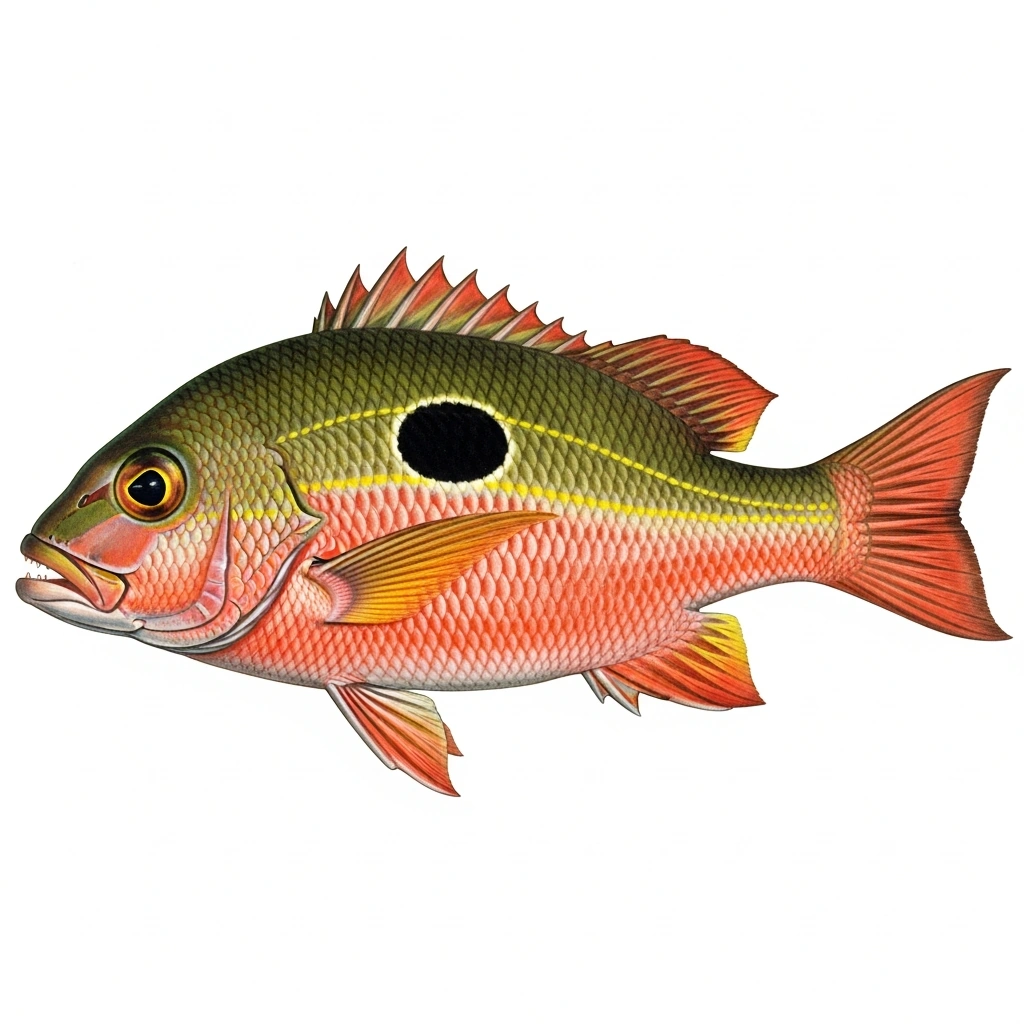
Prized snapper of Brazilian and Caribbean reefs. Cunning reef predator with excellent meat.
Identification
- Body
- Sturdy and elongated body with a prominent head.
- Colouration
- Features an olive-green coloration with pink hues and a distinctive darker band beneath the eye.
- Sexual dimorphism
- Absent/not evident
- Growth
- Fast, especially in the early years.
Taxonomy
- Family
- Lutjanidae
- Order
- Perciformes
- Class
- Actinopterygii
Related species
Habitat & distribution
- Environment
- Coast, Reefs, Open sea, Deep sea
- Preferred bottom
- Rock, Reef, Sand
- Geographic distribution
- Found along the western Atlantic coasts from Brazil to Florida and the Caribbean.
- Micro-habitat
- Often shelters near overhangs and crevices of reefs during the day.
Prefers waters with good visibility and structured habitats.
Presence by sea area
Diet
- Primary prey
- crustaceans, fish, mollusks
- Secondary prey
- squid, cuttlefish, lobsters
- Occasional prey
- other marine vertebrates, jellyfish
- Feeding behaviour
- Cunning hunter, approaches prey stealthily and captures them with quick lunges among corals.
- Natural predators
- sharks, barracuda, large groupers
Easily adapts to different food sources, ensuring survival even in environments with low food availability.
Behaviour
- Activity
- crepuscular
- Social behaviour
- solitary
- Aggressiveness
- medium
- Migration
- Resident species, with modest movements related to reproductive cycles.
- Seasonal behaviour
- During the spawning season, they gather in larger groups for spawning.
- Juveniles
- Juveniles tend to form small groups near mangroves or in shallow waters.
- Adults
- Adults are more solitary, occupying well-defined reef areas.
Reproduction
- Spawning season
- May, June, July
- Spawning depth
- between 20 and 60 meters
- Eggs
- Pelagic eggs, small and transparent.
- Larval stage
- Larvae are planktonic and develop rapidly as they move to protected structures.
- Sexual maturity
- varies between 2 and 5 years
When to catch Mutton snapper
Activity calendar
Activity by season
Best times
This species shows peak fishing activity in spring, summer and autumn, when the productivity index (FPI) reaches its highest values.
Fishing activity decreases in winter, when conditions are less favourable.
Ideal conditions
Atmospheric pressure
Aggressive, leaves reefs to hunt.
Hunts regularly near structure.
Hides in structure, wary.
Water temperature
Where to catch it
Best spots
Bottom preference
Spot type
Fishing techniques
Recommended
Other applicable
Recommended baits
Baits by pressure
How to really catch it
The mutton snapper is a reef predator that combines power and caution: a robust body, large eyes, a wide mouth, and the habit of vanishing into rock and coral the moment it feels pressure. If you want to catch it consistently, you have to think like an edge hunter, working the bottom with precision where the light drops and the reef starts to come alive.
🐟 Good to know
A lesser-known biological detail is its habitat shift with growth: adults are more solitary and hold well-defined reef areas, while juveniles tend to gather in small groups near mangroves or protected shallow water. This separation of habitat by life stage is well documented in the species.
🌊 Where & when
It is found across the western Atlantic, from Brazil to Florida and the Caribbean, over rocky bottom, reefs, and sandy areas from 10 to 90 meters, often around overhangs and crevices during the day. It becomes more approachable from March to November, especially at dusk; from May to July it may gather to spawn between 20 and 60 meters.
🎣 How to really catch it
The most reliable way to target it is deep bottom fishing with natural bait kept tight to the seabed: a powerful trolling or bottom rod, 20-30 lb main line, tough fluorocarbon leader, medium circle hook, and a drop sinker to hold position near the bottom. Sardines, squid, cuttlefish, and shrimp are effective when lowered near reefs, rock, and submerged ledges, where the bite is often firm and the first run heads straight for coral.
💡 The detail that makes the difference
The practical secret is simple: do not fish right on top of the reef, but just outside the shelter, along the edges of crevices, rock drops, or adjacent sand. This species hunts by stalking and lunging among corals; placing the bait on the edge of cover makes it visible without dropping it into the very place where a hooked fish will immediately bury itself.
Catch & handling tips
- Fight
- Strong fighter with quick and decisive runs, tends to quickly seek refuge in corals.
- Handling
- Handle carefully to avoid the spiny rays of the dorsal fin.
- Release
- Support under the belly during release and gently return to water.
Curiosities & culture
- Record catches
- Maximum documented size: up to about 94 cm and 15.6 kg (source: FishBase). There is no official IGFA All-Tackle weight record for this species.
- In the kitchen
- Delicate white meat, ideal for grilling or baking, common in dishes like ceviche and moqueca.
- Cultural notes
- Celebrated in Caribbean culinary tradition, often featured in year-end festivities.
- Historical notes
- A traditional catch for the indigenous peoples of the Caribbean islands, prized for its exquisite meat for centuries.