
Overview
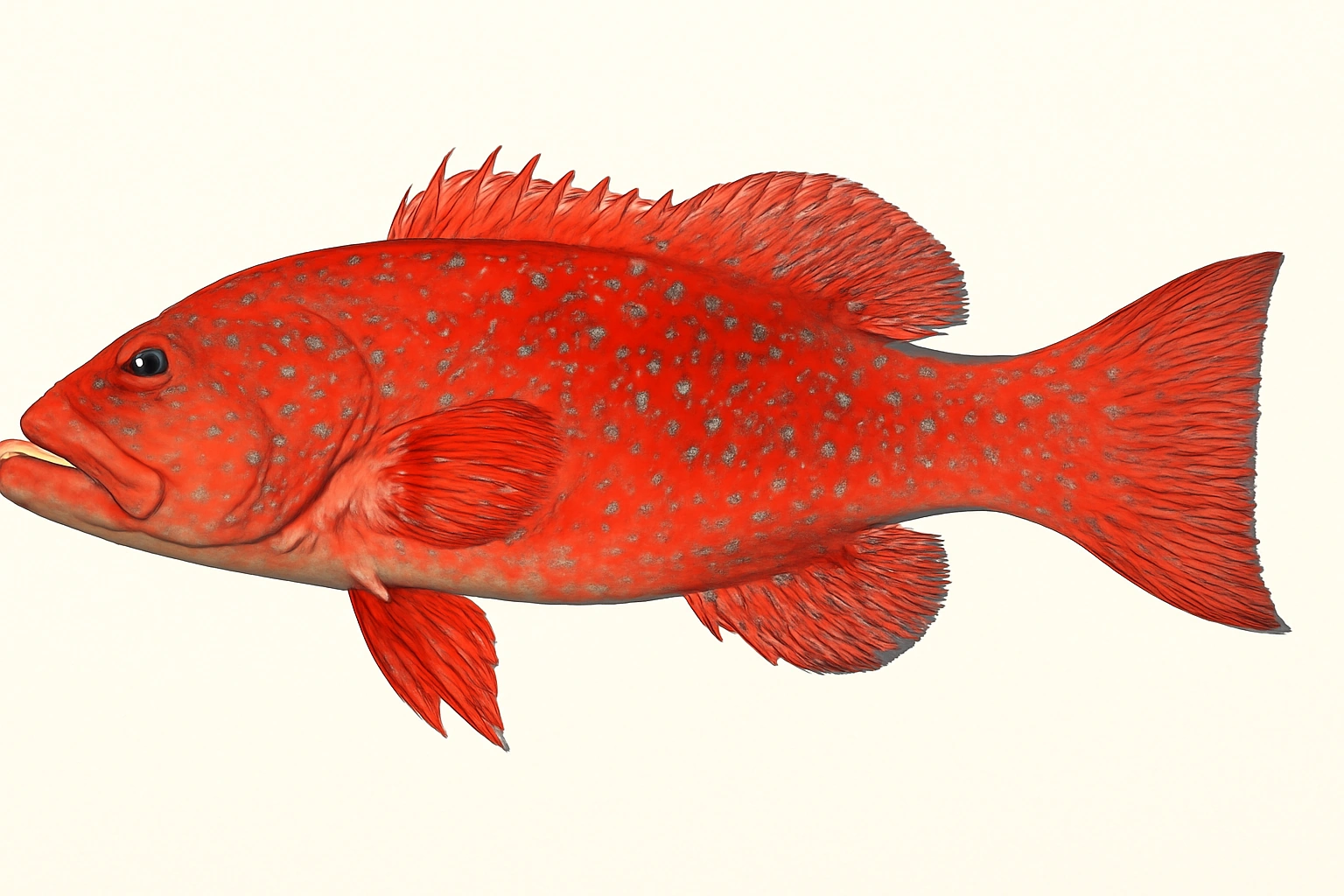
Elegant predator of Australian and Indo-Pacific coral reefs. Red-orange spotted, highly sought after in sport fishing.
Identification
- Body
- Elongated body, slightly compressed laterally.
- Colouration
- Reddish-orange with blue or black spots across the body.
- Sexual dimorphism
- Absent/not very evident
- Growth
- Moderate, reaching maturity in a few years.
Taxonomy
- Family
- Serranidae
- Order
- Perciformes
- Class
- Actinopterygii
Related species
Habitat & distribution
- Environment
- Reefs, Coast
- Preferred bottom
- Reef, Rock
- Geographic distribution
- Found along Australian coral reefs and the Indo-Pacific, from Hong Kong to the central Pacific.
- Micro-habitat
- Prefers hiding among rocks and corals where it hunts its prey.
Coral reefs offer protection and abundant food.
Presence by sea area
Diet
- Primary prey
- fish, crustaceans, octopuses
- Secondary prey
- shrimps, crabs, squids
- Occasional prey
- small mollusks, echinoderms
- Feeding behaviour
- An aggressive and patient hunter, waiting hidden among the corals to quickly catch prey.
- Natural predators
- sharks, large groupers, big pelagic fish
Active hunter, uses its camouflaged pattern to approach prey.
Behaviour
- Activity
- diurnal
- Social behaviour
- solitary
- Aggressiveness
- medium
- Migration
- Resident, rarely strays from native coral reefs.
- Seasonal behaviour
- Active throughout the year with a slight decrease in activity during colder periods.
- Juveniles
- Young individuals tend to stick close to birth areas in their early years.
- Adults
- Adults establish territories that they defend aggressively.
Reproduction
- Spawning season
- September, October, November
- Spawning depth
- between 66 and 197 feet
- Eggs
- Pelagic and transparent eggs, very small in size.
- Larval stage
- Larvae are planktonic and develop typical brown-orange coloration as they grow.
- Sexual maturity
- 3-4 years
When to catch Coral trout
Activity calendar
Activity by season
Best times
This species shows peak fishing activity in spring, summer and autumn, when the productivity index (FPI) reaches its highest values.
Fishing activity decreases in winter, when conditions are less favourable.
Ideal conditions
Atmospheric pressure
Very active, hunts among corals.
Regular activity.
Less active, takes shelter.
Takes shelter in reef.
Hunts actively.
Very active.
Water temperature
Where to catch it
Best spots
Bottom preference
Spot type
Fishing techniques
Recommended
Other applicable
Recommended baits
Baits by pressure
How to really catch it
The coral trout is one of the reef's clearest predators: spotted, solitary, always close to cover, ready to burst out without warning. To truly understand how to catch it, you have to think like it does: rock, coral, ambush, and one brief chance you cannot waste.
🐟 Good to know
Like many serranids, the coral trout releases transparent pelagic eggs: after spawning, the eggs remain suspended in the water column, and the larvae pass through a planktonic stage before developing their typical coloration as they grow. It is a detail most anglers never see, but it says a lot about the link between reef life and open water.
🌊 Where & when
It lives on reefs and rocky coastal bottoms, generally from 10 to 100 meters, with a clear preference for holes, cracks, and coral structure where it can hide and hunt. It is diurnal and present year-round, but it is more approachable through the warmer period into November; from September to November it is also in its spawning season, with spawning taking place between 20 and 60 meters.
🎣 How to really catch it
To catch it for real, jigging is the most concrete approach: work a lead jig or artificial lure close to the reef, keeping it tight to rocks, coral bommies, and submerged outcrops where the fish waits under cover. Natural baits such as live baitfish, squid, and shrimp also match its diet, but everything depends on precise presentation and an immediate response after the strike, because the fight is powerful and the fish heads straight for shelter. A medium-heavy rod, 15-30 kg braid, and a 30-50 kg fluorocarbon leader help keep it out of the structure.
💡 The detail that makes the difference
The most defensible practical tip is simple: focus on the first meters around cover, not on open water. Coral trout is an ambush hunter that stays hidden among corals and rocks, so the truly productive pass is the one that tracks tight to structure without drifting too far away; once the bait leaves that cover zone, it often leaves the strike window as well.
Catch & handling tips
- Fight
- Powerful and fast fight, attempts to shelter among the rocks.
- Handling
- Use gloves to avoid accidental cuts from gills or fins.
- Release
- Handle gently and release quickly to minimize stress, preferably in the water.
Curiosities & culture
- Record catches
- Maximum documented size: up to about 120 cm in length (source: FishBase); the published maximum weight (~23.6 kg) is considered likely overestimated. There is no IGFA All-Tackle record for this species.
- In the kitchen
- Highly valued for its delicate meat, often used in baked or grilled fish dishes.
- Cultural notes
- Considered a prestigious species and a symbol of wealth in Pacific countries.
- Historical notes
- Historically significant in island communities as an essential food resource and a testament to fishing skill.