
Overview
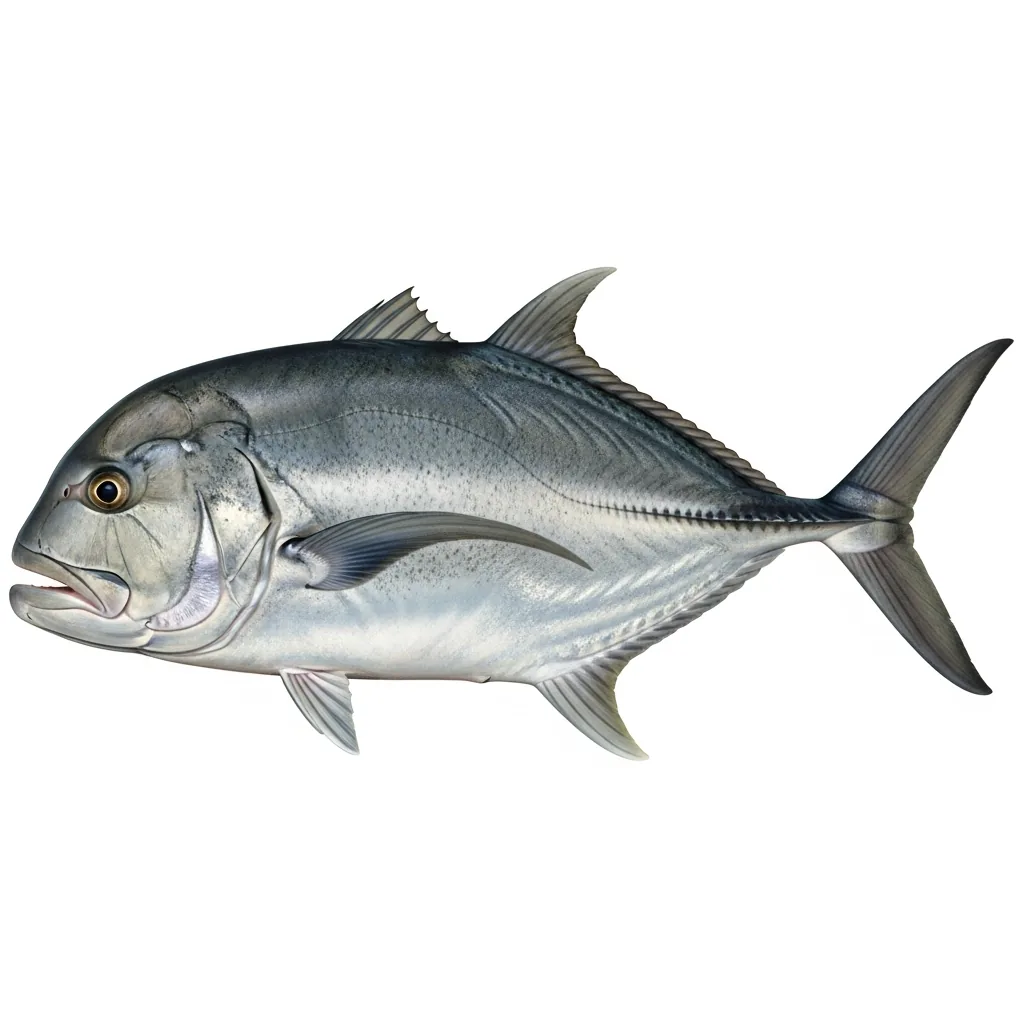
The king of tropical predators, unmatched power and aggression.
Identification
- Body
- Sturdy, muscular body with a convex upper profile.
- Colouration
- Gray-silver on the back fading to silvery white on the belly; larger ones may have dark spots.
- Sexual dimorphism
- Absent/not noticeable
- Growth
- Rapid, especially in the early years.
Taxonomy
- Family
- Carangidae
- Order
- Perciformes
- Class
- Actinopterygii
Related species
Habitat & distribution
- Environment
- Reefs, Coast, Open sea
- Preferred bottom
- Reef, Sand
- Geographic distribution
- Found throughout the Indo-Pacific, from South Africa to Hawaii and from Australia to Japan.
- Micro-habitat
- Often hides among coral branches, near rocks and submerged structures.
Often found near reefs for protection from predators and easy access to food.
Presence by sea area
Diet
- Primary prey
- fish, squid, octopus
- Secondary prey
- crustaceans, mollusks
- Occasional prey
- seabirds, organic debris
- Feeding behaviour
- Aggressive and opportunistic predator, often active near the surface and patrolling along coral reefs.
- Natural predators
- sharks, saltwater crocodiles, sea snakes
Food competition with other predators can influence hunting dynamics.
Behaviour
- Activity
- diurnal
- Social behaviour
- solitary
- Aggressiveness
- high
- Migration
- Resident, but makes short local movements between day and night.
- Seasonal behaviour
- During warmer months, more often near the surface, while in cooler months retreats to deeper waters.
- Juveniles
- Juveniles form small groups for protection near reefs.
- Adults
- Adult individuals are usually solitary and very territorial.
Reproduction
- Spawning season
- November, December
- Spawning depth
- between 10 and 50 meters
- Eggs
- Pelagic eggs, very small and numerous.
- Larval stage
- Larvae drift with currents, feeding on plankton until metamorphosis.
- Sexual maturity
- varies between 4 and 6 years
When to catch Giant trevally
Activity calendar
Activity by season
Best times
This species shows peak fishing activity in spring, summer and autumn, when the productivity index (FPI) reaches its highest values.
Fishing activity decreases in winter, when conditions are less favourable.
Ideal conditions
Atmospheric pressure
Extremely aggressive.
Active hunting along the reef.
Less active but still catchable.
Water temperature
Where to catch it
Best spots
Bottom preference
Spot type
Fishing techniques
Recommended
Other applicable
Recommended baits
Baits by pressure
How to really catch it
The giant trevally is one of the Indo-Pacific’s major predators: thick-bodied, territorial, built to accelerate and strike with force. When you picture it appearing out of the blue along a reef edge, you immediately understand why catching one is not just a capture, but a direct contest with a fish that rules its ground.
🐟 Good to know
An important biological trait is its reproduction: it releases pelagic eggs, very small and numerous, and the larvae drift with the currents, feeding on plankton until metamorphosis. This is a typical strategy of large tropical marine fishes, relying on currents to disperse the earliest life stages.
🌊 Where & when
It lives around coral reefs, coasts, open sea, sandy bottoms and submerged structure, from one to one hundred meters, often hiding among coral branches, rocks and wrecks. It is a diurnal predator; in warmer months it is more often near the surface, while in cooler water it tends to hold deeper. The most favorable period runs from March to November, with spawning between November and December at 10 to 50 meters.
🎣 How to really catch it
To target it effectively, the most concrete route is heavy spinning with poppers and other lures, worked near reefs, atoll passes, wrecks and coastal edges where it patrols for fish and cephalopods. A heavy spinning rod, 30-50 lb braid, an 80-100 lb fluorocarbon leader and strong hooks are a sound base; popping, spinning and jigging all make sense, but topwater in warmer months takes real advantage of its activity near the surface.
💡 The detail that makes the difference
The most defensible practical tip is to cast as close to structure as possible without putting the lure on top of it: giant trevally use coral branches, rocks and man-made structure as cover and ambush reference points. If the lure tracks just outside that edge, inside its patrol lane, the strike is biologically far more likely than in empty open water.
Catch & handling tips
- Fight
- Fights with power, swift bursts, and twists.
- Handling
- Use gloves to avoid cuts from fins and hold fish firmly when lifting.
- Release
- Handle gently, minimize time out of water, and use pliers to remove hooks.
Curiosities & culture
- Record catches
- Maximum documented size: up to about 170 cm and 80 kg (source: FishBase). IGFA All-Tackle record: 72.8 kg (160 lb 7 oz), caught by Keiki Hamasaki at Tokara (Japan) in 2006.
- In the kitchen
- Highly valued for sashimi and sushi, though the meat can be prone to ciguatera.
- Cultural notes
- In Polynesian culture, considered a prestigious catch and a symbol of strength.
- Historical notes
- Traditionally caught using artisanal techniques on Pacific islands.