
Overview
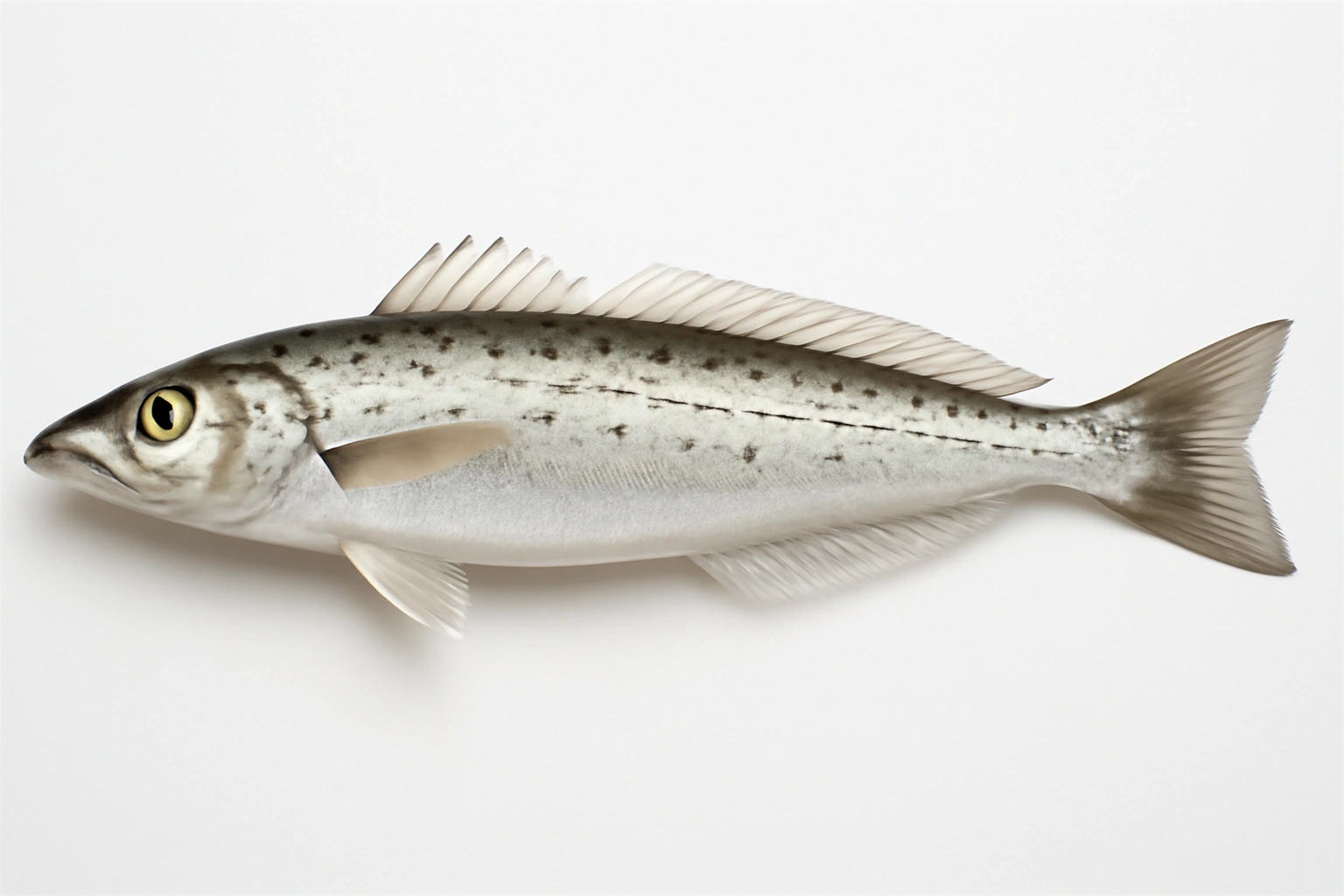
The King George Whiting is considered one of Australia's finest eating fish. Lives on sandy bottoms and seagrass beds, mainly in southern Australia. Fishing is relatively simple but finding large specimens requires experience. White, delicate flesh.
Identification
- Body
- Slender and tapered body with a small head.
- Colouration
- Silvery color with golden stripes along the sides.
- Sexual dimorphism
- absent/not obvious
- Growth
- fast, they reach maturity in a few years
Taxonomy
- Family
- Sillaginidae
- Order
- Perciformes
- Class
- Actinopterygii
Related species
Habitat & distribution
- Environment
- Coast, Estuarine
- Preferred bottom
- Sand, Seagrass
- Geographic distribution
- Mainly found in the southern part of Australia, particularly along the southern and western coasts.
- Micro-habitat
- Often shelters in seagrass beds and on sandy bottoms, hunts close to the substrate.
The sandy habitat and presence of seagrass meadows offer protection from predators.
Presence by sea area
Diet
- Primary prey
- crustaceans, annelids, mollusks
- Secondary prey
- small fish, gastropods, polychaetes
- Occasional prey
- zooplankton, fish eggs
- Feeding behaviour
- Feeds on the bottom during the day, searching for prey in the sandy substrate or among seagrasses.
- Natural predators
- sharks, dolphins, seals, seabirds
Feeding preferences change little throughout the year, focusing on benthic prey.
Behaviour
- Activity
- diurnal
- Social behaviour
- small_groups
- Aggressiveness
- low
- Migration
- stationary, but may make small seasonal movements
- Seasonal behaviour
- More active in the warm season when coastal waters are warmer and food-rich.
- Juveniles
- Juveniles are more often found in shallower waters and are more vulnerable to predators.
- Adults
- Adults tend to stay in groups and prefer deeper waters.
Reproduction
- Spawning season
- December, January, February
- Spawning depth
- between 20 and 60 meters
- Eggs
- The eggs are pelagic and transparent, small in size.
- Larval stage
- The larvae are planktonic and live in the water column until reaching the juvenile stage.
- Sexual maturity
- varies from 2 to 5 years
When to catch King George Whiting
Activity calendar
Activity by season
Best times
This species shows peak fishing activity in spring, summer and autumn, when the productivity index (FPI) reaches its highest values.
Fishing activity decreases in winter, when conditions are less favourable.
Ideal conditions
Water temperature
Where to catch it
Best spots
Bottom preference
Spot type
Fishing techniques
Recommended
Other applicable
Recommended baits
Baits by pressure
How to really catch it
King George Whiting is an elegant, understated bottom fish, marked by golden stripes, a slender body, and a presence that often gives itself away only at the last moment, over pale sand or among seagrass blades. When it begins feeding close to the substrate, it offers subtle, visual, and deeply rewarding fishing.
🐟 Good to know
One important biological detail is that its eggs are pelagic and transparent, while the larvae live in the water column as plankton before becoming juveniles. It is a clear transition: from a dispersed open-water phase to a life tied to sand, estuaries, and submerged seagrass beds.
🌊 Where & when
It is found mainly in southern Australia, along coasts and estuaries, over sandy bottoms and seagrass beds, from the shoreline down to 50 meters. It is more active in the warm season, but remains catchable from March to November; adults tend to stay in small groups in slightly deeper water, while juveniles use shallower areas. Spawning takes place from December to February, between 20 and 60 meters.
🎣 How to really catch it
To truly catch it, the most concrete approach is light, precise bottom fishing, worked slowly over sand and along the seagrass edge with a 2.1-2.4 m light rod, 4-8 lb main line, 10 lb fluorocarbon leader, small size 4-6 hooks, and 5-10 g sinkers. Shrimp, mollusks, and worm strips are ideal baits: keep them low and natural, letting them search where the fish feeds by day among substrate and vegetation.
💡 The detail that makes the difference
The tip that makes the difference is to focus on transitions, not uniform ground: the boundary between clean sand and seagrass is where this whiting looks for crustaceans, annelids, and mollusks. If the bait stays clean and just in contact with the bottom, with a slow and steady presentation, you are fishing right in its feeding lane.
Catch & handling tips
- Fight
- Fights with small jerks and resistances, trying to break free.
- Handling
- Handle with care to avoid damaging the skin.
- Release
- Release quickly ensuring not to damage the fins.
Curiosities & culture
- Record catches
- Maximum documented size: up to about 72 cm and 4.8 kg (source: FishBase). There is no official IGFA All-Tackle record for this species.
- In the kitchen
- Used in various Australian recipes, often fried or grilled.
- Cultural notes
- Considered a prized fish in Australia, highly valued for its delicate flesh.
- Historical notes
- Fishing for King George Whiting is a tradition in the coastal communities of southern Australia.