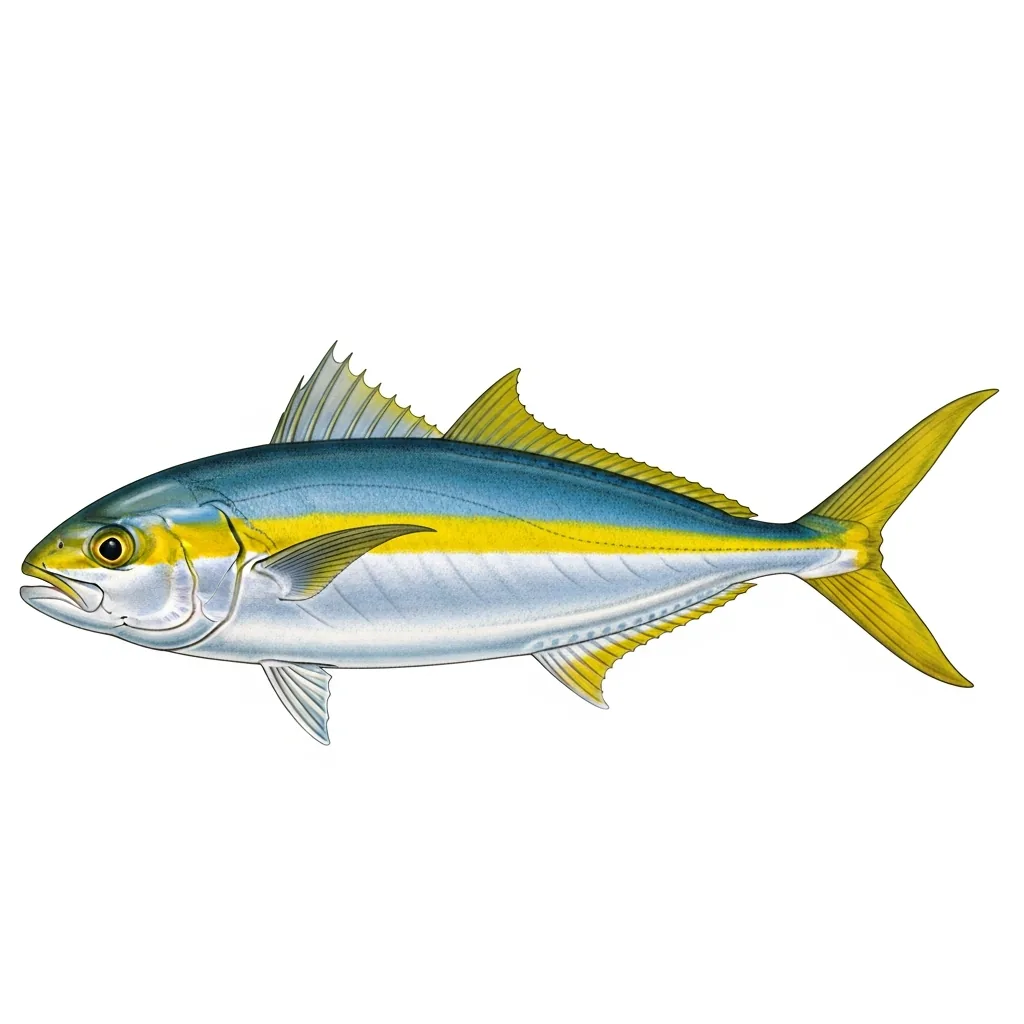

Overview
Powerful predator of the southern hemisphere, extraordinary fighter.
Identification
- Body
- Fusiform and very elongated body, with a well-defined lateral line.
- Colouration
- Generally blue-green or gray on the back, with lighter sides and a white belly. The body is marked by a distinctive yellow lateral band.
- Sexual dimorphism
- Absent/not obvious
- Growth
- Rapid, especially in juvenile stages, in favorable environments.
Taxonomy
- Family
- Carangidae
- Order
- Carangiformes
- Class
- Actinopterygii
Related species
Habitat & distribution
- Environment
- Open sea, Reefs, Coast
- Preferred bottom
- Rock, Reef
- Geographic distribution
- Found mainly in temperate waters of the southern hemisphere, including the coasts of Australia, New Zealand, South Africa, and parts of South America.
- Micro-habitat
- Prefers rocky coastal waters and submerged reefs where it hides and hunts its prey.
Often found near coral reefs, where marine life is abundant.
Presence by sea area
Diet
- Primary prey
- small fish, squid, crustaceans
- Secondary prey
- mackerel, sardines, anchovies, cephalopods
- Occasional prey
- krill, plankton, jellyfish
- Feeding behaviour
- An active predator, hunts in groups and pounces on prey quickly. Uses speed and agility to capture prey, also feeding opportunistically along the way.
- Natural predators
- sharks, orcas, large tuna, seals
Diet varies greatly depending on local availability of marine prey.
Behaviour
- Activity
- diurnal
- Social behaviour
- large_schools
- Aggressiveness
- medium
- Migration
- Resident in warm water areas, with seasonal movements according to water temperature.
- Seasonal behaviour
- Increases activity during warmer months, moving into shallow waters to hunt.
- Juveniles
- Juveniles tend to form large schools for protection and better hunting opportunities.
- Adults
- Adults may form smaller schools, usually active near the shore where their prey concentrates.
Reproduction
- Spawning season
- November, December, January
- Spawning depth
- between 20 and 60 meters
- Eggs
- Pelagic eggs, small, translucent, and floating.
- Larval stage
- The larvae are pelagic, spending early life stages suspended in surface waters, growing rapidly.
- Sexual maturity
- 4-5 years
When to catch Yellowtail kingfish
Activity calendar
Activity by season
Best times
This species shows peak fishing activity in spring, summer and autumn, when the productivity index (FPI) reaches its highest values.
Fishing activity decreases in winter, when conditions are less favourable.
Ideal conditions
Atmospheric pressure
Very active, attacks aggressively.
Good hunting activity.
Less reactive.
Water temperature
Where to catch it
Best spots
Bottom preference
Spot type
Fishing techniques
Recommended
Other applicable
Recommended baits
Baits by pressure
How to really catch it
The yellowtail kingfish is a coastal-pelagic predator that combines power, speed, and a clear instinct to strike. When it shows along a shoal or the edge of a submerged reef, the surface may look calm, but below moves a muscular fish that hunts in schools and immediately tests both nerves and tackle.
🐟 Good to know
A notable biological trait is its reproduction through pelagic eggs: small, translucent, and floating in the water column. The larvae are pelagic as well during their early stages, suspended in surface waters, a pattern fully consistent with a species tied both to open water and coastal structure.
🌊 Where & when
It occurs in temperate waters of the southern hemisphere, especially around rocky coasts, reefs, deep shoals, and submarine canyons, from very shallow water down to great depths. It becomes more approachable in the warmer months and through the long peak from March to November, when it moves more readily into shallow water to hunt; from November to January it spawns between 20 and 60 meters.
🎣 How to really catch it
To really fish for it, vertical jigging is the most concrete approach when it holds over reefs, shoals, and rocky edges: a heavy spinning rod, 30-50 lb braid, and a 50 lb fluorocarbon leader let you work metal lures and soft plastics close to structure with control. If the school rises or feeds more openly, trolling and popper fishing become effective options, while in drift fishing fresh sardines and squid remain highly credible baits.
💡 The detail that makes the difference
The practical secret is not to give it easy meters toward the bottom right after the strike. This species often tries to reach rocks and reef for cover, so it makes sense to fish hard-structure spots, but once hooked, keep steady pressure and a clean angle to pull it away from the structure before it can use the reef to its advantage.
Catch & handling tips
- Fight
- Known for its power and endurance, pulls strongly and dives with determination seeking refuge among rocks.
- Handling
- Use fishing gloves for a firm grip, avoid the gill area.
- Release
- Release quickly and gently to prevent trauma, especially if not intended for consumption.
Curiosities & culture
- Record catches
- Maximum documented size: up to about 250 cm and 96.8 kg (source: FishBase). IGFA All-Tackle record: 52 kg (114 lb 10 oz), caught at Motiti Island (New Zealand) in 1984.
- In the kitchen
- White and firm flesh, ideal for grilling or baking; also used in sushi preparation.
- Cultural notes
- Valued for its fighting qualities and is one of the most sought-after sport fishing targets.
- Historical notes
- Large populations of southern yellowtail have been well documented in the accounts of early explorers of the South Pacific coasts.