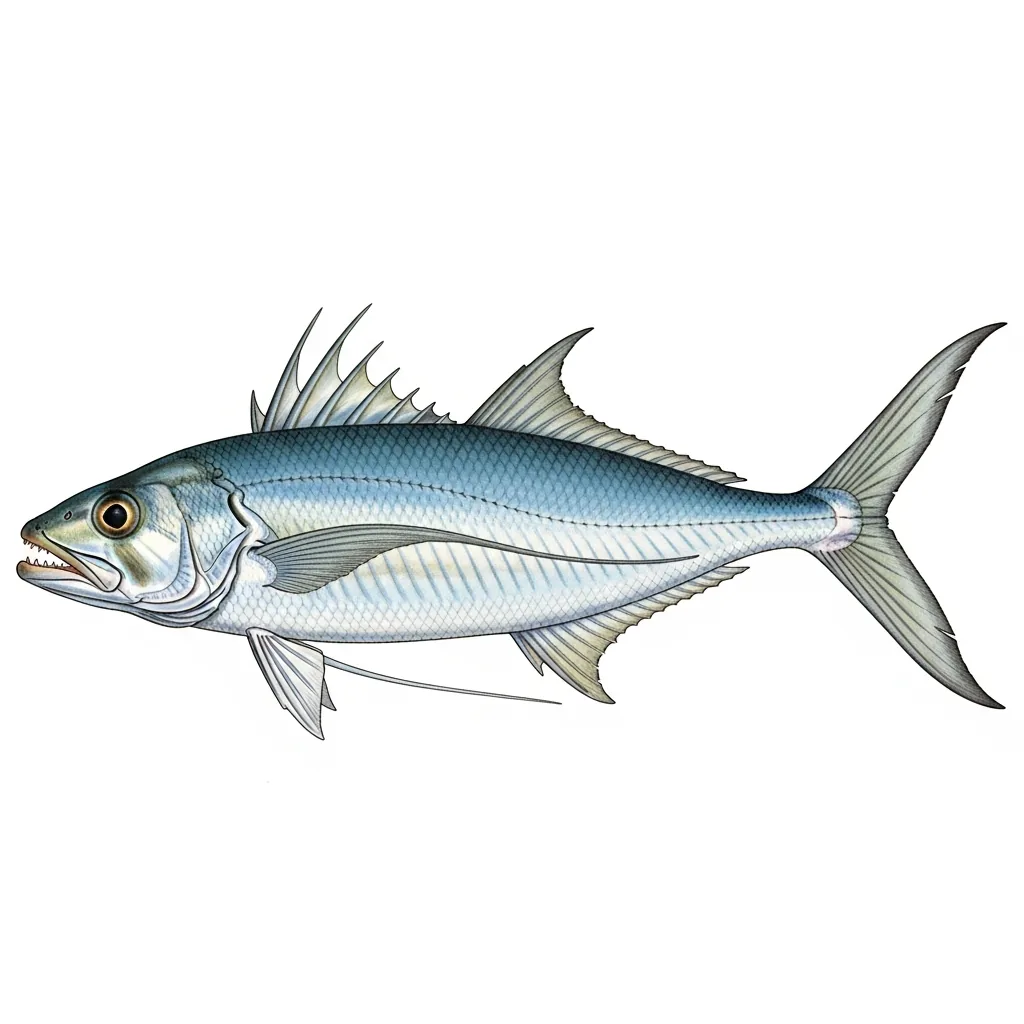

Overview
Powerful pelagic predator, hunts in schools near the surface. Prefers warm waters and sandy bottoms near rocky coasts.
Identification
- Body
- Elongated body, laterally compressed.
- Colouration
- Silvery with bluish hints on the back, white belly.
- Sexual dimorphism
- Absent/barely noticeable
- Growth
- Fast, develops quickly in early life stages.
Taxonomy
- Family
- Carangidae
- Order
- Perciformes
- Class
- Actinopterygii
Related species
Habitat & distribution
- Environment
- Coast, Open sea, Reefs
- Preferred bottom
- Sand, Rock, Gravel, Reef
- Geographic distribution
- Widespread along the Eastern Atlantic coasts, from the Bay of Biscay to Angola, and also in the Mediterranean Sea.
- Micro-habitat
- Often found near rocky shores and submerged structures where it hunts small fish.
Prefers calm waters and mixed bottoms for chasing prey.
Presence by sea area
Diet
- Primary prey
- small fish, shrimp, squid
- Secondary prey
- crustaceans, fish larvae, krill
- Occasional prey
- jellyfish, cephalopods
- Feeding behaviour
- Active predator, hunts in schools chasing prey in open water or near the surface.
- Natural predators
- sharks, tuna, larger fish
Actively hunts small species, using speed to surprise prey.
Behaviour
- Activity
- diurnal
- Social behaviour
- large_schools
- Aggressiveness
- medium
- Migration
- Undergoes seasonal migrations for spawning.
- Seasonal behaviour
- During warmer months, it moves closer to the shores for breeding.
- Juveniles
- Juveniles often inhabit protected coastal lagoons and areas.
- Adults
- Adults are often found offshore, forming large groups.
Reproduction
- Spawning season
- June, July
- Spawning depth
- between 10 and 30 meters
- Eggs
- Pelagic eggs, small and transparent.
- Larval stage
- Larvae are pelagic and develop quickly in surface waters.
- Sexual maturity
- 2-3 years
When to catch Leerfish
Activity calendar
Activity by season
Best times
This species shows peak fishing activity in summer and autumn, when the productivity index (FPI) reaches its highest values.
Fishing activity decreases in winter, when conditions are less favourable.
Ideal conditions
Atmospheric pressure
With low pressure moves away from coast. Difficult fishing.
Stable pressure = maximum predatory activity. Hunts in schools on surface.
With high pressure hunts actively on the surface. Good conditions.
Water temperature
Where to catch it
Best spots
Bottom preference
Spot type
Fishing techniques
Recommended
Other applicable
Recommended baits
Baits by pressure
How to really catch it
The pompano is a fast, compact predator, built to chase through blue water and cut the surface with sharp bursts. When a school moves into feeding mode near a rocky shore or a river mouth, the water seems to change its tone: that is when meeting it with a rod in hand becomes truly memorable.
🐟 Good to know
One notable biological trait of the pompano is its spawning with small, transparent pelagic eggs, released into the water column. The larvae are pelagic as well and develop in surface waters, while juveniles often use lagoons and protected coastal areas before shifting to the more mobile adult life.
🌊 Where & when
It is widespread along the Eastern Atlantic and throughout the Mediterranean, across coasts, open sea and reefs, over sand, rock, gravel and mixed bottoms down to 50 meters. It is often found near rocky shores and submerged structures where it hunts small fish; in the warmer months it moves closer to shore for spawning, becoming more accessible from June to November, with a marked peak in June and July when spawning takes place between 10 and 30 meters.
🎣 How to really catch it
To catch it effectively, spinning is the most concrete approach: a medium-heavy spinning rod, 20-30 lb braid and a 30-40 lb fluorocarbon leader let you cast surface lures along rocky points, river mouths and sandy beaches where schools push prey upward. Trolling also works, and when fish hold a bit deeper around structures and reefs, jigging becomes relevant; live baits, small fish and squid remain fully consistent with its diet.
💡 The detail that makes the difference
The detail that often makes the difference is reading the feeding height: pompano often chase in groups in open water or near the surface, so it pays to start high and fast with the lure before working deeper. If you see scattered but moving activity, do not stay fixed on one spot: track the school along the edge of rocks, the river mouth or the submerged structure.
Catch & handling tips
- Fight
- Strong fighter, leaps and makes quick circles.
- Handling
- Handle with care to avoid damage to the fins.
- Release
- Release quickly, preferably in water.
Curiosities & culture
- Record catches
- Maximum documented size: up to about 70 cm in length (source: FishBase). There is no IGFA All-Tackle record for this species.
- In the kitchen
- Meat appreciated for its texture and delicate flavor, often baked or grilled.
- Cultural notes
- Featured in fishing tales as a prized trophy for its strength and speed.
- Historical notes
- Historically caught with nets and traps, long considered a valued fish by coastal communities.