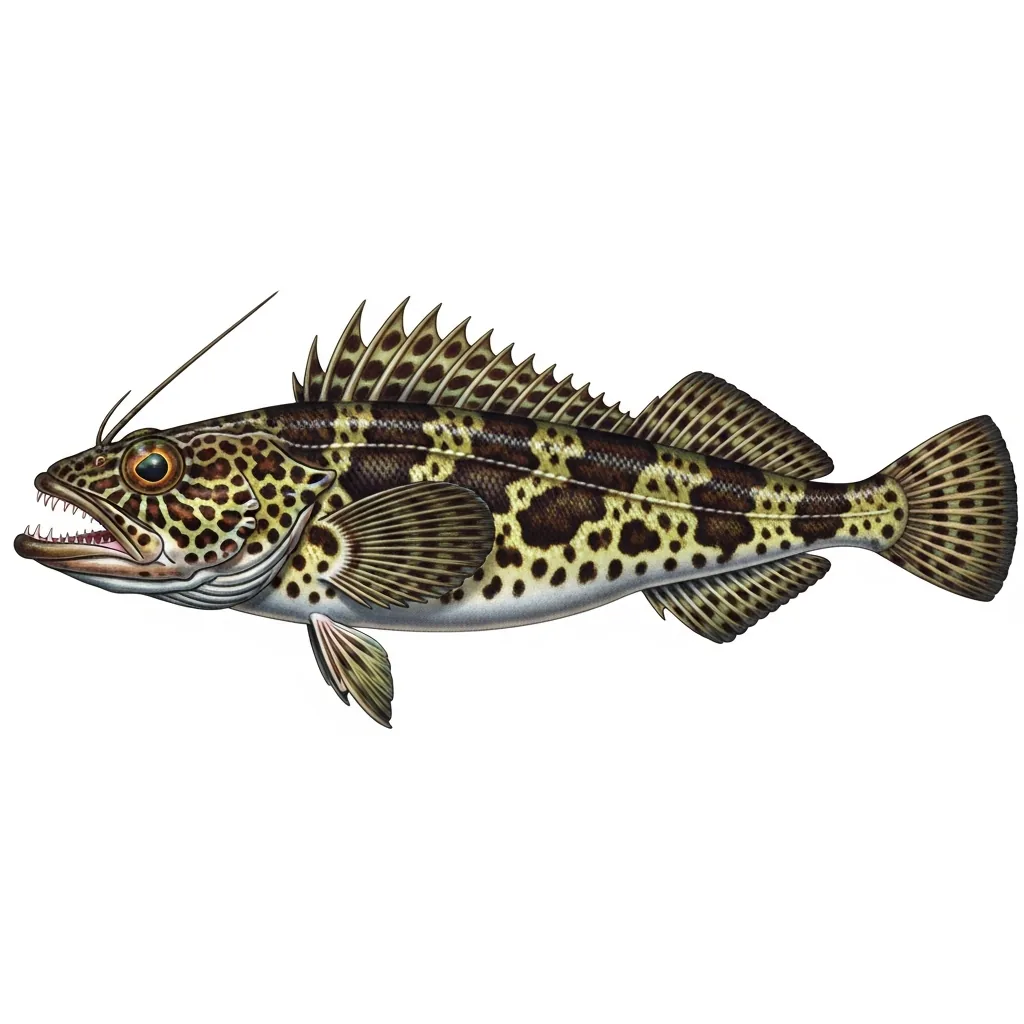

Overview
Large North Pacific predator, aggressive and territorial.
Identification
- Body
- Stout and elongated body with a large head and wide mouth.
- Colouration
- Colors range from brown to gray with blue-green marbling; often with irregular spots on the back.
- Sexual dimorphism
- Absent/not evident
- Growth
- Medium, grows rapidly in the early years and slows later.
Taxonomy
- Family
- Hexagrammidae
- Order
- Scorpaeniformes
- Class
- Actinopterygii
Related species
Habitat & distribution
- Environment
- Coast, Reefs, Open sea
- Preferred bottom
- Rock, Reef, Gravel
- Geographic distribution
- Found in the coastal waters of the northeastern Pacific, from southeastern Alaska to Baja California.
- Micro-habitat
- Hides among rocks and reefs to hunt; prefers rocky bottom areas.
Prefers temperate waters and areas with abundant cover and complex structures.
Presence by sea area
Diet
- Primary prey
- fish, octopuses, squid
- Secondary prey
- shrimp, crabs, krill
- Occasional prey
- fish eggs, sea stars
- Feeding behaviour
- An ambush predator, waits hidden among rocks to attack by surprise. Primarily hunts during daylight hours.
- Natural predators
- sea lions, seals, sharks, seabirds
Diverse prey makes the lingcod a highly adaptable predator to environmental changes.
Behaviour
- Activity
- diurnal
- Social behaviour
- solitary
- Aggressiveness
- high
- Migration
- Non-migratory
- Seasonal behaviour
- Moves closer to shore during the breeding season. Feeding activity may increase in warmer months.
- Juveniles
- Juveniles tend to stay in more sheltered and nearshore waters.
- Adults
- Adults are territorial and may occupy fixed hunting areas.
Reproduction
- Spawning season
- December, January, February
- Spawning depth
- between 20 and 60 meters
- Eggs
- Eggs are benthic, laid in clusters under rocks, measuring about 2-3 mm in diameter.
- Larval stage
- Larvae are pelagic and drift with currents before settling on the bottom.
- Sexual maturity
- 3-4 years
When to catch Lingcod
Activity calendar
Activity by season
Best times
This species shows peak fishing activity in spring, summer and autumn, when the productivity index (FPI) reaches its highest values.
Fishing activity decreases in winter, when conditions are less favourable.
Ideal conditions
Atmospheric pressure
Aggressive, attacks large lures.
Active near the bottom.
Stationary near dens.
Water temperature
Where to catch it
Best spots
Bottom preference
Spot type
Fishing techniques
Recommended
Other applicable
Recommended baits
Baits by pressure
How to really catch it
Lingcod is a true rock predator: big head, wide mouth, sharp teeth, holding still until the instant it chooses to strike. If you want to find it for real, you have to fish where the bottom breaks into lairs, stones, and shadows, where the silence of the seabed hides the ambush.
🐟 Good to know
One important biological detail is that lingcod has no swim bladder. Because of this, it lives closely tied to the bottom and structure, moving through rock, reef, and gravel with very direct positional control, a trait fully consistent with its life as a benthic ambush predator.
🌊 Where & when
It occurs along the northeastern Pacific from southeastern Alaska to Baja California, over rocky bottom, reefs, gravel, and submerged ledges from 10 to 450 meters. Adults are territorial and non-migratory, but during the breeding season, from December to February, they move closer to shore; feeding activity may increase in warmer months, and from March through November it remains a very fishable species.
🎣 How to really catch it
The most concrete way to catch it is bottom fishing on the drift over rocky reefs, shallow hard bottom, kelp areas, and submerged cliffs. A stout boat rod with 20 kg braid, a 25 kg fluorocarbon leader, a strong 5/0 hook, and an egg sinker lets you work close to bottom with live baitfish, squid bait, octopus, or artificial lures, keeping the offering low and inside its hunting lane.
💡 The detail that makes the difference
The practical edge is not letting the bait stray too far from structure. Lingcod hunts by day while hidden among rocks and strikes by surprise: when the presentation passes just above holes, cracks, and reef edges, it stays in the fish’s natural strike window; if it rises too far off bottom, it often leaves the zone where this predator is most likely to ambush.
Catch & handling tips
- Fight
- Shows endurance and strength, providing a significant fight when hooked.
- Handling
- Use gloves to avoid sharp teeth and handle carefully to minimize stress.
- Release
- Ensure rapid and gentle release to ensure survival.
Curiosities & culture
- Record catches
- Maximum documented size: up to about 152 cm and 59 kg (source: FishBase). IGFA All-Tackle record: 37.4 kg (82 lb 9 oz), caught at Homer, Alaska (USA), in 2007.
- In the kitchen
- Highly valued for its flavorful meat, often grilled or fried.
- Cultural notes
- Popular in the maritime culture of the northwest Pacific, often mentioned in fishing tales.
- Historical notes
- An important species for native coastal communities for both food and traditional fishing.