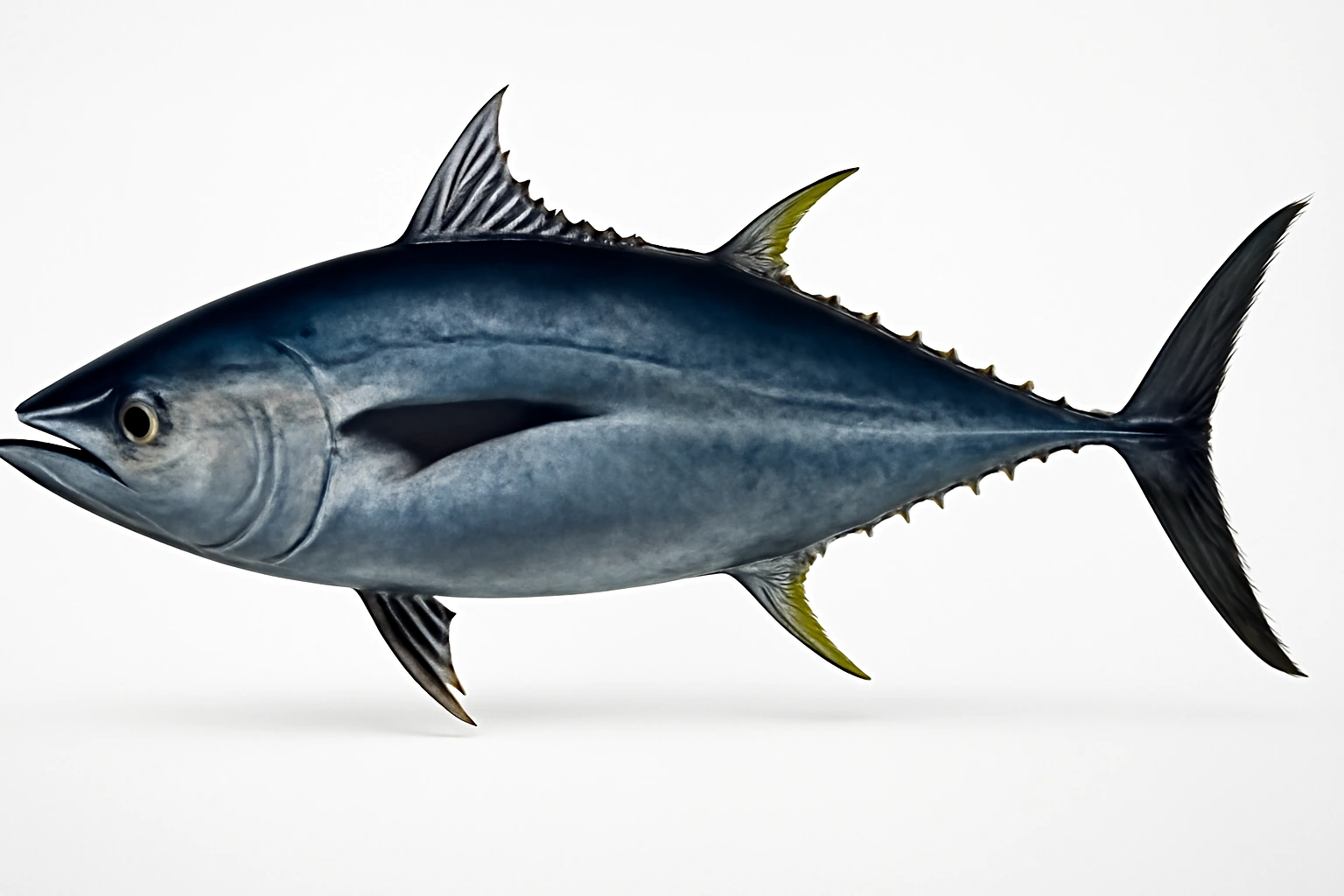

Overview
The Longtail Tuna is Australia's most common coastal tuna. Unlike other tunas, it hunts close to shore and often in very shallow water. Offers explosive fights with long, fast runs. Excellent flesh both raw and cooked.
Identification
- Body
- Fusiform and robust body with a long tapered tail.
- Colouration
- Bluish back with metallic silver hues on the sides and a white belly.
- Sexual dimorphism
- Absent/not prominent
- Growth
- Fast, reaching adult size in a few years
Taxonomy
- Family
- Scombridae
- Order
- Scombriformes
- Class
- Actinopterygii
Related species
Habitat & distribution
- Environment
- Coast, Open sea
- Preferred bottom
- Sand, Reef
- Geographic distribution
- Found along the western Indian Ocean and eastern Pacific Ocean coasts, particularly around Australia and Southeast Asia.
- Micro-habitat
- Often takes shelter near coastal reefs and in sandy inlets.
As a coastal tuna, it adapts well to different marine areas near the coast.
Presence by sea area
Diet
- Primary prey
- small fish, squid, shrimp
- Secondary prey
- sardines, anchovies, winglets
- Occasional prey
- jellyfish, crabs
- Feeding behaviour
- Hunts in schools, making quick raids on fish shoals or single prey.
- Natural predators
- tiger shark, mako shark, humans, marlin
Primarily hunts during the day, utilizing sharp eyesight to spot and pursue prey.
Behaviour
- Activity
- diurnal
- Social behaviour
- large_schools
- Aggressiveness
- medium
- Migration
- Undertakes seasonal coastal migrations following warm currents.
- Seasonal behaviour
- Moves closer to shore for spawning in warm months and ventures offshore in colder months.
- Juveniles
- Juveniles tend to form large groups to protect themselves from predators.
- Adults
- Adults gather in larger numbers during the spawning period.
Reproduction
- Spawning season
- April, May, June
- Spawning depth
- between 20 and 60 meters
- Eggs
- Highly numerous pelagic eggs, small in size.
- Larval stage
- Larvae are pelagic and disperse widely before growing up.
- Sexual maturity
- 3-4 years
When to catch Longtail Tuna
Activity calendar
Activity by season
Best times
This species shows peak fishing activity in spring, summer and autumn, when the productivity index (FPI) reaches its highest values.
Fishing activity decreases in winter, when conditions are less favourable.
Ideal conditions
Water temperature
Where to catch it
Best spots
Bottom preference
Spot type
Fishing techniques
Recommended
Other applicable
Recommended baits
Baits by pressure
How to really catch it
Longtail tuna is a compact, bright pelagic built to cut water and chase bait in schools. When feeding packs ignite near the coast, among foam, silver flashes and sudden bursts, it becomes the kind of fish that raises your pulse before the line even comes tight.
🐟 Good to know
Like other tunas, it belongs to a group of fishes whose gill ventilation depends on continuous swimming: movement supports the water flow needed for respiration. It is a simple but important key to understanding why it frequents open water, currents, and areas where it can remain constantly active.
🌊 Where & when
It is found along coastal and open waters of the western Indian Ocean and eastern Pacific, especially around Australia and Southeast Asia, from 1 to 100 meters. It uses coastal reefs, sandy inlets, transition areas, and river mouths; it is more approachable in the warm months, from March to November, with spawning from April to June, when it moves closer inshore following warm currents.
🎣 How to really catch it
For longtail tuna, the most concrete approach is spinning on feeding bust-ups and surface hot spots: get where the school is forcing bait upward and quickly present an artificial lure or a small baitfish. Trolling and jigging also work well around coastal reefs and transition zones, using a heavy spinning or trolling rod, 30-50 lb braid, and a 60 lb fluorocarbon leader, ready for long runs and sharp changes of direction.
💡 The detail that makes the difference
The most defensible secret is to read the forage before you read the fish. This species hunts small fish, squid, and shrimp in fast school raids: if you find nervous surface water, tightly packed anchovies or sardines, or activity near a river mouth, you have far more than a generic spot; you have the trigger that puts tuna into an attack window.
Catch & handling tips
- Fight
- Strong fighter with long runs, quickly changes direction.
- Handling
- Use gloves and handle gently to avoid damaging the fins.
- Release
- Release quickly after retrieval to minimize stress.
Curiosities & culture
- Record catches
- Maximum documented size: up to about 145 cm and 36 kg (source: FishBase). IGFA All-Tackle record: 35.9 kg (79 lb 2 oz), caught at Montague Island, NSW (Australia), in 1982.
- In the kitchen
- The meat is prized both raw as sashimi and cooked in various dishes.
- Cultural notes
- Considered significant in many coastal Australian and Asian cultures for sport fishing.
- Historical notes
- Longtail tuna fishing has been practiced for centuries in the coastal marine waters of Australia and Southeast Asia.