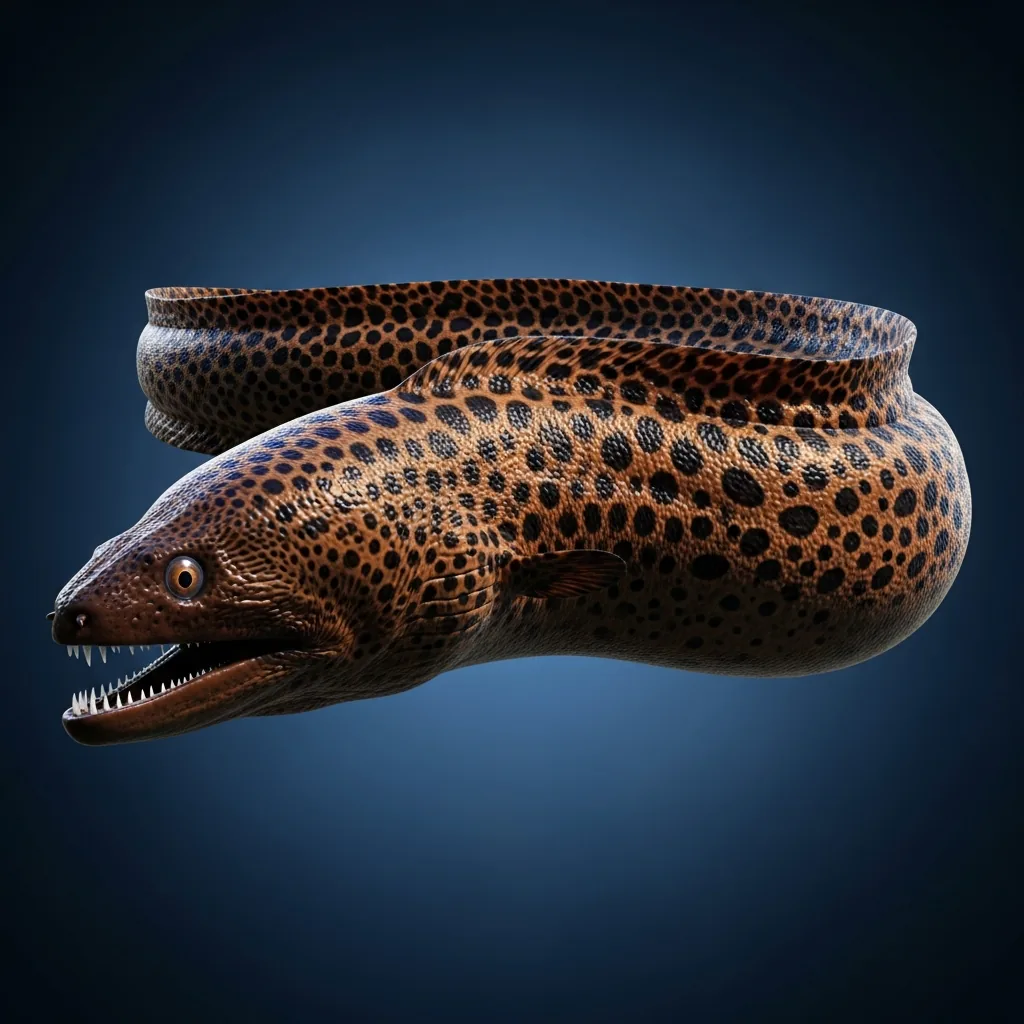

Overview
Very aggressive nocturnal predator, lives in deep crevices and reefs.
Identification
- Body
- The body is elongated and snake-like, similar to that of an eel.
- Colouration
- The coloring is mainly brown with irregular yellow spots of varying intensity.
- Sexual dimorphism
- Absent/not noticeable
- Growth
- Medium; it grows steadily over its lifetime.
Taxonomy
- Family
- Muraenidae
- Order
- Anguilliformes
- Class
- Actinopterygii
Related species
Habitat & distribution
- Environment
- Coast, Reefs, Deep sea
- Preferred bottom
- Rock, Reef
- Geographic distribution
- Found in the Mediterranean Sea and along the Atlantic coasts from Europe to North Africa.
- Micro-habitat
- Hides among rock crevices during the day, venturing out to hunt at night.
Prefers rocky areas for the ample availability of natural shelters.
Presence by sea area
Diet
- Primary prey
- octopuses, sea urchins, crustaceans
- Secondary prey
- small fish, marine invertebrates, carruggi
- Occasional prey
- small squids, crabs, shrimps
- Feeding behaviour
- The moray eel is an opportunistic predator, hunting at night with quick, lethal strikes.
- Natural predators
- large sharks, groupers, other large predatory fish
Prefers to hunt inactive or hidden prey during the night when visibility is low.
Behaviour
- Activity
- nocturnal
- Social behaviour
- solitary
- Aggressiveness
- high
- Migration
- Non-migratory
- Seasonal behaviour
- More active in summer due to warmer temperatures that enhance its metabolic activity.
- Juveniles
- Juveniles tend to hide in rock crevices to avoid predators.
- Adults
- Adults are usually territorial and stay close to their usual shelter.
Reproduction
- Spawning season
- June, July, August
- Spawning depth
- Between 20 and 60 meters
- Eggs
- Pelagic eggs, transparent and buoyant, very numerous.
- Larval stage
- Transparent larvae similar to eel larvae, called leptocephali.
- Sexual maturity
- Varies between 4 and 6 years
When to catch Mediterranean moray
Activity calendar
Activity by season
Best times
This species shows peak fishing activity in spring, summer and autumn, when the productivity index (FPI) reaches its highest values.
Ideal conditions
Atmospheric pressure
Very active and aggressive.
Regular activity.
Stays hidden in crevices.
Water temperature
Where to catch it
Best spots
Bottom preference
Spot type
Fishing techniques
Recommended
Other applicable
Recommended baits
Baits by pressure
How to really catch it
The Mediterranean moray is the living shadow of the rocks: a serpentine body, slick skin, a stout head and sharp teeth built for ambush. Truly catching one means entering its world of crevices, darkness and hard bottom, where every touch can turn into a short, stubborn fight back to the lair.
🐟 Good to know
One biological feature that is easy to overlook yet unmistakable is its lack of scales: the moray has naked, slimy skin, while its continuous dorsal fin runs along the long body profile. Its tubular nostrils and small eyes also reveal a species shaped to move and hunt among rocks and holes.
🌊 Where & when
You find it over rocky bottoms and reefs, along coasts and deeper areas, generally from 10 to 100 meters, in the Mediterranean and along the Atlantic coasts from Europe to North Africa. By day it stays hidden in cracks; by night it comes out to hunt. From spring to autumn it is more catchable, with stronger activity in summer; from June to August it spawns between 20 and 60 meters.
🎣 How to really catch it
The most practical way to target it is bottom fishing with a strong rod, tough nylon or braid, a steel or heavy fluorocarbon leader, reinforced hooks and quick-release sinkers. Work rocky crevices and den entrances with meaty baits such as squid, octopus, dead fish or fish strips, especially after dark, ready to stop its rush into the rocks immediately.
💡 The detail that makes the difference
The tip that really matters is not giving it any room after the take: adult morays are territorial and stay close to their shelter, so once hooked they often try to dive straight back into the crack, twisting around rock. Applying steady pressure at once and keeping a clean angle matters more than waiting.
Catch & handling tips
- Fight
- Fights hard when hooked, tends to coil around rocks.
- Handling
- Use thick gloves to avoid cuts from sharp teeth.
- Release
- Avoid injury, handle with care, and release as close to its natural habitat as possible.
Curiosities & culture
- Record catches
- Maximum documented size: up to about 150 cm and 6.5 kg (source: FishBase). There is no official IGFA All-Tackle record for this species.
- In the kitchen
- Moray eels are cooked in soups or baked in Mediterranean countries.
- Cultural notes
- In ancient Roman culture, moray eels were considered a delicacy and were often kept in special pools.
- Historical notes
- Often raised in Roman and Greek eras to test the technical abilities of aquaculture for food purposes.