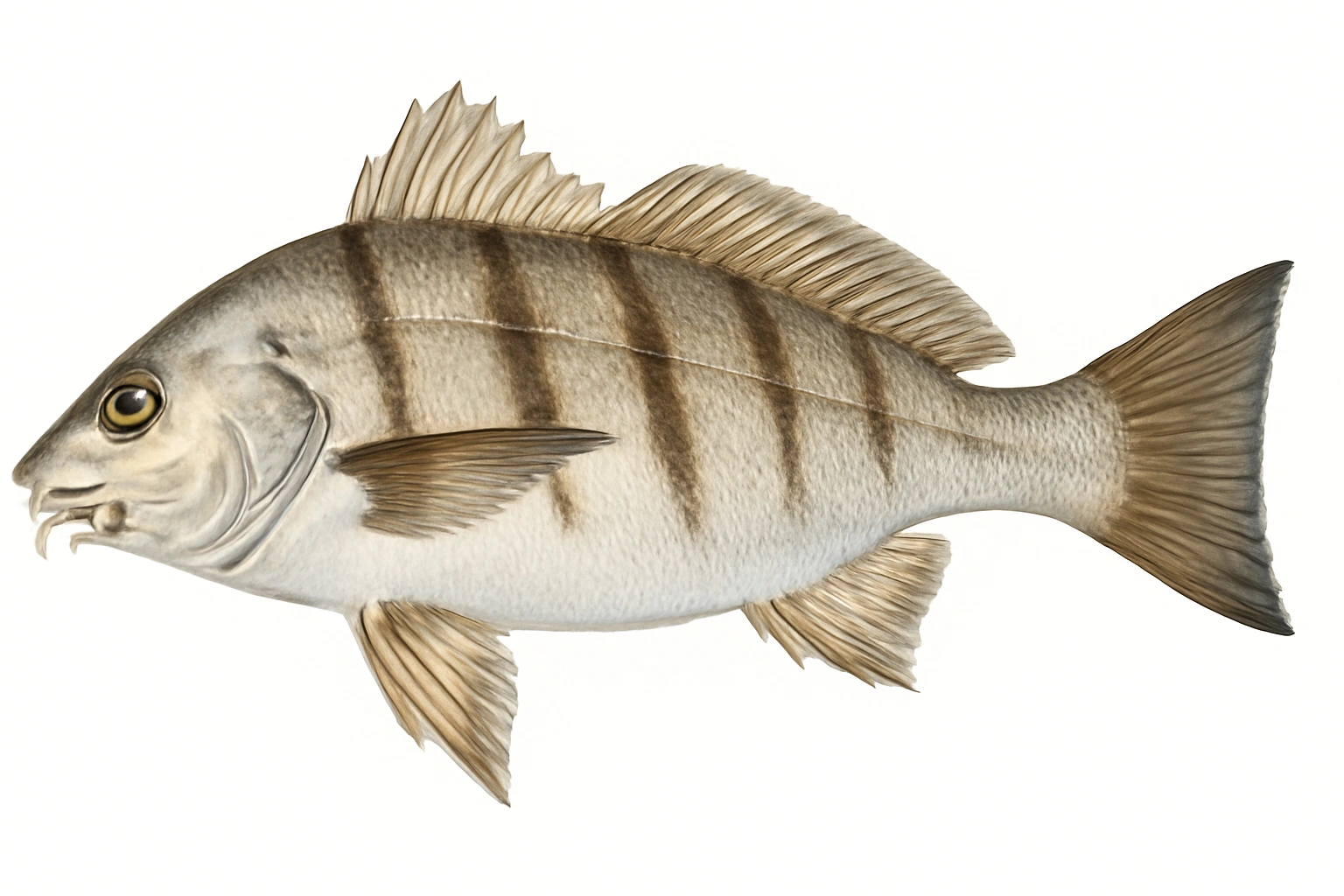

Overview
Prized fish of coastal sandy bottoms. Hunts small invertebrates on the bottom, especially after storms.
Identification
- Body
- Elongated body with a small head and central mouth.
- Colouration
- Gray with silvery reflections, sometimes with dark stripes along the sides.
- Sexual dimorphism
- Absent/Not evident.
- Growth
- Medium, grows steadily in early years.
Taxonomy
- Family
- Sciaenidae
- Order
- Perciformes
- Class
- Actinopterygii
Related species
Habitat & distribution
- Environment
- Coast, Open sea
- Preferred bottom
- Sand, Mud
- Geographic distribution
- Found in the Mediterranean Sea and along the eastern Atlantic Ocean coasts, from Norway to Morocco.
- Micro-habitat
- Hides in sandy bottoms during the day and hunts at night.
Prefers transitional zones between sand and mud, perfect for hiding and hunting.
Presence by sea area
Diet
- Primary prey
- crustaceans, mollusks, worms
- Secondary prey
- small fish, amphipods, gastropods
- Occasional prey
- cephalopods, annelids
- Feeding behaviour
- Primarily hunts near the bottom, using its protrusible mouth to suck in prey.
- Natural predators
- sharks, dolphins, large predatory fish
Frequently feeds near disturbed areas where prey are exposed.
Behaviour
- Activity
- crepuscular
- Social behaviour
- small_groups
- Aggressiveness
- low
- Migration
- Mostly resident with minor seasonal movements along the coasts.
- Seasonal behaviour
- Approaches the coast in spring and early summer for spawning. Moves slightly deeper in winter.
- Juveniles
- Young form small groups and stay close to shores for protection.
- Adults
- Adults move in groups and primarily hunt at night.
Reproduction
- Spawning season
- April, May, June
- Spawning depth
- between 20 and 60 meters
- Eggs
- Pelagic eggs, very small, develop at the surface.
- Larval stage
- Larvae are pelagic and become benthic once they reach the bottom.
- Sexual maturity
- 3-4 years
When to catch Shi drum
Activity calendar
Activity by season
Best times
This species shows peak fishing activity in spring, summer and autumn, when the productivity index (FPI) reaches its highest values.
Ideal conditions
Atmospheric pressure
Very active, searches for food in storm-stirred bottoms.
Regular activity, searches for food along the bottom.
Less active, moves away from shore.
Declining activity.
Good activity near the bottom.
Excellent, feeds frantically.
Water temperature
Where to catch it
Best spots
Bottom preference
Spot type
Fishing techniques
Recommended
Other applicable
Recommended baits
Baits by pressure
How to really catch it
The shi drum is an elegant, discreet bottom fish, with silver flanks and a mouth built to search for life in the sand. It does not always give dramatic signals, but once you enter its rhythm — fading light, the right bottom, a natural bait — it becomes a catch that feels deeply tied to the sea.
🐟 Good to know
A distinctive biological trait of the shi drum is its protrusible mouth: it extends it forward to suck in prey very close to the bottom. This explains well why it feeds mainly over sand and mud, searching for worms, crustaceans and mollusks with precise benthic feeding behavior.
🌊 Where & when
You find it from the coast to open sea, over sand and mud bottoms from 5 to 100 meters, in the Mediterranean and along the eastern Atlantic from Norway to Morocco. By day it tends to hide on sandy bottoms, while it becomes more active from dusk into the night; in spring and early summer it moves closer to shore for spawning, while in winter it shifts slightly deeper.
🎣 How to really catch it
To really catch it, beach casting and surf casting on sandy beaches are the most concrete paths: picture the pyramid sinker holding bottom, the natural bait resting on the seabed, and darkness starting to stretch across the water. A 7-9 ft medium-action rod, 0.20-0.30 mm monofilament, a 45 cm fluorocarbon leader, and size 1/0 to 2/0 hooks work well with marine worms and shrimp, the most coherent match for its bottom-oriented diet; bottom fishing from a boat and coastal trolling can also work over mixed bottoms and near harbors.
💡 The detail that makes the difference
The most reliable tip is simple: keep the bait low, clean, and still near the bottom. The shi drum feeds mainly there and uses a protrusible mouth to suck in benthic prey; for that reason, a natural presentation that does not lift too far above sand or mud is often more convincing than any extra trick.
Catch & handling tips
- Fight
- Displays moderate resistance, alternating brief runs with attempts to swim toward the bottom.
- Handling
- Handle carefully due to sharp dorsal fins.
- Release
- Release quickly if not intended for consumption, to prevent stress and harm.
Curiosities & culture
- Record catches
- Maximum documented size: up to about 104 cm and 11 kg (source: FishBase). There is no official IGFA All-Tackle record; the largest documented European catches are around 11 kg (Corsica, 1992).
- In the kitchen
- Highly prized white flesh, often baked or grilled with herbs.
- Cultural notes
- Considered a noble fish during ancient Roman times, often depicted in mosaics.
- Historical notes
- Historically significant fishing in the Mediterranean, associated with local coastal fishing traditions.