
Overview
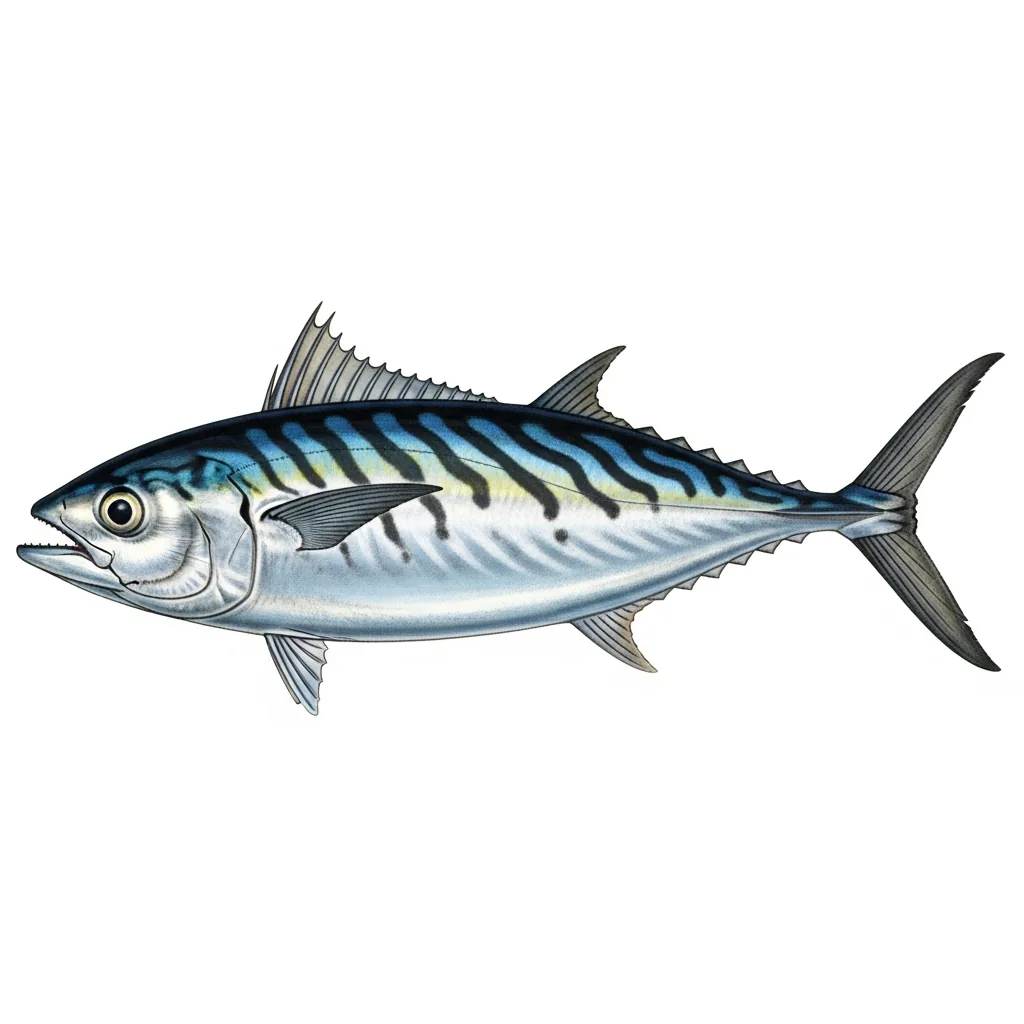
Tuna relative, fast and feisty. Often the first fish beginners catch on party boats in California.
Identification
- Body
- Elongated and streamlined fusiform body.
- Colouration
- Silvery body with dark stripes on the back and a light belly.
- Sexual dimorphism
- Absent/not noticeable
- Growth
- Fast, quick-growing species with high reproductive capability.
Taxonomy
- Family
- Scombridae
- Order
- Perciformes
- Class
- Actinopterygii
Related species
Habitat & distribution
- Environment
- Coast, Open sea, Pelagic
- Preferred bottom
- Pelagic
- Geographic distribution
- Pacific Ocean along the American coast from Southern California to Peru.
- Micro-habitat
- Prefers open waters near the coast, often hunting near schools of baitfish.
Frequently moves in search of baitfish schools.
Presence by sea area
Diet
- Primary prey
- anchovies, sardines, squid
- Secondary prey
- anchovies, lanternfish, planktonic crustaceans
- Occasional prey
- mullet, pipefish
- Feeding behaviour
- Fast and aggressive predator, hunts both individually and in small groups, often seen chasing schools of fish.
- Natural predators
- sharks, tunas, carnivorous seabirds
Prefers rapid and coordinated attacks, both solo and in groups.
Behaviour
- Activity
- diurnal
- Social behaviour
- small_groups
- Aggressiveness
- medium
- Migration
- Seasonal migrator along the coast seeking warmer waters.
- Seasonal behaviour
- Forms schools during warmer months when food is abundant, dispersing in colder months.
- Juveniles
- Juveniles form small groups near the coast for protection from predators.
- Adults
- Adults are often seen in groups around baitfish schools.
Reproduction
- Spawning season
- March, April, May
- Spawning depth
- Between 20 and 60 meters
- Eggs
- Pelagic eggs, small and transparent.
- Larval stage
- Highly active pelagic larvae that quickly disperse with the currents.
- Sexual maturity
- 2-3 years
When to catch Pacific Bonito
Activity calendar
Activity by season
Best times
This species shows peak fishing activity in spring, summer and autumn, when the productivity index (FPI) reaches its highest values.
Fishing activity decreases in winter, when conditions are less favourable.
Ideal conditions
Water temperature
Where to catch it
Best spots
Bottom preference
Spot type
Fishing techniques
Recommended
Other applicable
Recommended baits
Baits by pressure
How to really catch it
The Pacific bonito is a sharp, high-strung pelagic built to cut water: fusiform body, crescent tail, large eyes, and the burst speed of a pure hunter. When it moves onto bait schools near the coast, the surface seems to switch on; that is when it becomes a fish you feel before you fully see.
🐟 Good to know
A lesser-noticed biological detail is its pelagic spawning: from March to May it releases small, transparent eggs between 20 and 60 meters, and the highly active larvae quickly disperse with the currents. It is a typical strategy of coastal offshore fishes, closely tied to the mobile environment this species uses.
🌊 Where & when
Look for it in the eastern Pacific, from Southern California to Peru, in open water near the coast, along current lines, near rocky areas, and especially around baitfish schools. It is most fishable in the warm season, from March to November, when it forms schools and follows food; in colder months it tends to spread out.
🎣 How to really catch it
To catch it for real, spinning is the most concrete approach: a light spinning rod, 20-30 lb braid, 30-40 lb fluorocarbon leader, and fast casts wherever the sea wrinkles with bait activity. Retrieve decisively with artificials or sardines, and also work squid or live bait near moving schools: bonito feeds by day and responds well to a dynamic presentation.
💡 The detail that makes the difference
The practical edge is not to stay on empty water, but to follow the bait signal. Adults are often grouped around small forage fish while hunting, so instead of blind casting, read the current, splashes, and tight surface movement, then cast just beyond and bring the lure across the edge of the school.
Catch & handling tips
- Fight
- Fights vigorously, tends to move swiftly and energetically.
- Handling
- Use gloves to avoid injuries from teeth and fins.
- Release
- Ensure it is fully revived before releasing.
Curiosities & culture
- Record catches
- Maximum documented size: up to about 102 cm and 11.3 kg (source: FishBase). There is no official IGFA All-Tackle weight record for this species.
- In the kitchen
- Consumed fresh or smoked, sometimes used in sushi.
- Cultural notes
- Considered a prized sportfish for its fighting ability.
- Historical notes
- Traditionally fished by Native Americans along the Pacific Coast for centuries.