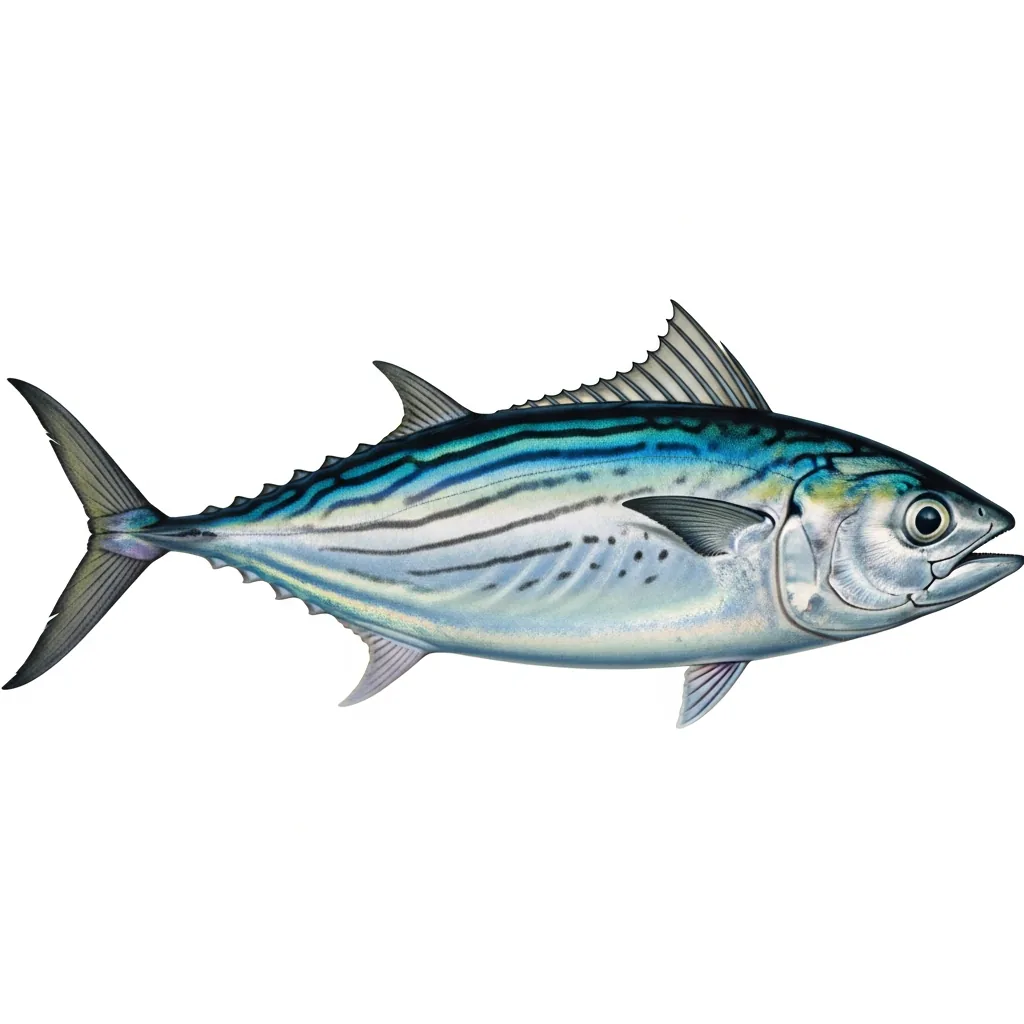

Overview
Very fast small tuna, often in schools, loves chasing anchovy and sardine schools.
Identification
- Body
- Long, streamlined body built for speed.
- Colouration
- Dark blue back with black stripes, silvery belly.
- Sexual dimorphism
- Absent or not very noticeable.
- Growth
- Fast, quickly reaches maturity.
Taxonomy
- Family
- Scombridae
- Order
- Scombriformes
- Class
- Actinopterygii
Related species
Habitat & distribution
- Environment
- Open sea, Pelagic
- Preferred bottom
- Open water
- Geographic distribution
- Tropical and temperate Atlantic, Mediterranean, and Black Sea.
- Micro-habitat
- Chases prey in open sea, rarely near shore.
Prefers warm and temperate waters, can chase prey to cooler regions based on seasons.
Presence by sea area
Diet
- Primary prey
- anchovies, sardines, mackerels
- Secondary prey
- mullets, garfish, jacks
- Occasional prey
- small crustaceans, squid
- Feeding behaviour
- Active, fast predator, hunts in schools mainly on the surface.
- Natural predators
- sharks, large tunas, swordfish
Diet based on the availability of small pelagic fish in open waters.
Behaviour
- Activity
- diurnal
- Social behaviour
- large_schools
- Aggressiveness
- medium
- Migration
- Engages in daily vertical and seasonal longitudinal migrations.
- Seasonal behaviour
- Approaches shore in spring and fall, more offshore in summer.
- Juveniles
- Juveniles form large schools near the coast.
- Adults
- Adults tend to move in smaller groups while hunting.
Reproduction
- Spawning season
- May, June, July
- Spawning depth
- between 65 and 165 feet
- Eggs
- Pelagic eggs, small size, transparent.
- Larval stage
- Planktonic larvae develop rapidly in schools.
- Sexual maturity
- 2-3 years
When to catch Atlantic bonito
Activity calendar
Activity by season
Best times
This species shows peak fishing activity in summer and autumn, when the productivity index (FPI) reaches its highest values.
Fishing activity decreases in winter, when conditions are less favourable.
Ideal conditions
Atmospheric pressure
Very active, hunts on surface.
Regular activity, follows schools.
Deeper, less visible on surface.
Water temperature
Where to catch it
Best spots
Bottom preference
Spot type
Fishing techniques
Recommended
Other applicable
Recommended baits
Baits by pressure
How to really catch it
The Atlantic bonito is a pelagic predator that cuts through the water with a fusiform body, large eyes, and a striped blue livery that seems to flare up when it goes on the hunt. When a school drives anchovies and sardines toward the surface, the sea changes its voice: that is when it truly becomes possible to meet it.
🐟 Good to know
Unlike many coastal fish, the Atlantic bonito has no swim bladder. This is a real trait of tunas and their relatives, and it helps explain its life in constant motion through the water column, with quick rises, dives, and movements offshore.
🌊 Where & when
It lives in open water, in pelagic environments, from the surface down to 200 meters, across the tropical and temperate Atlantic, the Mediterranean, and the Black Sea. It becomes more reachable in spring and fall, when it comes closer to shore during migrations; in summer it tends to spread farther offshore. From May to July it spawns between 20 and 50 meters.
🎣 How to really catch it
To catch it for real, spinning is the most concrete approach when the school is feeding high in the water. Look for open sea, feeding activity, schools of anchovies nearby, or passes over reefs, then cast spoons, jigs, or soft silicone lures and retrieve them firmly in the upper layers. A medium spinning rod, 0.30 nylon, and a 0.40 fluorocarbon leader give control over fast runs and sudden dives.
💡 The detail that makes the difference
The detail that makes the difference is reading the bait before the bonito itself. This species hunts schooling fish such as anchovies, sardines, and mackerel, often near the surface: if you see tight, fast activity with prey packed together and moving nervously, work immediately above and along the edges of the bait school, not through its center.
Catch & handling tips
- Fight
- Feisty and fast, alternates strong runs with quick dives.
- Handling
- Handle carefully to avoid injury from teeth and to preserve protective slime.
- Release
- Release quickly to ensure survival, handling the fish as little as possible.
Curiosities & culture
- Record catches
- Maximum documented size: up to about 91 cm and 11 kg (source: FishBase). IGFA All-Tackle record: 8.30 kg (18 lb 4 oz), caught in the Azores (Portugal) in 2003.
- In the kitchen
- Enjoyed grilled or smoked, particularly in Mediterranean regional dishes.
- Cultural notes
- Often mentioned in maritime literature as an example of a fast and feisty species.
- Historical notes
- Known since ancient times, the 'palamita' has been a food resource for Mediterranean coastal communities.