
Overview
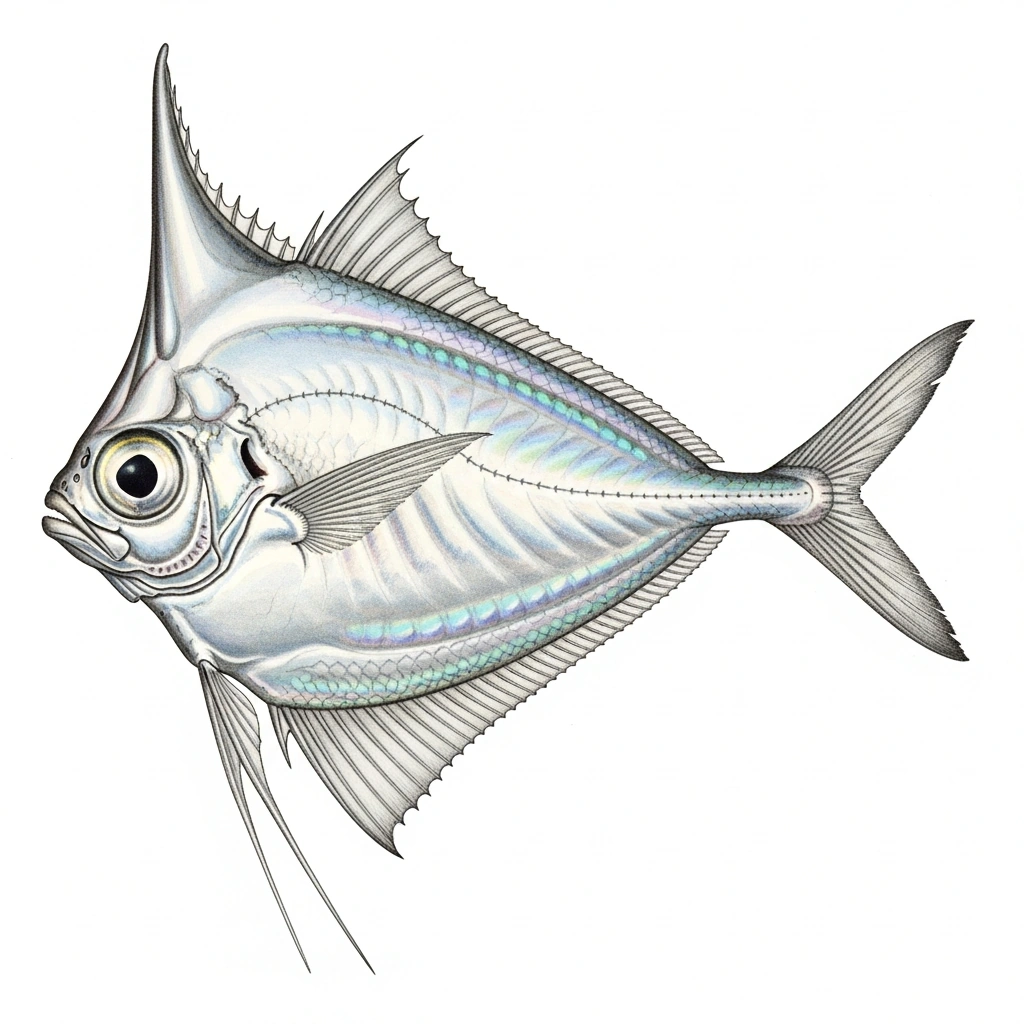
Silvery coastal fish with flat tall body. Very fun to catch on light tackle.
Identification
- Body
- Laterally compressed and very tall body with an extremely curved dorsal profile.
- Colouration
- Silvery with bluish reflections, often showing dark oblique bands when excited.
- Sexual dimorphism
- Absent/not pronounced
- Growth
- Moderate; grows quickly in the early years before stabilizing.
Taxonomy
- Family
- Carangidae
- Order
- Perciformes
- Class
- Actinopterygii
Related species
Habitat & distribution
- Environment
- Coast, Open sea, Reefs
- Preferred bottom
- Sand, Seagrass
- Geographic distribution
- Found in the Western Atlantic Ocean, from the shores of Canada down to Brazil, including the Gulf of Mexico and the Caribbean.
- Micro-habitat
- Often shelters near submerged structures like reefs, bridge pilings, and wrecks.
Adaptable to various coastal microhabitats, often near submerged human structures.
Presence by sea area
Diet
- Primary prey
- shrimp, small fish, small crustaceans
- Secondary prey
- small crabs, marine insect larvae, algae
- Occasional prey
- mollusk larvae, amphipod larvae
- Feeding behaviour
- Active predator, primarily feeding at dusk, using agility to chase swift prey.
- Natural predators
- groupers, mackerels, sharks, large tunas
Diet varies based on prey availability and seasonal environmental conditions.
Behaviour
- Activity
- diurnal
- Social behaviour
- small_groups
- Aggressiveness
- low
- Migration
- Resident, with possible slight seasonal movements toward warmer waters.
- Seasonal behaviour
- May be more active during warmer months when feeding activity increases.
- Juveniles
- Younger fish tend to stay closer to the shore and in shallower waters for protection.
- Adults
- Adults range further from the coast and tend to form small hunting groups.
Reproduction
- Spawning season
- June, July, August
- Spawning depth
- Between 10 and 30 meters
- Eggs
- Small, numerous pelagic eggs.
- Larval stage
- Planktonic larvae rely on currents for dispersal.
- Sexual maturity
- 2-3 years
When to catch Atlantic lookdown
Activity calendar
Activity by season
Best times
This species shows peak fishing activity in spring, summer and autumn, when the productivity index (FPI) reaches its highest values.
Fishing activity decreases in winter, when conditions are less favourable.
Ideal conditions
Atmospheric pressure
Active in schools near the coast.
Regular feeding.
Less active.
Water temperature
Where to catch it
Best spots
Bottom preference
Spot type
Fishing techniques
Recommended
Other applicable
Recommended baits
Baits by pressure
How to really catch it
The lookdown is a thin, tall flash of silver, with a sharply curved back and a downturned mouth, able to appear suddenly beside a piling or over a strip of sand. It is not a brutal predator but an agile, mobile hunter, and that is exactly why catching it consistently takes sharp observation, proper timing, and clean presentations.
🐟 Good to know
One real and useful biological point is its growth: it reaches maturity at 2-3 years and releases small, numerous pelagic eggs, while the larvae remain planktonic and are dispersed by currents. That ties the species to productive coastal systems, where juveniles and adults may use different zones.
🌊 Where & when
It is found from 1 to 50 meters over sand and seagrass, along the coast, on reefs, and also offshore, often near submerged structure such as reefs, bridge pilings, and wrecks. Juveniles stay closer to shore and shallower, while adults range farther out in small groups. It is diurnal, but feeds mainly at dusk, often becoming more active in the warmer months from March to November; from June to August it spawns between 10 and 30 meters.
🎣 How to really catch it
The most concrete approach is light spinning around pilings, sandy edges, reefs, and wrecks, using a 7-9 foot spinning rod, 10-15 lb monofilament, and a 20-25 lb fluorocarbon leader. A silver artificial lure works well because it matches small fish and shrimp, its typical prey; alternatively, a float or drift presentation with natural shrimp and light weights offers a discreet drop. Keep the retrieve lively but not frantic, allowing for its quick lateral bursts.
💡 The detail that makes the difference
The most defensible practical trick is simple: work the edge of the structure first, not the heart of the snag. Lookdown shelter near pilings, reefs, and wrecks, but also hunt over sand and seagrass; running the bait or lure along that boundary better imitates a passing prey item and avoids unnecessary hang-ups.
Catch & handling tips
- Fight
- Puts up a medium fight, with rapid side-to-side bursts.
- Handling
- Use a damp cloth to avoid damaging its silvery skin.
- Release
- Gently release back into water; ensure it swims away strongly.
Curiosities & culture
- Record catches
- Maximum documented size: up to about 48 cm in length (source: FishBase). IGFA All-Tackle record: 2.15 kg (4 lb 12 oz), caught in Florida (USA) in 2004.
- In the kitchen
- The fillet is prized for its white, delicate meat, often served fried or grilled.
- Cultural notes
- Often mentioned in sport fishermen's tales for its unique features and attractive appearance.
- Historical notes
- Historically fished in coastal waters since colonial times, valued for fresh consumption.