
Overview
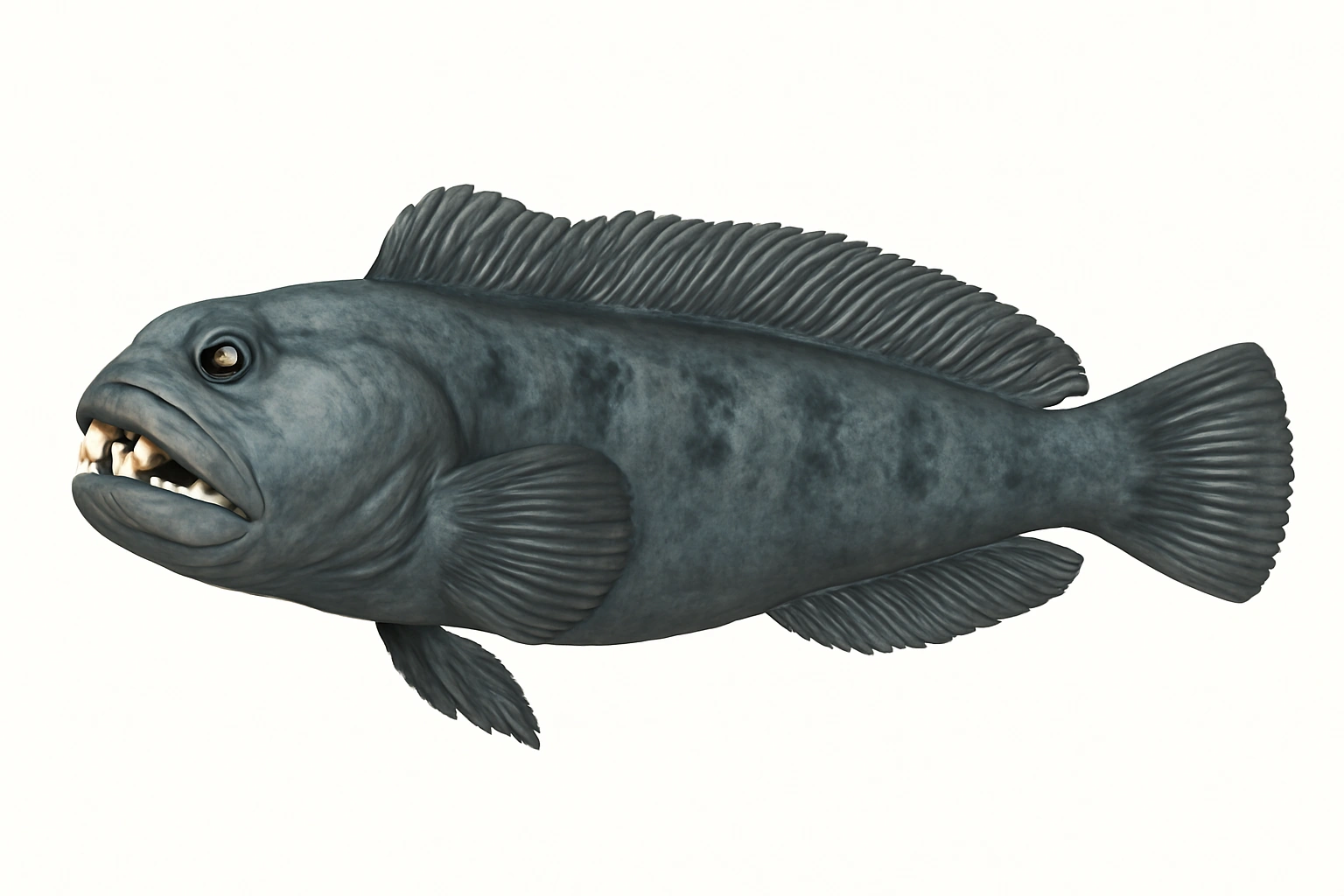
Solitary predator of cold Nordic waters. Possesses extremely powerful teeth for breaking mollusk and crustacean shells.
Identification
- Body
- Elongated and sturdy body, with a large, rounded head.
- Colouration
- Gray or brownish with dark spots, varying with depth and habitat.
- Sexual dimorphism
- Absent/barely noticeable
- Growth
- Slow, typical of cold-water species.
Taxonomy
- Family
- Anarhichadidae
- Order
- Perciformes
- Class
- Actinopterygii
Related species
Habitat & distribution
- Environment
- Coast, Deep sea
- Preferred bottom
- Rock, Mud
- Geographic distribution
- Found in the North Atlantic, from the coasts of Canada and Greenland to the coasts of Scandinavia and Iceland.
- Micro-habitat
- Prefers caves or crevices between rocks where it shelters and hunts.
Prefers rocky bottoms and uses crevices for shelter.
Presence by sea area
Diet
- Primary prey
- mollusks, crustaceans, sea urchins
- Secondary prey
- small fish, starfish, benthic crustaceans
- Occasional prey
- jellyfish, algae, crabs
- Feeding behaviour
- Solitary predator feeding mainly on the seafloor, using its powerful teeth to break prey shells.
- Natural predators
- orcas, large sharks, seals
Its powerful dentition allows it to crush hard-shelled prey.
Behaviour
- Activity
- diurnal
- Social behaviour
- solitary
- Aggressiveness
- medium
- Migration
- Resident, but may move slightly depending on weather conditions.
- Seasonal behaviour
- During summer months found at shallower depths to facilitate food hunting.
- Juveniles
- Young tend to hide among rocks to avoid predators.
- Adults
- Adults are more assertive in defending their territory and active in hunting.
Reproduction
- Spawning season
- September, October
- Spawning depth
- between 30 and 150 meters
- Eggs
- Eggs are large, adhesive, and laid on solid surfaces.
- Larval stage
- Benthic larvae that stay sheltered among the rocks until maturity.
- Sexual maturity
- 5-6 years
When to catch Atlantic wolffish
Activity calendar
Activity by season
Best times
This species shows peak fishing activity in spring, summer and autumn, when the productivity index (FPI) reaches its highest values.
Fishing activity decreases in winter, when conditions are less favourable.
Ideal conditions
Atmospheric pressure
Active, leaves den to hunt.
Regular activity.
Stays in den.
Stays in den.
Good hunting activity.
More active, leaves den.
Water temperature
Where to catch it
Best spots
Bottom preference
Spot type
Fishing techniques
Recommended
Other applicable
Recommended baits
Baits by pressure
How to really catch it
The Atlantic wolffish is not an open-water chaser: it is a heavy, solitary bottom predator that lives where rock opens into crevices and caves. Truly targeting it means fishing close to shelter, almost knocking at the door of an animal that defends its space and crushes shells with remarkable teeth.
🐟 Good to know
One notable biological trait of the Atlantic wolffish is its specialized feeding: it feeds mainly on mollusks, crustaceans, and sea urchins, using very strong teeth to break shells and other hard structures. This benthic diet clearly explains why it frequents rocky and muddy bottoms and stays so closely tied to the seabed.
🌊 Where & when
You find it in the North Atlantic, from the coasts of Canada and Greenland to Scandinavia and Iceland, between 20 and 500 meters, especially over rocky areas, submerged reefs, small caves, and also muddy bottoms. The most favorable months run from March to November, with easier access in summer, when it tends to move shallower to feed; between September and October it spawns from 30 to 150 meters.
🎣 How to really catch it
The most practical approach is bottom fishing with a vertical rig, worked slowly and precisely over rock, firm mud, and the mouths of hideouts. A bottom rod with 20-30 lb line, a steel leader, large single hooks, and heavy shovel sinkers lets you hold the bait where it really matters: crabs, mollusks, and fish fillets are the most consistent offerings for its diet. When it takes, the fight is vigorous and powerful, often staying tight to the bottom.
💡 The detail that makes the difference
The tip that really matters is not to fish too far off the bottom. The Atlantic wolffish feeds mainly on the seabed and shelters in crevices and caves: keeping the bait working just above rock or mud, rather than suspended in the water column, makes the presentation far more natural for a benthic, territorial species.
Catch & handling tips
- Fight
- Fights vigorously using its muscular strength.
- Handling
- Handle with care due to sharp teeth.
- Release
- Release at depth to minimize post-capture stress.
Curiosities & culture
- Record catches
- Maximum documented size: up to about 150 cm and 23.6 kg (source: FishBase). IGFA All-Tackle record: 23.6 kg (52 lb), caught at Georges Bank, Massachusetts (USA), in 1986.
- In the kitchen
- White and firm meat, used in Nordic stews and soups.
- Cultural notes
- Symbol of resilience and strength in Nordic culture.
- Historical notes
- Historically caught using pots and traps in cold seas.