
Overview
Venomous fish that lives buried in sand, ambush predator.
Identification
- Body
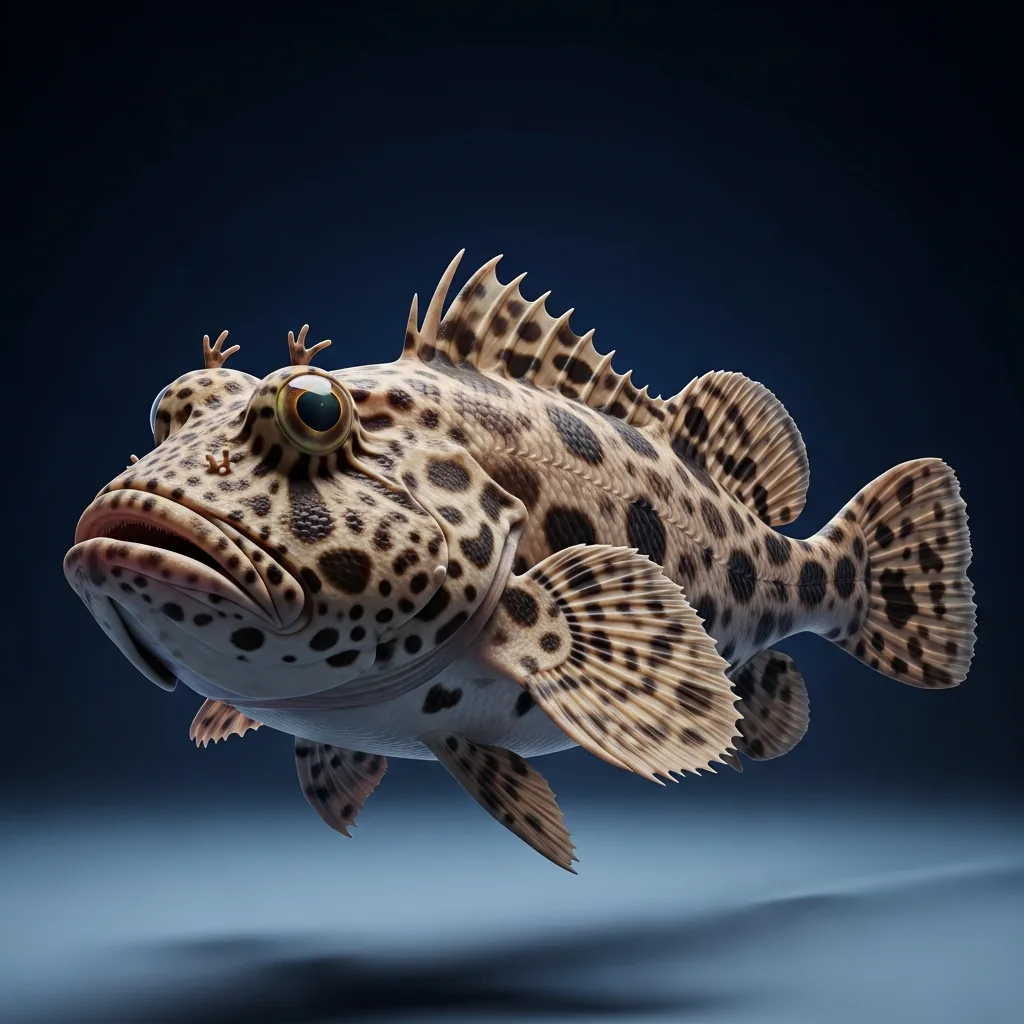
- Stocky and bulky body, with a large, flattened head.
- Colouration
- Main color is brown or gray with darker spots and stripes.
- Sexual dimorphism
- Absent/not noticeable
- Growth
- Slow, characteristic of species that live buried.
Taxonomy
- Family
- Uranoscopidae
- Order
- Perciformes
- Class
- Actinopterygii
Related species
Habitat & distribution
- Environment
- Coast, Open sea, Reefs
- Preferred bottom
- Sand
- Geographic distribution
- Common in the Mediterranean Sea, found in the coastal areas of the eastern Atlantic from the Bay of Biscay to West Africa.
- Micro-habitat
- Hides buried in the sand with only eyes and mouth exposed.
Relies mainly on sandy bottoms for camouflage and hunting.
Presence by sea area
Diet
- Primary prey
- small fish, shrimp, crustaceans
- Secondary prey
- annelids, mollusks, polychaetes
- Occasional prey
- squid, fish larvae
- Feeding behaviour
- Ambush predator, stays buried under the sand and strikes at prey when it gets close.
- Natural predators
- large carnivorous fish, seabirds, sharks
The ambush predation strategy is efficient for a buried organism.
Behaviour
- Activity
- nocturnal
- Social behaviour
- solitary
- Aggressiveness
- medium
- Migration
- Non-migratory, does not undertake significant seasonal migrations.
- Seasonal behaviour
- May be more active in warmer seasons, hunting for prey.
- Juveniles
- Young tend to hide in shallower waters and are more mobile.
- Adults
- Adults generally remain still and hidden under the sand, waiting for prey.
Reproduction
- Spawning season
- May, June
- Spawning depth
- between 20 and 60 meters
- Eggs
- Pelagic, transparent, small-sized eggs.
- Larval stage
- Pelagic larvae that drift with currents before settling on the seabed.
- Sexual maturity
- varies between 2 and 4 years
When to catch Atlantic stargazer
Activity calendar
Activity by season
Best times
This species shows peak fishing activity in spring, summer and autumn, when the productivity index (FPI) reaches its highest values.
Fishing activity decreases in winter, when conditions are less favourable.
Ideal conditions
Atmospheric pressure
Very active.
Regular activity.
Stays still on the seabed.
Water temperature
Where to catch it
Best spots
Bottom preference
Spot type
Fishing techniques
Recommended
Other applicable
Recommended baits
Baits by pressure
How to really catch it
The stargazer is a bottom predator that seems to vanish into the landscape: a broad head, upward-facing eyes, and a mouth ready to burst from the sand. Truly finding it means reading a seabed that looks empty and understanding where, beneath that pale skin of sand, it lies motionless in wait.
🐟 Good to know
One genuine peculiarity of the stargazer is the presence of an electric organ above the back, an unusual feature among coastal bottom fish. Added to this are upward-facing eyes and mouth, an anatomical design fully consistent with the life of an ambush predator buried in sediment.
🌊 Where & when
It lives on sandy bottoms along coasts, in open sea, and around reef areas, from very shallow water down to 150 meters, and is common in the Mediterranean and the eastern Atlantic. It becomes more interesting from spring through autumn, with greater activity in warmer seasons; between May and June it spawns at 20 to 60 meters.
🎣 How to really catch it
To really catch it, handlining or a classic bottom setup with a medium-heavy rod is the most practical route: 0.30 mm monofilament, a tough 0.40 mm fluorocarbon leader, long-shank size 2-4 hooks, and a 30-50 g olive sinker. Work coastal sand, sandbanks, and current-swept stretches, using shrimp, squid, sardine, or small fish pieces kept tight to the bottom.
💡 The detail that makes the difference
The small detail that makes the difference is not lifting the bait too far off the bottom: the stargazer hunts from below, often buried with only eyes and mouth exposed. If the bait stays in the immediate sand zone, near a slight channel or a seam of current, it enters the fish’s true strike space.
Catch & handling tips
- Fight
- Fights vigorously when hooked, but lacks significant stamina.
- Handling
- Beware of spines and mouth, use gloves if possible.
- Release
- Ensure the hook is properly removed and release the fish gently.
Curiosities & culture
- Record catches
- Maximum documented size: up to about 56 cm and 0.9 kg (source: FishBase). There is no official IGFA All-Tackle record for this species.
- In the kitchen
- Not particularly popular in cooking due to spines but sometimes used in mixed fish dishes.
- Cultural notes
- Known for its unique appearance and ability to produce a mild electrical shock.
- Historical notes
- Mentioned in some ancient fishery treaties for its peculiar habit of 'stargazing'.