
Overview
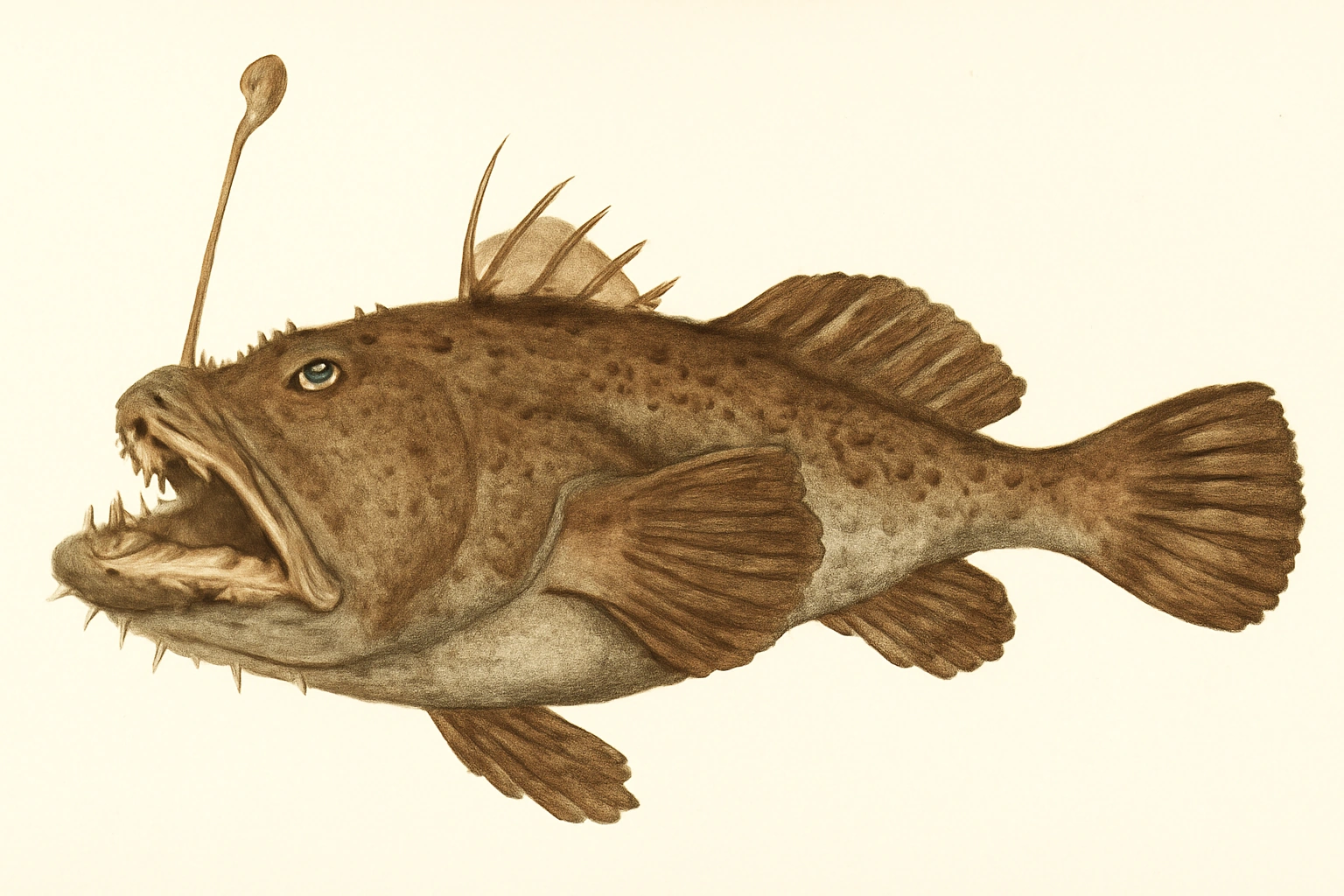
Unique-looking fish that camouflages on the bottom. Uses a biological lure on its head to attract prey.
Identification
- Body
- Flat, wide body with a large head and prominent mouth.
- Colouration
- Generally brown or gray with lighter spots for camouflage on the sea bed.
- Sexual dimorphism
- Absent/Not very evident
- Growth
- Slow, characteristic of many solitary benthic predators
Taxonomy
- Family
- Lophiidae
- Order
- Lophiiformes
- Class
- Actinopterygii
Related species
Habitat & distribution
- Environment
- Coast, Deep sea
- Preferred bottom
- Sand, Mud, Gravel
- Geographic distribution
- Found in the northeastern Atlantic, from Morocco to Norway, including the Mediterranean Sea.
- Micro-habitat
- Prefers to partially bury itself in sediment, blending into its surroundings.
Prefers soft or sandy bottoms where it can partially bury itself.
Presence by sea area
Diet
- Primary prey
- fish, crustaceans, squid
- Secondary prey
- cuttlefish, octopus, crabs
- Occasional prey
- eels, starfish
- Feeding behaviour
- Uses a lure on its head to attract prey, staying motionless until they are close enough to capture with a quick strike.
- Natural predators
- sharks, large predatory fish, humans
The lure on its head is a unique adaptation for effective feeding.
Behaviour
- Activity
- nocturnal
- Social behaviour
- solitary
- Aggressiveness
- medium
- Migration
- Sedentary, with possible small seasonal movements to deeper waters in colder months.
- Seasonal behaviour
- May shift to different depths with seasonal temperature changes.
- Juveniles
- Young prefer shallower waters, gradually adapting to deeper areas as they age.
- Adults
- Mostly stays immobile on the sea floor, waiting for prey while camouflaged.
Reproduction
- Spawning season
- April, May
- Spawning depth
- between 20 and 60 meters
- Eggs
- Eggs are pelagic, carried by currents until they hatch.
- Larval stage
- Larvae are pelagic and develop near the surface before sinking to the seabed.
- Sexual maturity
- 4-6 years
When to catch Monkfish
Activity calendar
Activity by season
Best times
This species shows peak fishing activity in spring, autumn and winter, when the productivity index (FPI) reaches its highest values.
Ideal conditions
Atmospheric pressure
More active, moves to search for food.
Regular activity, ambush on bottom.
Still on bottom, waits for prey.
Stays still on bottom.
Regular ambush activity.
Moves to search for prey.
Water temperature
Where to catch it
Best spots
Bottom preference
Spot type
Fishing techniques
Recommended
Other applicable
Recommended baits
Baits by pressure
How to really catch it
The anglerfish is a bottom predator that seems built to vanish into the landscape and strike without warning. When the seabed turns to sand, mud, or gravel and everything looks still, that is where its huge mouth can turn an ordinary patch of sea into a memorable encounter.
🐟 Good to know
One notable biological trait of the anglerfish is that its earliest life stages are not spent on the bottom: eggs and larvae are pelagic, carried by currents and developing near the surface before juveniles gradually descend toward the seabed. It is strongly benthic as an adult, but not from the very beginning.
🌊 Where & when
It lives in the northeastern Atlantic from Morocco to Norway, including the Mediterranean, from coastal waters to the deep sea, between 20 and 1000 meters. It is most fishable over sandy, muddy, or gravel bottoms, also near cliffs and in deep inlets. It is more active at night; in colder months it may shift somewhat deeper, while from April to May it spawns between 20 and 60 meters.
🎣 How to really catch it
To really fish for it, bottom fishing is the most concrete approach: a heavy jigging rod, 20-30 lb braid, a 40-60 lb fluorocarbon leader, circle hooks, and a sliding sinker let you work close to the seabed without losing contact. Drop over sand or mud, especially near changes in structure, and present natural baits such as squid, sardine, or cuttlefish so they stay stable and tight to the bottom, exactly where this fish waits in ambush.
💡 The detail that makes the difference
The detail that makes a difference is not to think of anglerfish as a fish to chase, but one to draw out of hiding. If the bottom is clean and the bait stays just above or resting on the sediment, in a place where it can partially bury and camouflage itself, you are matching the species' real hunting behavior.
Catch & handling tips
- Fight
- Initially resists, then surrenders quickly if hooked properly.
- Handling
- Handle with gloves to avoid spines and impacts from the mouth.
- Release
- Gently release close to the seabed to minimize stress.
Curiosities & culture
- Record catches
- Maximum documented size: up to about 200 cm and 58 kg (source: FishBase). IGFA All-Tackle record: 57.4 kg (126 lb 12 oz), caught at Sognefjorden (Norway) in 1996.
- In the kitchen
- Highly prized in cooking, particularly in soups and stews like brodetto and grilled tails.
- Cultural notes
- Also known as 'monster fish', it appears in many stories and cultures as live bait.
- Historical notes
- Once little valued, it has gained popularity in fish markets in recent decades.