
Overview
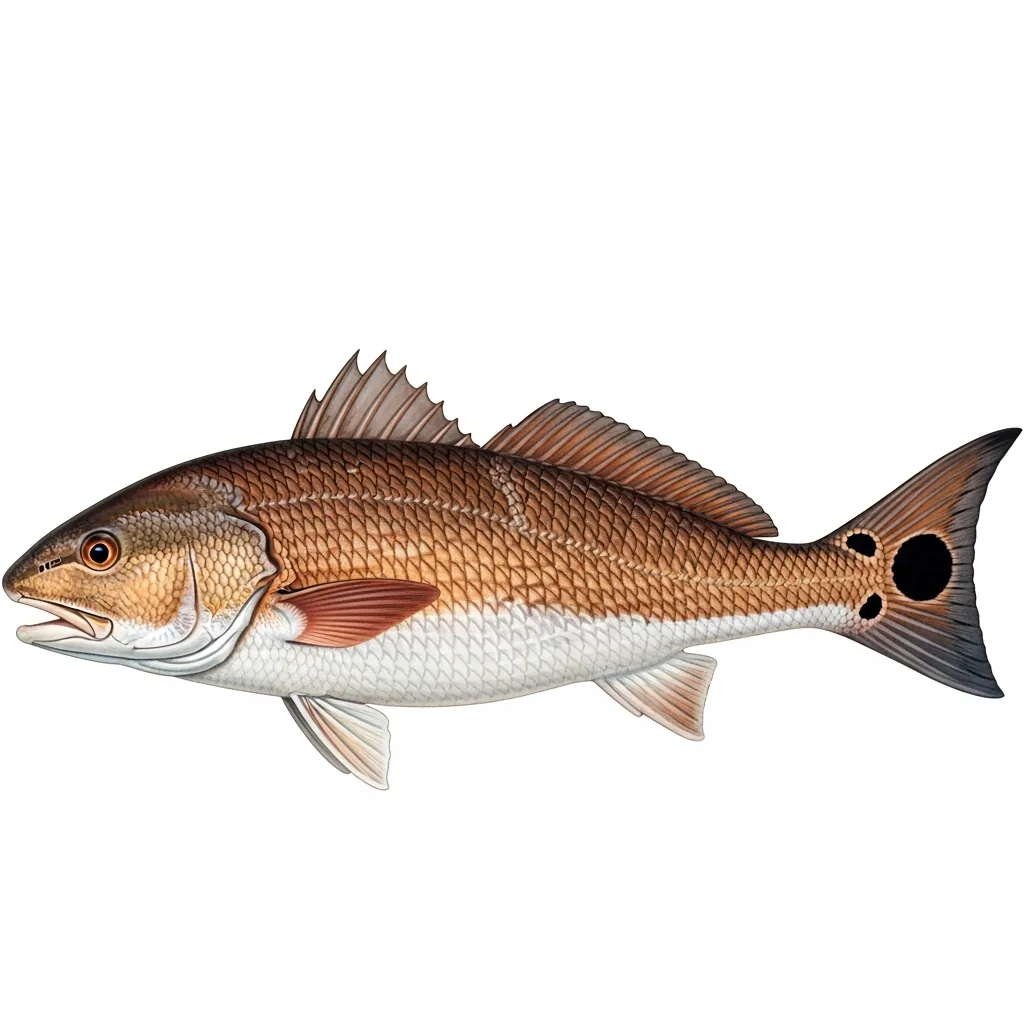
Iconic fish of the Gulf of Mexico, recognizable by the black spot on the tail.
Identification
- Body
- The body is robust and elongated, with a large head and fleshy lips.
- Colouration
- Coloration ranges from reddish to bronze. A distinctive black spot near the base of the tail.
- Sexual dimorphism
- Not very noticeable
- Growth
- Fast, especially in the early years of life
Taxonomy
- Family
- Sciaenidae
- Order
- Perciformes
- Class
- Actinopterygii
Related species
Habitat & distribution
- Environment
- Coast, Estuaries, Brackish
- Preferred bottom
- Sand, Mud, Seagrass
- Geographic distribution
- Common along the Atlantic coasts of North America, from Massachusetts to the Gulf of Mexico.
- Micro-habitat
- Often found in estuaries and shallow waters, hiding in seagrass beds.
Prefers sandy and muddy bottoms where it can camouflage and find food.
Presence by sea area
Diet
- Primary prey
- crabs, shrimp, mollusks
- Secondary prey
- small fish, octopus, squid
- Occasional prey
- algae, organic debris
- Feeding behaviour
- Opportunistic hunter, feeds by digging in sandy bottoms and estuaries, often in small groups.
- Natural predators
- sharks, fish eyes, water birds
Diet varies based on the availability of prey in the area.
Behaviour
- Activity
- diurnal
- Social behaviour
- small_groups
- Aggressiveness
- medium
- Migration
- Migrates to coastal waters in summer and moves to deeper waters in winter.
- Seasonal behaviour
- During warmer months, it approaches the shore, while in colder months it moves to deeper waters.
- Juveniles
- Juveniles live in shallow waters and prefer areas with marine vegetation.
- Adults
- Adults form small groups and move in coastal channels.
Reproduction
- Spawning season
- August, September, October
- Spawning depth
- between 1 and 4 meters
- Eggs
- Eggs are pelagic, spherical, and transparent, with a diameter of about 1 mm.
- Larval stage
- Larvae are planktonic and develop as fins and coloration grow.
- Sexual maturity
- 3-4 years
When to catch Red drum
Activity calendar
Activity by season
Best times
This species shows peak fishing activity in spring, summer and autumn, when the productivity index (FPI) reaches its highest values.
Fishing activity decreases in winter, when conditions are less favourable.
Ideal conditions
Atmospheric pressure
Very active, hunts aggressively.
Good activity in shallow areas.
Buries in mud, less mobile.
Water temperature
Where to catch it
Best spots
Bottom preference
Spot type
Fishing techniques
Recommended
Other applicable
Recommended baits
Baits by pressure
How to really catch it
The red drum is a powerful, practical coastal predator, one of those fish you seem to feel before you see it, when shallow water over sand and mud suddenly looks alive. If you really want to target it, you have to think like it does: search the bottom, read the channels, and place the bait where it digs to feed.
🐟 Good to know
A biological detail that often goes unnoticed is its downward-facing mouth with fleshy lips, together with a well-developed lateral line: traits consistent with feeding close to the bottom, where it detects and picks up prey such as crabs, shrimp, and mollusks among sand, mud, and seagrass.
🌊 Where & when
It occurs along the Atlantic coasts of North America, from Massachusetts to the Gulf of Mexico, especially in estuaries, river mouths, sandy beaches, and seagrass beds, from very shallow water down to deeper bottoms. It is most approachable from March to November, moving closer to shore in warmer months; in winter it tends to shift deeper. Between August and October it spawns in shallow water.
🎣 How to really catch it
The most concrete approach is bottom fishing, because red drum feeds by digging in the bottom and searching for benthic prey. Picture a simple rig with an egg sinker, a 30 lb fluorocarbon or mono leader, and a 2/0-4/0 circle hook, set on sand, mud, or the edges of seagrass in estuaries and river mouths. Fresh shrimp and crabs are key baits; squid is also valid, while spinning and surfcasting work well in the same coastal corridors.
💡 The detail that makes the difference
The most defensible tip is to focus your casts on the edges between bare bottom and marine vegetation, or along the coastal channels used by adults. This is not a random detail: juveniles seek cover in seagrass, adults move in small groups through channels, and the species feeds on the bottom. Placing the bait on that boundary better matches its real behavior.
Catch & handling tips
- Fight
- The red drum is known for its powerful runs and energetic fights.
- Handling
- Handle carefully to avoid excessive stress.
- Release
- Release gently back into the water, ensuring the fish is vital.
Curiosities & culture
- Record catches
- Maximum documented size: up to about 155 cm and 45 kg (source: FishBase). IGFA All-Tackle record: 42.69 kg (94 lb 2 oz), caught by David Deuel at Avon, North Carolina (USA), in 1984.
- In the kitchen
- Cherished for its white, tasty meat, often baked or grilled.
- Cultural notes
- Considered a symbol of energy and resilience in coastal cultures of the United States.
- Historical notes
- Historically fished by indigenous American communities for sustenance and trade.