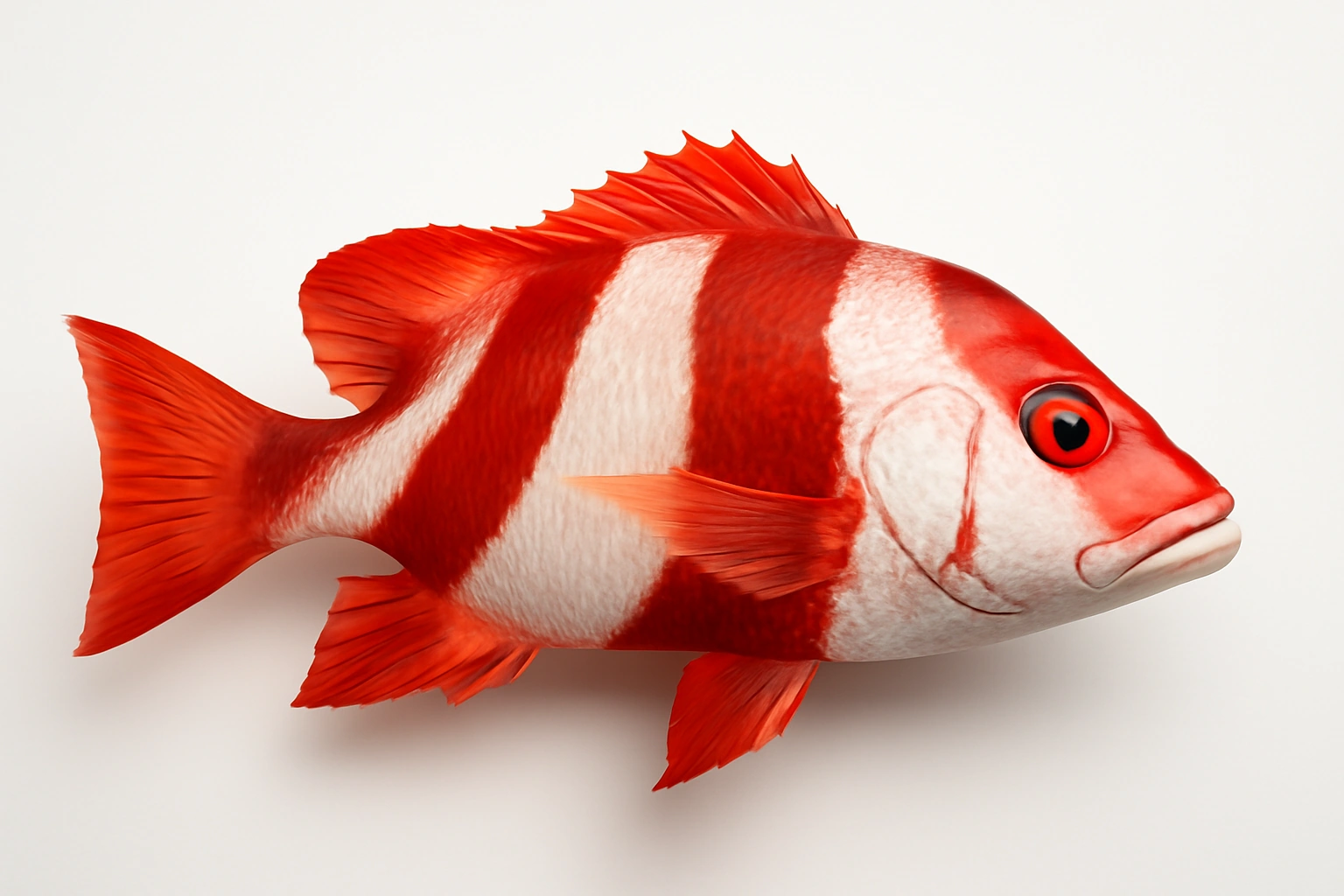

Overview
The Red Emperor is one of Australia's most prized reef fish. With its intense red colour and impressive size, it's both a trophy and excellent table fish. Found mainly in northern and Western Australian waters on deep coral bottoms.
Identification
- Body
- Elongated and robust body, with a convex forehead profile.
- Colouration
- Deep red coloration with light stripes on the sides.
- Sexual dimorphism
- Absent/not prominent
- Growth
- medium; they grow consistently until maturity.
Taxonomy
- Family
- Lutjanidae
- Order
- Perciformes
- Class
- Actinopterygii
Related species
Habitat & distribution
- Environment
- Coast, Reefs, Deep sea
- Preferred bottom
- Reef
- Geographic distribution
- Common in the tropical and subtropical waters of northern and Western Australia. Also found in the Red Sea and Arabian Sea.
- Micro-habitat
- Seeks refuge in coral structures and near deep rocky bottoms.
Coral structures provide both protection and a variety of prey.
Presence by sea area
Diet
- Primary prey
- crustaceans, small fish, squid
- Secondary prey
- shrimp, octopus, starfish
- Occasional prey
- algae, jellyfish
- Feeding behaviour
- Opportunistic predator, actively hunts on coral reefs and rocky bottoms.
- Natural predators
- hammerhead shark, groupers, barracuda, moray eels
Diet varies depending on the availability of seasonal prey.
Behaviour
- Activity
- diurnal
- Social behaviour
- small_groups
- Aggressiveness
- medium
- Migration
- resident
- Seasonal behaviour
- Active year-round, with feeding activity peaking during warmer months.
- Juveniles
- Juveniles tend to stay in shallower waters and near lagoons.
- Adults
- Adults move to deeper waters and prefer coral reefs.
Reproduction
- Spawning season
- June, July, August
- Spawning depth
- between 20 and 60 meters
- Eggs
- Pelagic, small and transparent.
- Larval stage
- Larvae are pelagic and develop in open water before settling on the bottom.
- Sexual maturity
- 3-4 years
When to catch Red Emperor
Activity calendar
Activity by season
Best times
This species shows peak fishing activity in spring, summer and autumn, when the productivity index (FPI) reaches its highest values.
Fishing activity decreases in winter, when conditions are less favourable.
Ideal conditions
Water temperature
Where to catch it
Best spots
Bottom preference
Spot type
Fishing techniques
Recommended
Other applicable
Recommended baits
Baits by pressure
How to really catch it
The red emperor is a rock-dwelling snapper with both presence and substance: vivid red, robust-bodied, large-eyed, and armed with a mouth built to hunt through reef and stone. When it starts feeding near deep structure, every bite feels like the start of a hard drive back to the bottom.
🐟 Good to know
Juveniles and adults do not use the same habitats with the same consistency: young fish more often remain in shallower water near lagoons, while adults move deeper and center their lives around coral reefs. That difference also helps read the likely size of fish holding on a given spot.
🌊 Where & when
It lives along coasts, reefs, and deep rocky bottoms from 10 to 200 meters, sheltering in coral structure, offshore shoals, and around submerged platforms. It is active year-round, but warmer months bring stronger feeding activity; from June to August it spawns between 20 and 60 meters.
🎣 How to really catch it
To truly target it, bottom fishing is the most concrete approach: drop a natural bait such as shrimp, squid, cuttlefish, or sardine tight to reef or deep rock, using a sturdy bottom rod, 30-50 lb braid, a 60-100 lb fluorocarbon leader, 3/0-5/0 hooks, and a quick-release sinker. Strike response matters, because its typical reaction is an immediate surge back down.
💡 The detail that makes the difference
The practical edge is to fish the structure itself, not just the general area: this opportunistic predator actively hunts over reef and rock, but also shelters there. Keeping the bait close to the productive edge of that cover, without lifting it too far off bottom, improves the chance of meeting a fish that is actually feeding.
Catch & handling tips
- Fight
- Fights vigorously with strong pulls towards the bottom.
- Handling
- Use gloves to prevent injury from spines.
- Release
- Return to water quickly to improve survival chances.
Curiosities & culture
- Record catches
- Maximum documented size: up to about 116 cm and 32.7 kg (source: FishBase). IGFA All-Tackle record: 21.14 kg (46 lb 10 oz), caught by Andrew Godley at Kitanoshima (Japan) in 2023.
- In the kitchen
- Considered an excellent table fish; often served roasted or grilled.
- Cultural notes
- Symbol of abundance and prosperity in some Pacific cultures.
- Historical notes
- Once caught with large-scale nets, fishing is now more regulated to protect the species.