
Overview
Very common grouper in the Gulf of Mexico. Creates its own burrows in the seabed and attracts other fish.
Identification
- Body
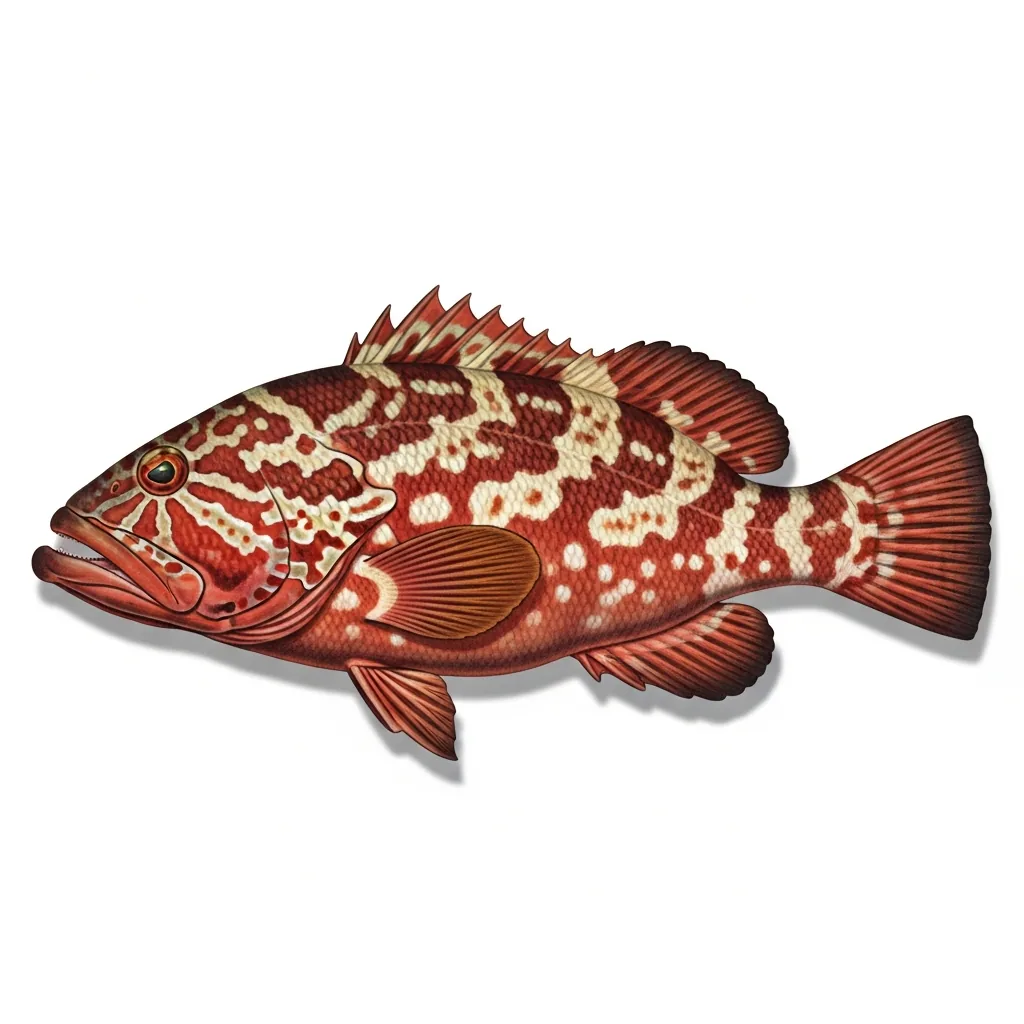
- Sturdy and elongated body with a large head and prominent mouth.
- Colouration
- Reddish or brown-red coloration with darker spots along the sides. Juveniles may have white stripes.
- Sexual dimorphism
- Absent/minimal
- Growth
- Medium, grows quickly in the first years and then slows down.
Taxonomy
- Family
- Serranidae
- Order
- Perciformes
- Class
- Actinopterygii
Related species
Habitat & distribution
- Environment
- Coast, Reefs, Open sea
- Preferred bottom
- Rock, Sand, Reef
- Geographic distribution
- Found in the Gulf of Mexico, along the western Atlantic coast from Alabama to northern Brazil.
- Micro-habitat
- Often hides in burrows dug into the seabed, used for shelter and ambushing prey.
Stable in areas with rocky formations and reefs that provide natural cover.
Presence by sea area
Diet
- Primary prey
- fish, crustaceans, squid
- Secondary prey
- shrimp, crabs, octopus
- Occasional prey
- small mollusks, fish larvae
- Feeding behaviour
- Ambush predator, often waits to surprise prey from hideouts in rocky bottoms.
- Natural predators
- sharks, large barracuda, killer whales
Prefers to hunt at night, using darkness to ambush prey.
Behaviour
- Activity
- nocturnal
- Social behaviour
- solitary
- Aggressiveness
- medium
- Migration
- Non-migratory, but exhibits seasonal movements for reproduction.
- Seasonal behaviour
- Becomes more active in the summer months during the breeding season.
- Juveniles
- Juveniles are more social and form small groups within reefs.
- Adults
- Adults are territorial and often stationary, preferring to stay in their shelters.
Reproduction
- Spawning season
- May, June, July, August
- Spawning depth
- between 20 and 60 meters
- Eggs
- Small pelagic eggs, laid in large numbers.
- Larval stage
- Larvae are pelagic and drift with currents before settling on the bottom.
- Sexual maturity
- 3-4 years
When to catch Red Grouper
Activity calendar
Activity by season
Best times
This species shows peak fishing activity in spring, summer and autumn, when the productivity index (FPI) reaches its highest values.
Fishing activity decreases in winter, when conditions are less favourable.
Ideal conditions
Water temperature
Where to catch it
Best spots
Bottom preference
Spot type
Fishing techniques
Recommended
Other applicable
Recommended baits
Baits by pressure
How to really catch it
The red grouper is a compact, powerful bottom predator built to stay tight to structure and strike from very close range. If you want to catch it for real, you have to enter its world: burrows dug into the seabed, reef edges, and that brief moment when it leaves the shadow and commits.
🐟 Good to know
Like other groupers, the red grouper produces pelagic eggs and passes through a pelagic larval stage before settling to the bottom. It is a key biological shift: from a larva carried by currents to a territorial, resident adult tied to specific shelters.
🌊 Where & when
You find it from 10 to 100 meters over rock, sand, and reefs, along coasts, banks, and open-sea grounds, especially where the bottom offers holes and cover. It is most appealing from March to November and becomes more active in summer, from May to August, when it also makes seasonal reproductive movements between 20 and 60 meters.
🎣 How to really catch it
The most concrete approach is bottom fishing or vertical fishing very close to the structure, with a 20-30 lb rod, 30-50 lb braid, 40-60 lb fluorocarbon leader, 3/0-5/0 circle hooks, and 100-200 g ball sinkers. Baits like live fish, squid, fresh crustaceans, and shrimp make perfect sense because they match its natural diet. On high spots, rocky reefs, and broken coastlines, the goal is to present the bait right on the bottom, at the entrance to the shelter.
💡 The detail that makes the difference
The key moment is not only the bite, but the first run after the hookup: red grouper tries immediately to get back into its hole. That is why it helps to fish with a setup already ready to lift it off the bottom in the first moments, especially on rocky spots where it lives as a territorial ambush predator.
Catch & handling tips
- Fight
- Strong resistance with attempts to retreat to dens once hooked.
- Handling
- Use gloves to avoid fin spines.
- Release
- Handle carefully to avoid damaging the gills; best released using a descending device.
Curiosities & culture
- Record catches
- Maximum documented size: up to about 125 cm and 23 kg (source: FishBase). IGFA All-Tackle record: 19.16 kg (42 lb 4 oz), caught by Del Wiseman Jr. in 1997.
- In the kitchen
- Highly appreciated in cooking; used in fish stews and grilled dishes.
- Cultural notes
- The red grouper is often considered a symbol of stability in traditional fishing ports.
- Historical notes
- Traditionally caught with handmade hooks and lines by Caribbean fishermen.