
Overview
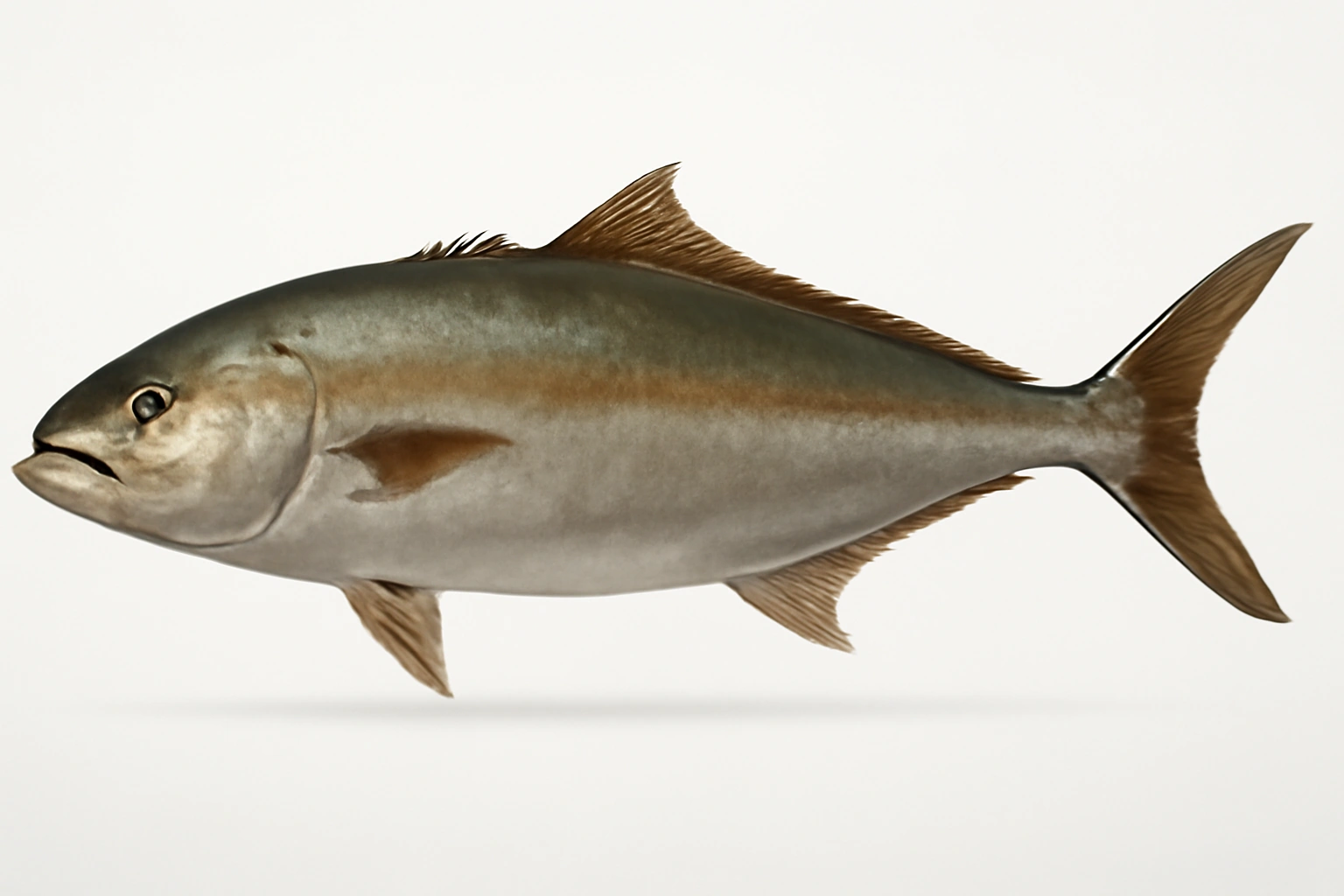
The Samson Fish is related to kingfish and is considered one of the most powerful fish in Australian waters. Endemic to southern and western Australia, it fights with brutal force, often powering towards the bottom. A true test for any tackle.
Identification
- Body
- Robust and streamlined body, similar to the Amberjack.
- Colouration
- Silvery-grey with golden reflections and dark horizontal bands along the sides.
- Sexual dimorphism
- Absent/not obvious
- Growth
- Moderate, with significant growth especially in the first five years.
Taxonomy
- Family
- Carangidae
- Order
- Carangiformes
- Class
- Actinopterygii
Related species
Habitat & distribution
- Environment
- Coast, Open sea, Reefs
- Preferred bottom
- Reef, Rock
- Geographic distribution
- Endemic to southern and western Australia, found in the temperate waters of the adjacent Indian Ocean.
- Micro-habitat
- Often hides near reefs and submerged structures while hunting.
In its range, it prefers areas with moderate currents and good cover.
Presence by sea area
Diet
- Primary prey
- small fish, squid, cuttlefish
- Secondary prey
- crustaceans, prawns, crabs
- Occasional prey
- jellyfish, plankton, fish eggs
- Feeding behaviour
- Active predator that swims quickly to chase its prey, using sight to spot and capture them in rocky environments.
- Natural predators
- sharks, tuna, seals
Its diet varies with the seasonal availability of prey.
Behaviour
- Activity
- diurnal
- Social behaviour
- small_groups
- Aggressiveness
- high
- Migration
- Sedentary, but moves between different depths based on water temperature.
- Seasonal behaviour
- More active in shallower waters during summer months for spawning, moving to deeper waters in winter.
- Juveniles
- Usually found near algae and rocks, hiding from larger predators.
- Adults
- Forms small groups and strongly defends its territory against intruders.
Reproduction
- Spawning season
- November, December, January
- Spawning depth
- Between 20 and 60 meters
- Eggs
- Pelagic eggs that are very small and transparent, often carried by currents.
- Larval stage
- Pelagic larvae that develop quickly, feeding on plankton and small aquatic organisms.
- Sexual maturity
- 3-4 years
When to catch Samson Fish
Activity calendar
Activity by season
Best times
This species shows peak fishing activity in spring, summer and autumn, when the productivity index (FPI) reaches its highest values.
Fishing activity decreases in winter, when conditions are less favourable.
Ideal conditions
Water temperature
Where to catch it
Best spots
Bottom preference
Spot type
Fishing techniques
Recommended
Other applicable
Recommended baits
Baits by pressure
How to really catch it
Samson Fish is a robust, high-strung and extremely powerful pelagic predator, one of those fish that turns a strike into a pure test of control. When it appears over a wreck or along a submerged reef, with clear water over hard structure, you immediately understand that finding it is not enough: you have to fish for it the right way.
🐟 Good to know
One biological detail that is often overlooked is that its eggs are pelagic: tiny, transparent and carried by currents. The larvae are pelagic as well and feed on plankton and small aquatic organisms before juveniles become more closely associated with algae, rocks and coastal structure.
🌊 Where & when
It lives from 10 to 200 meters around reefs, rocks, submerged ledges and wrecks, both along the coast and offshore, in the temperate waters of southern and western Australia. It is more active in shallower water during summer, when it spawns between 20 and 60 meters from November to January; in winter it tends to move deeper.
🎣 How to really catch it
The most reliable way to target it is vertical jigging over deep reefs, offshore rocks and wrecks, working close to the structure where it hunts from cover. Use medium-heavy jigging rods, 50-80 lb braid and an 80-100 lb fluorocarbon leader: squid, live bait, sardines or artificials all make sense because they match its diet of small fish and cephalopods. Once hooked, expect a hard dive toward the bottom.
💡 The detail that makes the difference
The practical edge is to keep your bait or jig tight to the structure without losing control of it for an instant. Samson Fish hunts by sight in rocky ground and often stays close to reefs and submerged obstacles: if you work too high in the water column, you are very often simply fishing above its head.
Catch & handling tips
- Fight
- Strong fighter that tends to dive towards the bottom once hooked.
- Handling
- Handle with care, avoid putting hands near the gills to prevent injury.
- Release
- Ensure the fish is well-oxygenated before release, supporting its body as it goes back into the water.
Curiosities & culture
- Record catches
- Maximum documented size: up to about 150 cm and 53 kg (source: FishBase). IGFA All-Tackle record: 29.75 kg (65 lb 9 oz), caught at Rottnest Island, Western Australia.
- In the kitchen
- Typically baked or grilled, appreciated for its firm and flavorful meat.
- Cultural notes
- Considered a trophy among sport fishermen, often the subject of legends and fishing exploits in Australia.
- Historical notes
- Historically, catching the Samson Fish posed a challenge for coastal Australians, becoming a symbol of a fisherman's strength and endurance.