
Overview
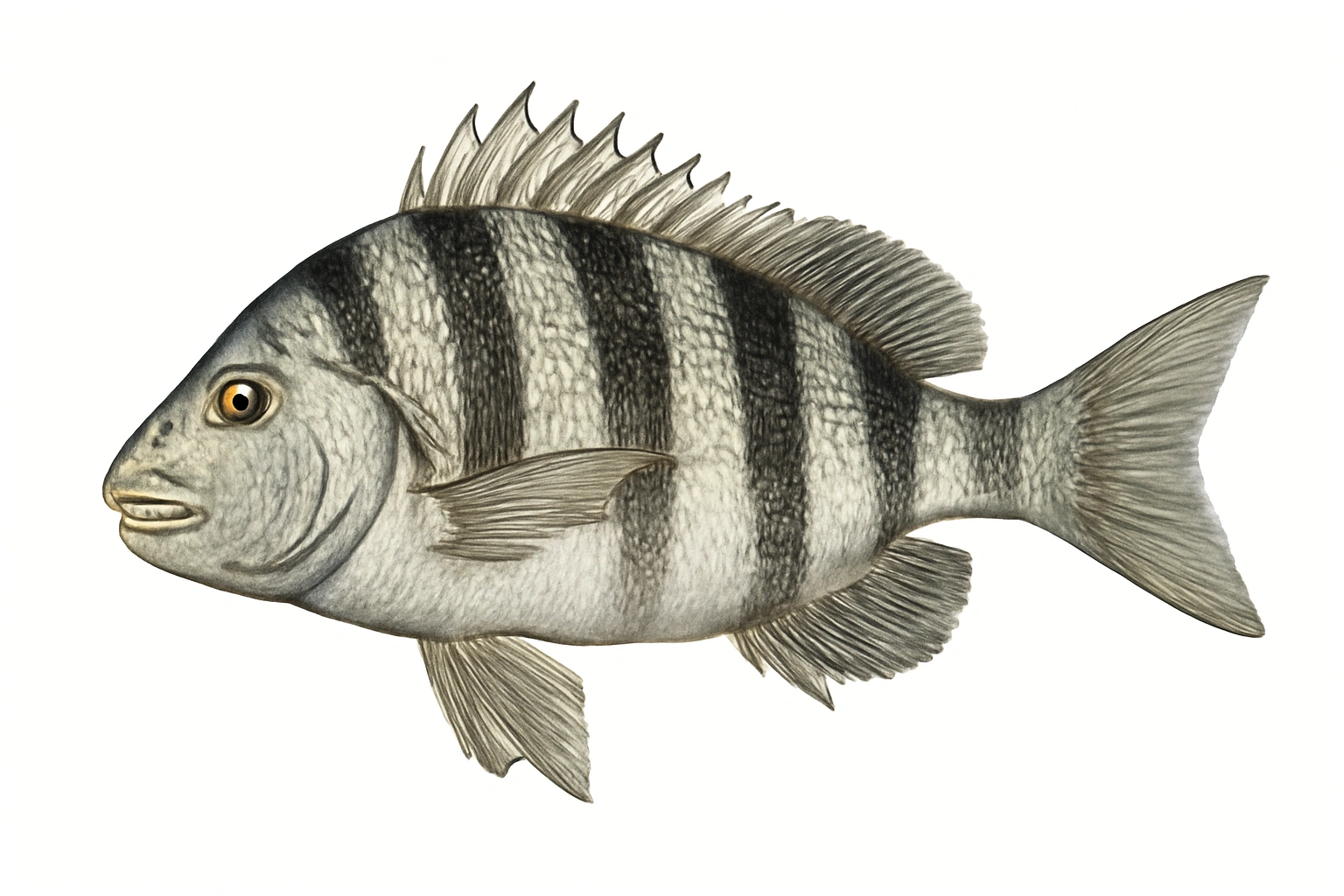
Fish with powerful bite and human-like teeth. Feeds on crustaceans and barnacles on submerged structures.
Identification
- Body
- Oval and laterally compressed body with a stubby head and strong teeth.
- Colouration
- Silvery color with dark vertical bands across the body, resembling a zebra.
- Sexual dimorphism
- Absent/not obvious
- Growth
- Medium, depending on food availability and habitat.
Taxonomy
- Family
- Sparidae
- Order
- Perciformes
- Class
- Actinopterygii
Related species
Habitat & distribution
- Environment
- Coast, Reefs, Estuaries
- Preferred bottom
- Rock, Reef, Estuarine
- Geographic distribution
- Found along the Atlantic coasts of the United States up to the Gulf of Mexico.
- Micro-habitat
- Prefers areas with submerged structures like bridge pilings and artificial structures where it can feed on crustaceans.
Submerged structures and rocky bottoms are important for effective hunting.
Presence by sea area
Diet
- Primary prey
- crustaceans, mollusks, barnacle
- Secondary prey
- small fish, annelids, algae
- Occasional prey
- sea urchins, coral
- Feeding behaviour
- Uses its sturdy teeth to crush and consume hard-shelled prey on submerged structures.
- Natural predators
- shark, greater barracuda, dolphins
Thanks to its unique teeth, it efficiently feeds on hard-shelled prey.
Behaviour
- Activity
- diurnal
- Social behaviour
- small_groups
- Aggressiveness
- medium
- Migration
- Resident with limited movements related to feeding cycles and seasons.
- Seasonal behaviour
- During colder months, moves closer to the coasts to spawn.
- Juveniles
- Juveniles often hide in shallow, vegetation-rich waters to protect themselves from predators.
- Adults
- Adults are more solitary or gather in small groups, especially during the spawning season.
Reproduction
- Spawning season
- March, April, May
- Spawning depth
- Between 2 and 10 meters
- Eggs
- Eggs are pelagic and float near the surface.
- Larval stage
- Larvae live in coastal waters and develop rapidly in protected areas.
- Sexual maturity
- 3-4 years
When to catch Sheepshead
Activity calendar
Activity by season
Best times
This species shows peak fishing activity in spring, summer and autumn, when the productivity index (FPI) reaches its highest values.
Fishing activity decreases in winter, when conditions are less favourable.
Ideal conditions
Atmospheric pressure
Active near structures.
Steady bite during the day.
Less active, hides.
Slow bite.
Good steady bite.
Very active.
Water temperature
Where to catch it
Best spots
Bottom preference
Spot type
Fishing techniques
Recommended
Other applicable
Recommended baits
Baits by pressure
How to really catch it
Sheepshead is a structure fish: you find it where concrete is encrusted, where pilings fade into green water, and every hard surface holds food. It has a compact body, bold vertical bars, and remarkable teeth built to crush shells: if you want to catch it consistently, you have to think the way it feeds.
🐟 Good to know
Its best-known feature is also highly functional: the front teeth look almost human, but they are mainly used to grip and work hard prey, while the overall robust dentition lets it crush crustaceans, mollusks, and barnacles gathered from submerged structure.
🌊 Where & when
It lives along the Atlantic coasts of the United States down to the Gulf of Mexico, around rocks, reefs, and estuaries, often in 1 to 15 meters of water. It becomes especially fishable around bridge pilings, docks, and artificial reefs, particularly in colder months when it moves closer to shore to spawn; from March to May it spawns between 2 and 10 meters.
🎣 How to really catch it
The most concrete way to target it is to fish tight to structure, from shore or boat, using natural baits such as crabs, shrimp, mussels, or clams. A sturdy 2.5-3 meter rod, 10-15 kg main line, 20-25 kg leader, strong medium-size hooks, and enough weight for the current let you place the bait where it feeds and stop it when it tries to dive back into rocks or pilings.
💡 The detail that makes the difference
The most defensible practical tip is simple: focus your casts or drops on the live side of the structure, the encrusted face swept by water, because that is where this sparid looks for barnacles, mollusks, and crustaceans. There is no need to fish far away: the right zone is often tight to the piling, dock edge, or artificial reef.
Catch & handling tips
- Fight
- Fighter and resilient, tends to seek refuge among rocks.
- Handling
- Handle cautiously to avoid spines on the dorsal fin.
- Release
- If released, it should be gently returned to the water, preferably in structured habitats.
Curiosities & culture
- Record catches
- Maximum documented size: up to about 91 cm and 9.6 kg (source: FishBase). IGFA All-Tackle record: 9.63 kg (21 lb 4 oz), caught at New Orleans, Louisiana (USA), in 1982.
- In the kitchen
- Valued for its white and firm meat, typically baked or fried.
- Cultural notes
- Often depicted in popular culture and known for its ability to adapt to various coastal environments.
- Historical notes
- Traditionally caught by artisan fishing along the American coasts for generations.