
Overview
Tropical predator found in coastal areas and mangroves.
Identification
- Body
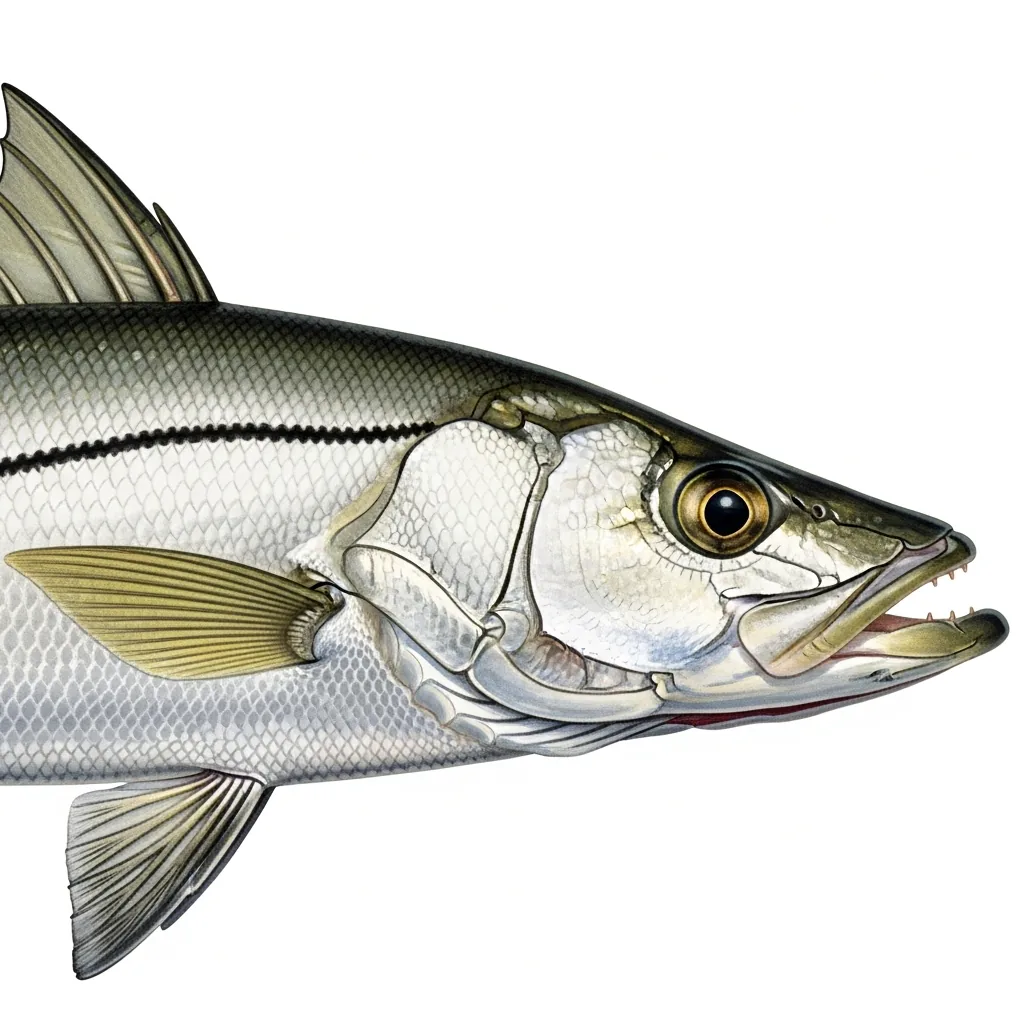
- Slim and elongated body with a characteristic large mouth.
- Colouration
- Silvery coloration with a darker back, often tending towards olive green or brown.
- Sexual dimorphism
- Absent/not very noticeable
- Growth
- Fast, especially in the early years of life.
Taxonomy
- Family
- Centropomidae
- Order
- Perciformes
- Class
- Actinopterygii
Related species
Habitat & distribution
- Environment
- Coast, Estuaries, Brackish
- Preferred bottom
- Sand, Mud, Seagrass
- Geographic distribution
- Found along the western Atlantic coast, from southern Florida to Brazil, including the Gulf of Mexico.
- Micro-habitat
- Often found near shores, mangroves, river mouths, and lagoons.
Prefers habitats with abundant cover and food availability.
Presence by sea area
Diet
- Primary prey
- small fish, crustaceans, shrimp
- Secondary prey
- crabs, mollusks, live bait
- Occasional prey
- insects, algae
- Feeding behaviour
- Prefers to hunt at dawn and dusk, using ambush tactics to surprise prey.
- Natural predators
- sharks, tarpon, sea cranes, humans
Uses ambush tactics to capture prey, exploiting low light conditions.
Behaviour
- Activity
- crepuscular
- Social behaviour
- solitary
- Aggressiveness
- medium
- Migration
- Resident, with small seasonal migrations between brackish and marine waters.
- Seasonal behaviour
- Moves closer to the shore during the warmer months for breeding and feeding.
- Juveniles
- Juveniles inhabit shallower, protected waters, such as lagoons.
- Adults
- Adults can be found in both brackish and marine waters, more active during twilight hours.
Reproduction
- Spawning season
- June, July, August
- Spawning depth
- between 5 and 15 meters
- Eggs
- Pelagic and transparent eggs, small in size.
- Larval stage
- Planktonic larvae that develop in coastal waters and later settle in protected habitats.
- Sexual maturity
- 3-4 years
When to catch Snook
Activity calendar
Activity by season
Best times
This species shows peak fishing activity in spring, summer and autumn, when the productivity index (FPI) reaches its highest values.
Fishing activity decreases in winter, when conditions are less favourable.
Ideal conditions
Atmospheric pressure
Very aggressive and reactive.
Good hunting activity.
Lethargic, hard to trigger.
Water temperature
Where to catch it
Best spots
Bottom preference
Spot type
Fishing techniques
Recommended
Other applicable
Recommended baits
Baits by pressure
How to really catch it
The snook is an elegant, high-strung predator, with a long body, a large mouth, and a dark lateral line that looks ink-drawn. It lives where water changes color and smell, between river mouth and sea, and there it delivers sharp strikes and hard fights marked by jumps and sudden surges.
🐟 Good to know
Snook eggs are pelagic and transparent, and the larvae are planktonic, developing in coastal waters before settling into more protected habitats. That detail matters: it helps explain why juveniles are common in lagoons and sheltered shallows, while adults move between brackish and marine water.
🌊 Where & when
Look for it along the western Atlantic coast, from southern Florida to Brazil and in the Gulf of Mexico, especially around mangroves, river mouths, lagoons, and sandy beaches over sand, mud, or seagrass. It is most catchable at dawn and through the fading light of dusk, with a strong season from March to November; in the warmer months it moves closer to shore, and from June to August it spawns between 5 and 15 meters.
🎣 How to really catch it
The most concrete way to catch it is light-but-powerful spinning in current lanes around river mouths, mangroves, and lagoons, using a medium-heavy spinning rod, 20-30 lb main line, and a fluorocarbon leader. Shrimp, small baitfish, and brightly colored artificials are ideal because they match its natural diet; if you fish natural bait, a 3/0-4/0 circle hook with a sliding sinker works well near the bottom or along edges where it sets ambushes.
💡 The detail that makes the difference
The practical edge is to present the bait along transition lines, where open water meets cover: a mangrove edge, a lagoon outlet, a river-mouth cut, the border of a seagrass bed. Snook hunts by ambush at dawn and dusk, and it often responds best when the bait tracks tight to the edge rather than crossing empty water.
Catch & handling tips
- Fight
- Fights vigorously with jumps and sudden runs.
- Handling
- Handle carefully to avoid injury to the mouth and gills.
- Release
- Ensure the fish is fully recovered before release.
Curiosities & culture
- Record catches
- Maximum documented size: up to about 140 cm and 24 kg (source: FishBase). IGFA All-Tackle record: 24.2 kg (53 lb 10 oz), caught at Parismina (Costa Rica) in 1978.
- In the kitchen
- Valued for its white, delicate flesh, often grilled or fried.
- Cultural notes
- Celebrated in coastal regions for its sporting nature and charm in local catches.
- Historical notes
- Snook fishing has been a tradition for generations in the coastal areas of the southern United States and the Caribbean.