
Overview
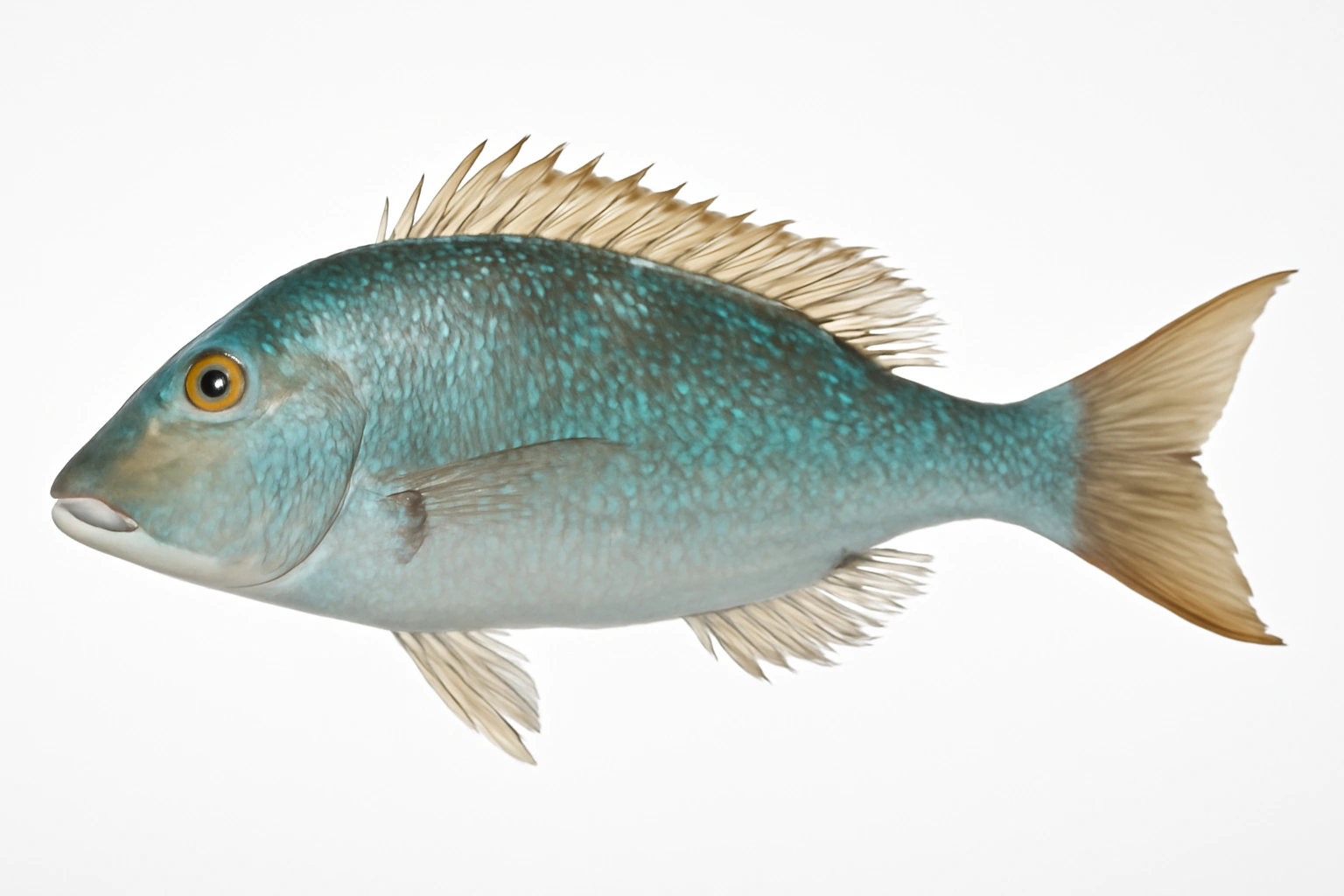
The Spangled Emperor is one of the most common reef fish in tropical Australian waters. With its silvery body speckled with blue, it's both beautiful and excellent eating. Often found on sandy bottoms near coral reefs.
Identification
- Body
- Strong, oval-shaped body, with a pointed snout.
- Colouration
- Silvery body with blue spots, fins with yellowish edges.
- Sexual dimorphism
- Absent/not very noticeable
- Growth
- Medium, well-adapted to reef environments.
Taxonomy
- Family
- Lethrinidae
- Order
- Perciformes
- Class
- Actinopterygii
Related species
Habitat & distribution
- Environment
- Reefs, Coast
- Preferred bottom
- Sand, Reef
- Geographic distribution
- The Spotted Emperor is found in the Indian Ocean and western Pacific, often along the coasts of Australia and the Red Sea.
- Micro-habitat
- Commonly found on sandy bottoms near coral reefs where it shelters and hunts.
Prefers areas with coral reefs for greater protection from predators.
Presence by sea area
Diet
- Primary prey
- mollusks, crustaceans, small fish
- Secondary prey
- annelids, echinoderms, algae
- Occasional prey
- plankton, organic debris
- Feeding behaviour
- Primarily feeds at night, searching for prey along sandy bottoms and around coral reefs.
- Natural predators
- sharks, large groupers, large predatory fish
Feasting near coral reefs provides a constant flow of prey attracted by the structure.
Behaviour
- Activity
- nocturnal
- Social behaviour
- small_groups
- Aggressiveness
- medium
- Migration
- Resides in one area with minor seasonal movements.
- Seasonal behaviour
- During colder seasons, it moves deeper, while in summer it approaches the shores.
- Juveniles
- Juveniles often form small groups in protected reef areas.
- Adults
- Adults tend to be solitary or in small groups, often near caves or complex coral structures.
Reproduction
- Spawning season
- October, November, December
- Spawning depth
- between 30 to 100 feet
- Eggs
- Pelagic, translucent, and small-sized eggs.
- Larval stage
- Larvae are pelagic and disperse with winds and currents before settling on the seabed.
- Sexual maturity
- Varies between 2 and 5 years
When to catch Spangled Emperor
Activity calendar
Activity by season
Best times
This species shows peak fishing activity in spring, summer and autumn, when the productivity index (FPI) reaches its highest values.
Fishing activity decreases in winter, when conditions are less favourable.
Ideal conditions
Water temperature
Where to catch it
Best spots
Bottom preference
Spot type
Fishing techniques
Recommended
Other applicable
Recommended baits
Baits by pressure
How to really catch it
The spotted emperor is a solid, wary bottom fish, with a pointed snout, large eyes, and a silvery body dusted with blue spots that disappears over pale sand and living coral. When it leaves cover to hunt along the reef edge, it is direct and powerful: to catch it consistently, you need to read the bottom before you ever feel the bite.
🐟 Good to know
An important biological trait of this species is its pelagic eggs: after spawning, the eggs remain suspended in the water column, and the larvae are dispersed by winds and currents before settling to the seabed. This is a key process in explaining how the species can populate coastal stretches and reef habitats that are far apart.
🌊 Where & when
It lives from 1 to 75 meters over sandy bottoms near coral reefs, along coasts, reef edges, tidal channels, and submerged rocky structures in the Indian Ocean and western Pacific, including the Red Sea and many Australian coasts. It is most interesting from spring through autumn, especially in summer when it moves closer to shore; in colder seasons it tends to shift deeper. It feeds mainly at night, and from October to December it spawns between 10 and 30 meters.
🎣 How to really catch it
If you want to catch it for real, the most concrete approach is bottom fishing on transition lines between sand and reef, where the fish shelters and hunts. Picture the sinker touching down on the reef margin, the fluorocarbon leader lying clean above the sand, and a natural bait such as squid, shrimp, sardine, or fish strips presented still and tidy on 4/0 to 6/0 circle hooks. A sturdy spinning rod, 20-30 lb braid, and 30-50 g bottom weights are enough to handle its short, powerful surges close to structure.
💡 The detail that makes the difference
The most defensible secret is simple: place your casts or drops on the sharp boundary between sandy patch and coral structure, not deep inside the coral. That is where the spotted emperor searches at night for mollusks, crustaceans, and small fish along the bottom, and where you are most likely to intercept it while keeping a natural bait in a true feeding lane.
Catch & handling tips
- Fight
- Fights vigorously with short, powerful runs.
- Handling
- Use gloves and be cautious of sharp fins.
- Release
- Quickly release after gentle retrieval to maintain the efficiency of the sensory organs.
Curiosities & culture
- Record catches
- Maximum documented size: up to about 87 cm and 8.4 kg (source: FishBase). There is no official IGFA All-Tackle record for this species.
- In the kitchen
- Highly valued in traditional baked or grilled fish dishes, common in Mediterranean and Asian cuisines.
- Cultural notes
- Considered a symbol of marine resilience due to its adaptation to tropical currents.
- Historical notes
- The fishing of the Spotted Emperor has ancient roots, being an important fish for coastal communities for centuries.