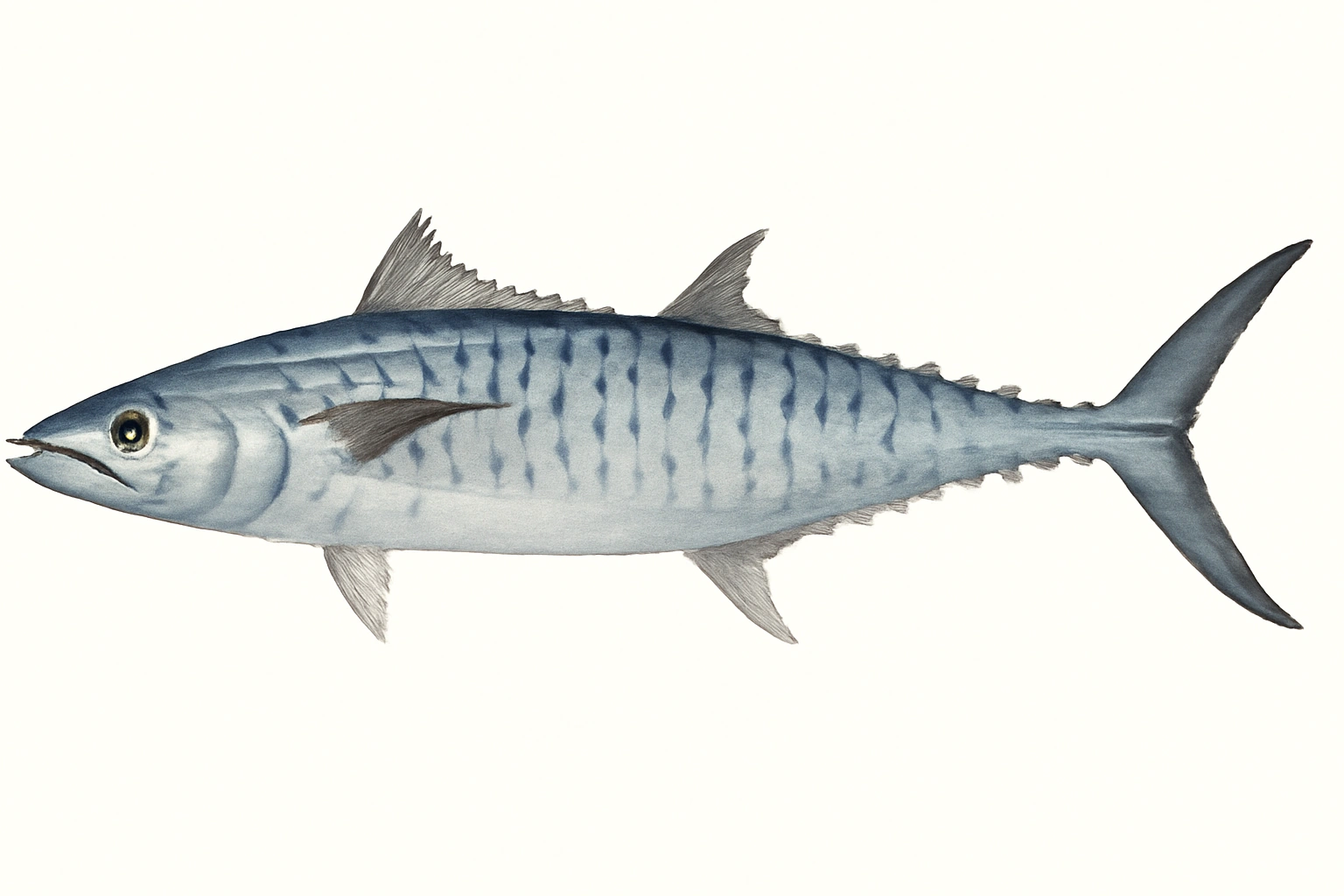

Overview
Large tropical pelagic predator, extremely fast and powerful. Hunts schools of small fish with lightning attacks.
Identification
- Body
- Long and slender body with a tapered head.
- Colouration
- Silvery body with dark, wavy lines along the sides.
- Sexual dimorphism
- Absent/barely noticeable
- Growth
- Fast, reaching significant sizes in just a few years.
Taxonomy
- Family
- Scombridae
- Order
- Scombriformes
- Class
- Actinopterygii
Related species
Habitat & distribution
- Environment
- Open sea, Coast, Reefs
- Preferred bottom
- Sand, Rock, Reef
- Geographic distribution
- Found in the warm waters of the Indian and Pacific Oceans, from the eastern coast of Africa to Japan and Australia.
- Micro-habitat
- Prefers warm waters near the coast and rocky sea floors; takes refuge in areas rich in prey.
Coral reefs offer habitat rich in prey and shelter.
Presence by sea area
Diet
- Primary prey
- anchovies, sardines, mackerels
- Secondary prey
- squids, shrimps, octopuses
- Occasional prey
- crustaceans, jellyfish
- Feeding behaviour
- Hunts in schools, exhibiting fast and coordinated attacks on schools of smaller fish.
- Natural predators
- sharks, tunas, orcas
Its diet primarily consists of pelagic fish abundant near coral reefs.
Behaviour
- Activity
- diurnal
- Social behaviour
- small_groups
- Aggressiveness
- medium
- Migration
- Undertakes seasonal migrations following warm currents and prey availability.
- Seasonal behaviour
- Most active during the warmer months, tends to move toward warmer waters.
- Juveniles
- Juveniles often hide in shallow waters near coral reefs.
- Adults
- Adults form small groups and relocate to open seas for hunting.
Reproduction
- Spawning season
- September, October, November
- Spawning depth
- between 20 and 60 meters
- Eggs
- The eggs are pelagic, transparent, and develop rapidly.
- Larval stage
- Larvae are small and transparent, following currents until finding safe shelter.
- Sexual maturity
- varies from 2 to 4 years
When to catch Spanish mackerel
Activity calendar
Activity by season
Best times
This species shows peak fishing activity in spring, summer and autumn, when the productivity index (FPI) reaches its highest values.
Fishing activity decreases in winter, when conditions are less favourable.
Ideal conditions
Atmospheric pressure
Very active on surface.
Hunts regularly.
Moves away from coast.
Moves away from coast.
Hunts along reefs.
Frantic surface attacks.
Water temperature
Where to catch it
Best spots
Bottom preference
Spot type
Fishing techniques
Recommended
Other applicable
Recommended baits
Baits by pressure
How to really catch it
The Indo-Pacific king mackerel is a large pelagic fish built to chase: a streamlined body, deeply forked tail, pointed head, and sharp teeth made for schooling predation. When it moves in to hunt near the coast, reefs, or open water, the strike is sudden and spectacular, and knowing where to intercept it changes everything.
🐟 Good to know
A remarkable biological trait of Scomberomorus commerson is its pelagic spawning strategy: eggs are released into open water, remain transparent, and develop quickly, while the larvae drift with currents until they find shelter. It is a typical strategy of large warm-water pelagic fishes.
🌊 Where & when
It lives in the warm waters of the Indian and Pacific Oceans, from the eastern African coast to Japan and Australia, between 10 and 200 meters, over sand, rock, reefs, open sea, and prey-rich coastal water. It is most active in the warmer months and follows favorable currents and bait; from September to November it spawns between 20 and 60 meters.
🎣 How to really catch it
To target it effectively, trolling is the most concrete approach: picture the wake slicing blue-green water along reef edges, sandy bottoms, and coasts where sardines, anchovies, and small mackerels gather. A heavy trolling rod with 20-30 lb braid, a 50 lb fluorocarbon leader, 4/0-6/0 hooks, and baitfish or live squid gives a believable presentation to a daytime hunter that attacks in small groups.
💡 The detail that makes the difference
The most reliable tip is to look for the fish where compact bait is present, not simply where the water looks promising. This species holds and hunts in prey-rich areas, so if you find tightly packed forage fish near reef, rock, or warm coastal water, you have already read half the right scene before even setting a bait.
Catch & handling tips
- Fight
- A vigorous fighter, performs fast runs and jumps out of the water.
- Handling
- Use gloves to avoid sharp teeth, handle with care.
- Release
- When releasing, be careful not to damage the fins and release quickly.
Curiosities & culture
- Record catches
- Maximum documented size: up to about 240 cm and 70 kg (source: FishBase). IGFA All-Tackle record: 44.91 kg (99 lb), caught in South Africa in 1982.
- In the kitchen
- Used in Thai and Filipino cuisine, often grilled or smoked.
- Cultural notes
- Valued in Southeast Asia and Pacific islands for its premium meat.
- Historical notes
- Has always held economic and cultural significance in the coastal societies of the Indian Ocean.