
Overview
Iconic predator of the American Atlantic coast, very combative and sought after.
Identification
- Body
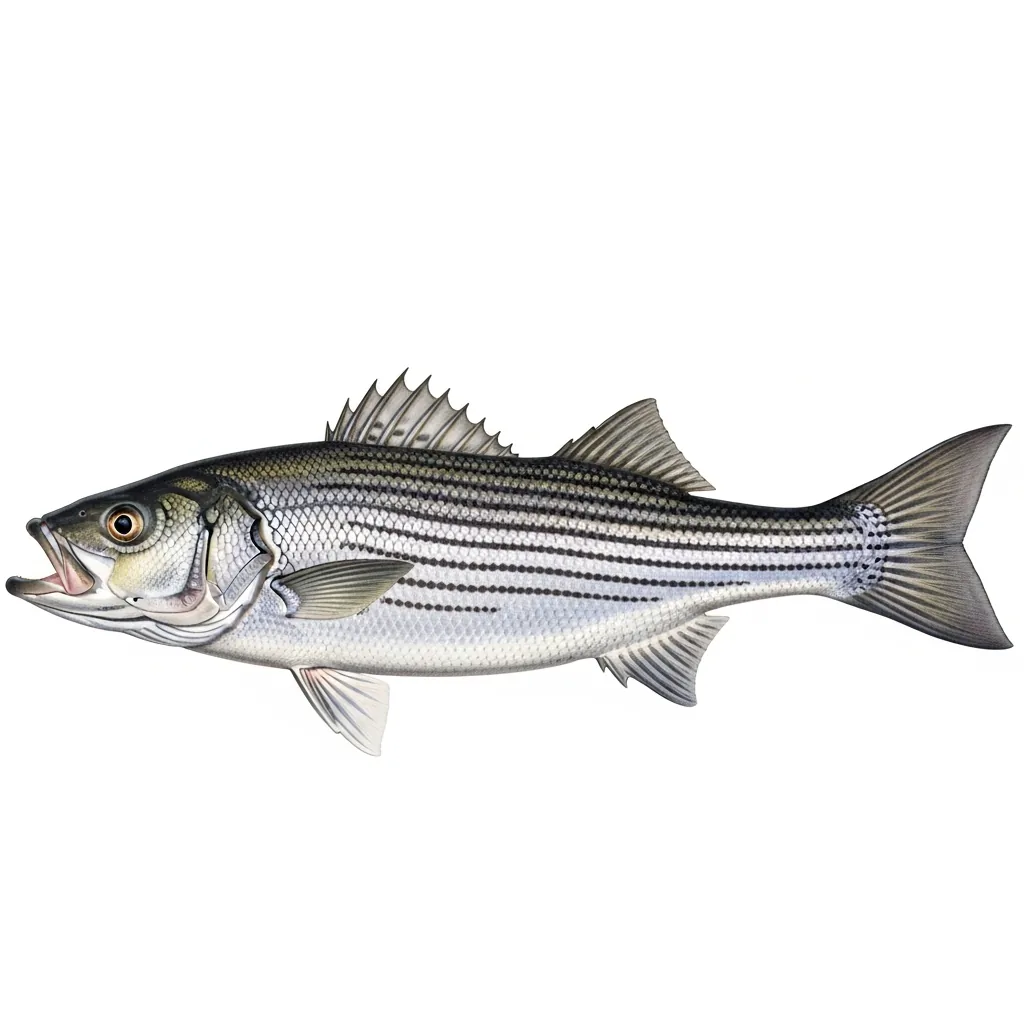
- Streamlined, robust body with a well-marked lateral line.
- Colouration
- Silvery color with dark horizontal stripes along the sides.
- Sexual dimorphism
- Absent/not noticeable
- Growth
- Fast growth in the early years, then slows down.
Taxonomy
- Family
- Moronidae
- Order
- Perciformes
- Class
- Actinopterygii
Related species
Habitat & distribution
- Environment
- Coast, Estuaries
- Preferred bottom
- Sand, Rock
- Geographic distribution
- Atlantic coasts of North America, from the Gulf of Mexico to Canada.
- Micro-habitat
- Prefers coastal areas and river mouths, often found under bridges or near structures.
Often found near submerged structures offering shelter and hunting opportunities.
Presence by sea area
Diet
- Primary prey
- small fish, crustaceans, mollusks
- Secondary prey
- aquatic insects, cephalopods, amphibians
- Occasional prey
- algae, small invertebrates
- Feeding behaviour
- Active predator, hunts in schools, uses keen eyesight to spot prey.
- Natural predators
- sharks, seabirds, seals
Adjusts its diet based on local prey availability.
Behaviour
- Activity
- diurnal
- Social behaviour
- small_groups
- Aggressiveness
- medium
- Migration
- Seasonal migrations along the coast for spawning.
- Seasonal behaviour
- Moves to coastal areas for breeding in spring and summer.
- Juveniles
- Juveniles tend to stay in brackish waters until maturity.
- Adults
- Adults often form small groups while hunting.
Reproduction
- Spawning season
- April, May, June
- Spawning depth
- between 30 and 200 feet
- Eggs
- Pelagic eggs that float until hatching.
- Larval stage
- Larvae float with currents until they mature.
- Sexual maturity
- 4-6 years
When to catch Striped bass
Activity calendar
Activity by season
Best times
This species shows peak fishing activity in spring, summer and autumn, when the productivity index (FPI) reaches its highest values.
Fishing activity decreases in winter, when conditions are less favourable.
Ideal conditions
Atmospheric pressure
Exceptionally active, attacks on surface.
Good activity, follows baitfish.
Less aggressive, moves deeper.
Water temperature
Where to catch it
Best spots
Bottom preference
Spot type
Fishing techniques
Recommended
Other applicable
Recommended baits
Baits by pressure
How to really catch it
The striped bass is a powerful, wide-ranging coastal predator, with a streamlined body, large mouth, and dark horizontal stripes that stand out the moment it breaks the surface. When it moves in to feed around river mouths, piers, and rocky edges, every cast can turn into a long, stubborn run that immediately tests both tackle and nerves.
🐟 Good to know
One notable biological trait of this species is its use of pelagic eggs: after spawning, the eggs remain suspended and float until hatching. The larvae also drift with the currents, a key stage in the species' dispersal through estuaries and along the coast.
🌊 Where & when
It lives along the Atlantic coasts of North America, from the Gulf of Mexico to Canada, using coasts, estuaries, and river mouths from 1 to 100 meters, often near bridges and other structure. It becomes especially approachable from March through November, with a marked push in spring and summer, when it moves toward the coast to breed; spawning takes place from April through June.
🎣 How to really catch it
To really catch it, spinning is the clearest match to its biology: make long casts and controlled retrieves around river mouths, bridge pilings, piers, and rocky beaches, where it hunts small fish in small groups and relies heavily on sight. A sturdy spinning rod, 15-30 lb line, and a 20-40 lb fluorocarbon leader give control during long runs; when fishing natural bait from piers or in current, live bait and cut bait on 4/0-6/0 circle hooks are a practical choice.
💡 The detail that makes the difference
A practical edge is to work the lure tight to structure, but not randomly across it: under bridges, along current seams, and at inlets, striped bass use cover and clean edges to ambush prey. Repeating neat presentations through the same water lane is defensible because this predator hunts in groups and tends to hold in favorable feeding zones.
Catch & handling tips
- Fight
- Strong and resilient, tends to make long runs.
- Handling
- Use gloves, support the body well to avoid injuries.
- Release
- Release carefully, ensuring it's well oxygenated.
Curiosities & culture
- Record catches
- Maximum documented size: up to about 200 cm and 57 kg (source: FishBase). IGFA All-Tackle record: 37.14 kg (81 lb 14 oz), caught by Gregory Myerson at Long Island Sound, Connecticut (USA), in 2011.
- In the kitchen
- Used to make soups and grilled dishes.
- Cultural notes
- Symbol of strength and endurance, popular in sport fishing.
- Historical notes
- Rich fishing history, essential for Atlantic coastal communities.