
Overview
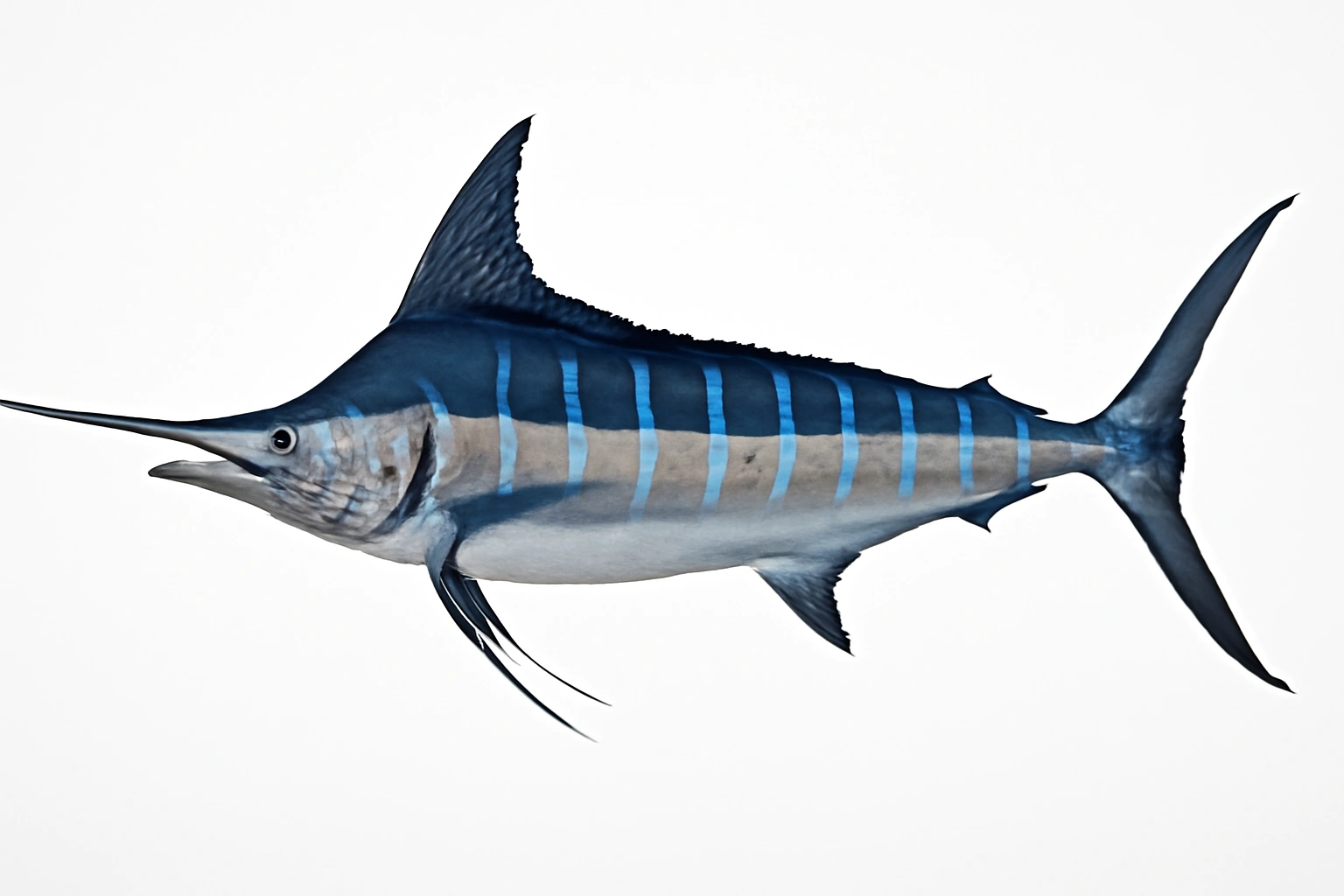
The Striped Marlin is one of the most sought-after big game fish in Australian waters. A spectacular aerial fighter, it can leap dozens of times during a fight. Fishing concentrates along the east coast, with Port Stephens as the marlin capital of the world.
Identification
- Body
- Slim and streamlined body with an elongated bill.
- Colouration
- Steel blue body with lighter vertical stripes, silvery belly.
- Sexual dimorphism
- Absent/not obvious
- Growth
- Fast in early life stages, growing considerably within a few years.
Taxonomy
- Family
- Istiophoridae
- Order
- Istiophoriformes
- Class
- Actinopterygii
Related species
Habitat & distribution
- Environment
- Open sea, Reefs, Pelagic
- Preferred bottom
- Open sea, Reefs
- Geographic distribution
- Found in tropical and subtropical waters of the Pacific Ocean, including the Indian and Atlantic Oceans.
- Micro-habitat
- Prefers to hunt near current-rich areas where prey is abundant.
Prefers warm seas with abundant currents that promote plankton and prey accumulation.
Presence by sea area
Diet
- Primary prey
- pelagic fish, squid, mackerel
- Secondary prey
- cephalopods, mackerel, needlefish
- Occasional prey
- crustaceans, jellyfish
- Feeding behaviour
- Active and voracious predator, uses its bill to hunt in open waters, even at the surface.
- Natural predators
- orcas, sharks, large pelagic fish
Uses its bill to stun and injure prey.
Behaviour
- Activity
- diurnal
- Social behaviour
- solitary
- Aggressiveness
- medium
- Migration
- Undertakes massive migrations based on seasons and currents.
- Seasonal behaviour
- During warmer months, they tend to be more active and move closer to shore to spawn.
- Juveniles
- Form small schools to enhance survival.
- Adults
- Solitary but may occasionally join small groups for hunting.
Reproduction
- Spawning season
- November, December
- Spawning depth
- between 20 and 60 meters
- Eggs
- Transparent, spherical pelagic eggs of very small size.
- Larval stage
- Pelagic larvae that grow rapidly and soon begin to behave like predators.
- Sexual maturity
- Varies between 2 and 5 years
When to catch Striped Marlin
Activity calendar
Activity by season
Best times
This species shows peak fishing activity in spring, summer and autumn, when the productivity index (FPI) reaches its highest values.
Fishing activity decreases in winter, when conditions are less favourable.
Ideal conditions
Water temperature
Where to catch it
Best spots
Bottom preference
Spot type
Fishing techniques
Recommended
Other applicable
Recommended baits
Baits by pressure
How to really catch it
Striped marlin is a sleek, large pelagic fish armed with a bill and built for open water, where it patrols currents, drop-offs, and reef edges in search of fast prey. When it appears in the spread or breaks the surface with its bright blue bars lit up, you immediately understand why chasing it is one of offshore fishing’s most intense tests.
🐟 Good to know
The vertical blue bars on a striped marlin are not just decorative: they can stand out strongly during active phases and near the surface, making the fish unmistakable when it lights up in the water. That is a real species trait, along with its tall dorsal fin and long bill.
🌊 Where & when
Look for it in open water from the surface down to 200 meters, especially around ocean slopes, coral banks, deep offshore water, and current-rich zones where pelagic fish and squid concentrate. It becomes more catchable in warmer months and through the long peak from March to November; from November to December it also tends to move closer to shore to spawn, between 20 and 60 meters.
🎣 How to really catch it
The most concrete approach is trolling: a sturdy trolling rod, 30-80 lb main line, 100-150 lb fluorocarbon or monofilament leader, and 8/0-10/0 circle hooks, pulling squid, sardines, baitfish, or live needlefish along current lines and drop-offs. If fish are showing high in the water, live baiting, drifting, or kite fishing with live needlefish become very credible options, because this species actively hunts in the upper layer as well.
💡 The detail that makes the difference
A practical edge is to work the seam of the current rather than the middle of slack water. Striped marlin hunt where prey gathers, often near reefs, drop-offs, and current lines: running a live or trolled bait right along that boundary matches its real biology and puts you in the right lane when it decides to rise and strike.
Catch & handling tips
- Fight
- Puts up a strong fight, performing spectacular jumps out of the water.
- Handling
- Use gloves to avoid cuts from scales and bill.
- Release
- Release quickly to minimize stress, keeping the head submerged to ensure good oxygenation.
Curiosities & culture
- Record catches
- Maximum documented size: up to about 4.2 m and 440 kg (source: FishBase). IGFA All-Tackle record: 224.1 kg (494 lb), caught by Bill Boniface at Tutukaka (New Zealand) in 1986.
- In the kitchen
- Marlin is prized for its firm and flavorful meat, famous in Hawaiian and Japanese cuisines.
- Cultural notes
- Symbol of strength and freedom in many Pacific coastal cultures.
- Historical notes
- Historically fished for its strength and endurance, a mark of prestige among sport anglers.