
Overview
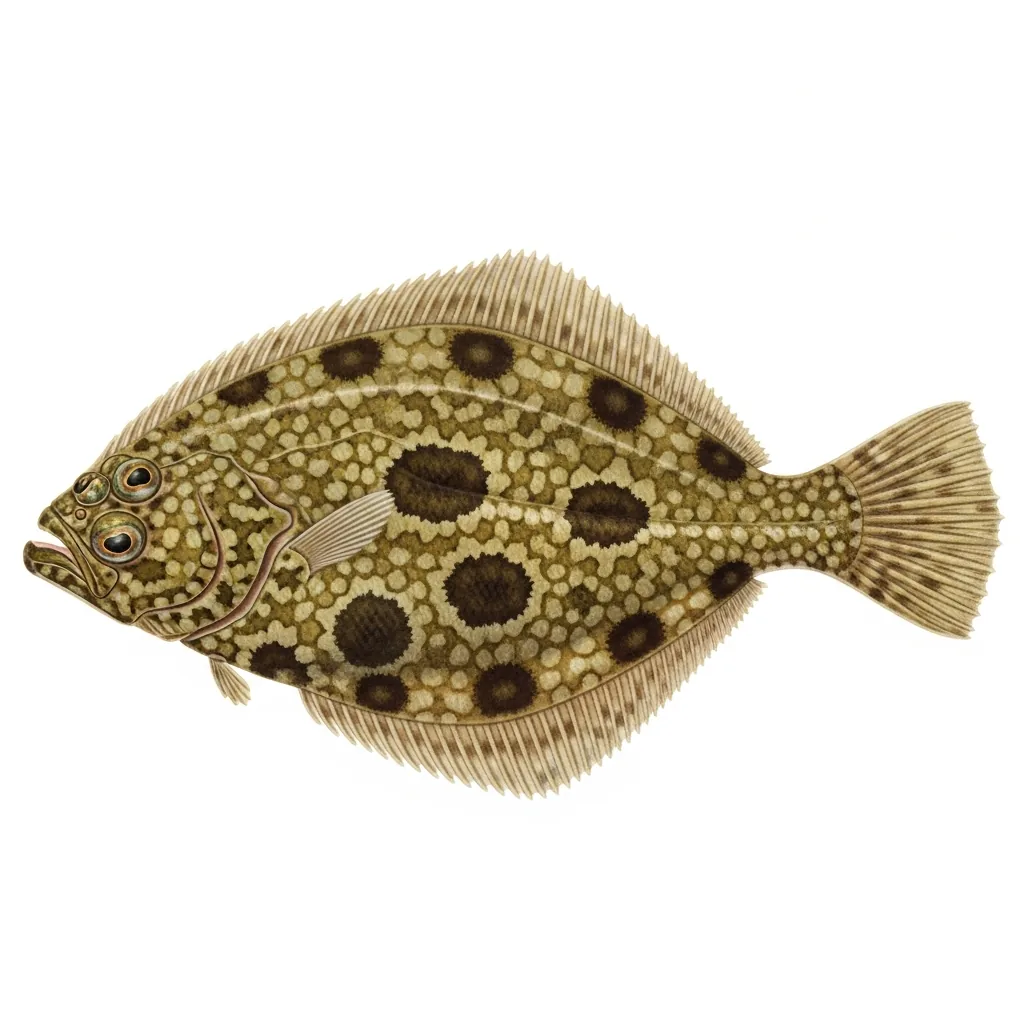
Very popular flatfish on the US Atlantic coast, also known as 'Fluke'. Active predator that camouflages on sandy bottoms.
Identification
- Body
- Flat body with eyes on one side, typical of flatfish.
- Colouration
- Brown coloration with spots that help camouflage on the sandy bottom.
- Sexual dimorphism
- Absent/not noticeable
- Growth
- Moderate, with faster growth in the initial years of life.
Taxonomy
- Family
- Paralichthyidae
- Order
- Pleuronectiformes
- Class
- Actinopterygii
Related species
Habitat & distribution
- Environment
- Coast, Open sea, Estuaries
- Preferred bottom
- Sand, Gravel
- Geographic distribution
- Along the U.S. Atlantic coast from Florida to New England.
- Micro-habitat
- Hides in sandy or gravelly bottoms to ambush prey.
Prefers coastal areas for spawning and feeding.
Presence by sea area
Diet
- Primary prey
- shrimp, crabs, small fish
- Secondary prey
- cephalopods, mollusks, amphipods
- Occasional prey
- insect larvae, seaweed, plankton
- Feeding behaviour
- Active predator using camouflage to surprise prey.
- Natural predators
- sharks, dolphins, larger fish, sea birds
Diet varies depending on prey availability.
Behaviour
- Activity
- diurnal
- Social behaviour
- solitary
- Aggressiveness
- low
- Migration
- Seasonal migrations along the coast for spawning.
- Seasonal behaviour
- Moves to deeper waters in winter and shallower waters in summer.
- Juveniles
- Juveniles remain in more coastal and shallow waters.
- Adults
- Adults tend to move to deeper waters.
Reproduction
- Spawning season
- May, June, July
- Spawning depth
- between 65 and 200 feet
- Eggs
- Small pelagic eggs that float.
- Larval stage
- Transparent larvae that live in plankton before settling on the bottom.
- Sexual maturity
- 3-4 years
When to catch Summer Flounder
Activity calendar
Activity by season
Best times
This species shows peak fishing activity in spring, summer and autumn, when the productivity index (FPI) reaches its highest values.
Fishing activity decreases in winter, when conditions are less favourable.
Ideal conditions
Water temperature
Where to catch it
Best spots
Bottom preference
Spot type
Fishing techniques
Recommended
Other applicable
Recommended baits
Baits by pressure
How to really catch it
The summer flounder is a refined bottom predator: nearly invisible on sand, then suddenly explosive, with a wide mouth lined with sharp teeth. To understand how to catch it, you have to think like it does—low to the bottom, eyes alert, waiting for the right moment.
🐟 Good to know
Like other flatfish, the summer flounder does not begin life in its final shape: as a larva it is transparent and lives in the plankton, then transforms during development and adapts to life on the bottom. It is a real and remarkable biological shift, closely tied to its camouflage-based hunting style.
🌊 Where & when
You find it along the U.S. Atlantic coast from Florida to New England, over sandy or gravelly bottoms in coastal waters, open sea, and estuaries. It becomes especially relevant from spring into autumn, when it also uses shallower water; in winter it tends to move deeper, and from May through July it makes seasonal spawning-related movements along the coast.
🎣 How to really catch it
To really fish for it, drifting over sand or gravel is the most direct reading of the species: let the boat carry you across clean bottom, river mouths, estuaries, or submerged rises, keeping the bait close to the seabed where flounder hide and hunt. Small baitfish, shrimp, and squid all match its diet; a light trolling rod, 15-20 lb braid, a 30 lb fluorocarbon leader, 2/0-3/0 circle hooks, and a 1-2 oz ball sinker help keep the presentation in the strike zone.
💡 The detail that makes the difference
The practical detail that changes a day is simple: stay on spots where an even bottom is broken by a slight rise or a transition from sand to gravel. Summer flounder is an ambush predator that relies on camouflage on the bottom; a bait presented tight to those bottom changes enters its natural attack lane.
Catch & handling tips
- Fight
- Erratic movements and attempts to dive to the bottom.
- Handling
- Avoid touching the gills, handle carefully to prevent skin damage.
- Release
- Make sure to handle with wet hands and release promptly back into the water.
Curiosities & culture
- Record catches
- Maximum documented size: up to about 12 kg (source: FishBase). IGFA All-Tackle record: 5.13 kg (11 lb 5 oz), caught at Jamaica Bay, New York (USA), in 2022.
- In the kitchen
- Highly appreciated in fried or baked dishes, often served with lemon juice.
- Cultural notes
- Popular in sport fishing along the U.S. Atlantic coast.
- Historical notes
- Considered an important resource for both commercial and recreational fishing along the Atlantic coast.