
Overview
The largest flatfish in the Western Atlantic. Very popular in the Gulf of Mexico, also caught by night gigging.
Identification
- Body
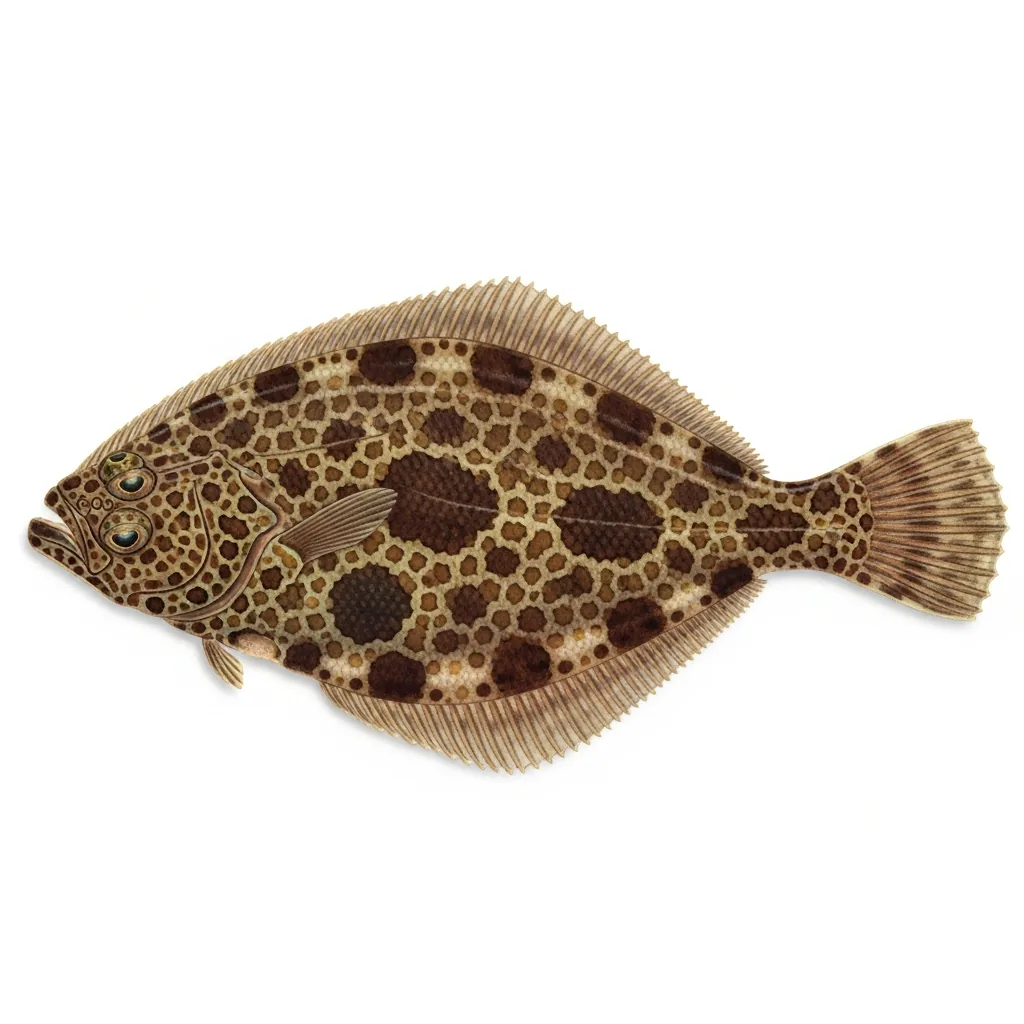
- Laterally flattened body with both eyes on the upper side.
- Colouration
- Olive-brown coloration with irregular black spots on the top side to blend with sandy bottoms.
- Sexual dimorphism
- Not very noticeable
- Growth
- Moderate, although growth can depend on environmental conditions and food availability.
Taxonomy
- Family
- Paralichthyidae
- Order
- Pleuronectiformes
- Class
- Actinopterygii
Related species
Habitat & distribution
- Environment
- Coast, Estuaries, Brackish
- Preferred bottom
- Sand, Mud, Seagrass
- Geographic distribution
- Along the Atlantic coast of the United States, from North Carolina to the Gulf of Mexico.
- Micro-habitat
- Prefers to partially bury in sandy or muddy bottoms, near underwater vegetation.
Southern flounders easily adapt to brackish habitats and show a preference for less disturbed areas.
Presence by sea area
Diet
- Primary prey
- shrimp, small fish, crustaceans
- Secondary prey
- crabs, insect larvae, mollusks
- Occasional prey
- annelids, seaweed
- Feeding behaviour
- Uses camouflage to silently approach prey, quickly lunging to catch it with its wide mouth.
- Natural predators
- sharks, large predatory fishes, seabirds
Its feeding method is closely tied to its ability to camouflage in its specific habitat.
Behaviour
- Activity
- nocturnal
- Social behaviour
- solitary
- Aggressiveness
- low
- Migration
- Undertakes seasonal migrations to deeper waters during winter.
- Seasonal behaviour
- Moves closer to coastal areas and estuaries during warmer months; migrates to deeper waters in winter.
- Juveniles
- Young tend to stay closer to the shore and sandy bottoms.
- Adults
- Adults inhabit more varied seabeds and can be found in both brackish and marine waters.
Reproduction
- Spawning season
- September, October, November
- Spawning depth
- between 20 and 60 meters
- Eggs
- Pelagic and transparent eggs, small size.
- Larval stage
- The larvae are planktonic, influenced by marine currents until they metamorphose at a young age.
- Sexual maturity
- 2-3 years
When to catch Southern Flounder
Activity calendar
Activity by season
Best times
This species shows peak fishing activity in spring, summer and autumn, when the productivity index (FPI) reaches its highest values.
Fishing activity decreases in winter, when conditions are less favourable.
Ideal conditions
Water temperature
Where to catch it
Best spots
Bottom preference
Spot type
Fishing techniques
Recommended
Other applicable
Recommended baits
Baits by pressure
How to really catch it
The southern flounder is a bottom predator that seems to vanish into the landscape, then suddenly appears in a short, sharp, precise strike. To really understand it, picture sand, slightly stained water, and a motionless outline waiting for the right moment.
🐟 Good to know
Like all flatfishes, it goes through a remarkable metamorphosis: in the larval stages the body is symmetrical, then one eye migrates to the upper side. In the adult of this species, the eyes are on the left side, a detail that also helps identify it with confidence.
🌊 Where & when
It lives along the Atlantic coast of the United States, from North Carolina to the Gulf of Mexico, in coastal waters, estuaries, and brackish areas, over sand, mud, and submerged vegetation, from 1 to 60 meters. In warmer months it moves closer to bays, estuaries, and shorelines; in winter it shifts offshore and deeper, including for autumn spawning between 20 and 60 meters.
🎣 How to really catch it
The most practical way to target it is bottom fishing, keeping the bait working close to the seabed where it lies partially buried. A medium-heavy spinning rod with 15-20 lb monofilament, a 20-30 lb fluorocarbon leader, size 1/0-3/0 circle hooks, and a 1/4 to 1 ounce egg sinker lets you present shrimp, dead fish, or crabs effectively in estuaries, sandy bays, vegetated areas, and near piers.
💡 The detail that makes the difference
The most dependable tip is simple: fish slowly and low, without lifting the bait too far off the bottom. Southern flounder hunts with camouflage and short lunges at shrimp, small fish, and crustaceans; a bait that stays in its visual lane, just above sand or mud, is intercepted far more naturally than a high, fast presentation.
Catch & handling tips
- Fight
- Puts up a fight but without excessive jumps or bursts, tends to resist using its flat body.
- Handling
- Handle with care to avoid damaging skin or fins.
- Release
- Gently release in shallow water for a safe recovery.
Curiosities & culture
- Record catches
- Maximum documented size: up to about 83 cm and 9.3 kg (source: FishBase). IGFA All-Tackle record: 9.33 kg (20 lb 9 oz), caught in 1983 (USA).
- In the kitchen
- Often used for fried fish dishes, very popular cooked 'meunière style'.
- Cultural notes
- Valued for its delicate white flesh, highly sought after by sport anglers.
- Historical notes
- The southern flounder has been traditionally fished for centuries, contributing to the economy of coastal communities in the Atlantic.