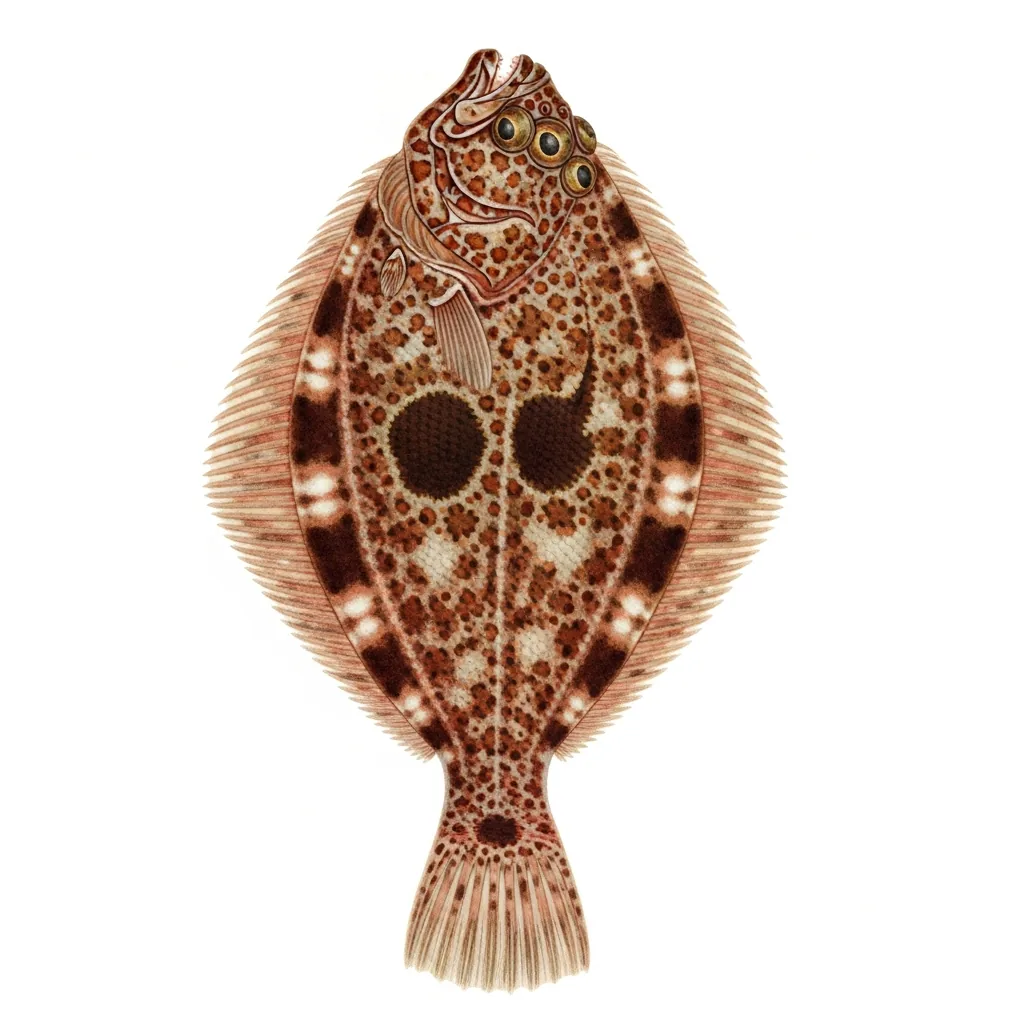

Overview
Classic New England flatfish. Caught mainly in winter and spring when waters are cold.
Identification
- Body
- Flat body with eyes on one side.
- Colouration
- Brown with irregular dark spots, lighter on the underside.
- Sexual dimorphism
- Absent/not very noticeable
- Growth
- Slow, typical of species in cold waters.
Taxonomy
- Family
- Pleuronectidae
- Order
- Pleuronectiformes
- Class
- Actinopterygii
Related species
Habitat & distribution
- Environment
- Coast, Estuaries, Brackish
- Preferred bottom
- Sand, Mud
- Geographic distribution
- Northeastern coasts of North America, from Labrador to Georgia.
- Micro-habitat
- Prefers to bury itself in sandy or muddy bottoms to hide from predators and ambush prey.
Prefers sandy and muddy bottoms near coasts and estuaries.
Presence by sea area
Diet
- Primary prey
- gastropods, bivalves, amphipods
- Secondary prey
- small crustaceans, annelid worms, zooplankton
- Occasional prey
- small fish, insect larvae
- Feeding behaviour
- Feeds on the sea floor, preying on small organisms by suction with its mouth.
- Natural predators
- sharks, seals, large predatory fish, seabirds
Favoring a benthic habitat, it has adapted to a diet of small bottom organisms.
Behaviour
- Activity
- diurnal
- Social behaviour
- solitary
- Aggressiveness
- low
- Migration
- Non-migratory, with small seasonal movements to deeper waters in summer.
- Seasonal behaviour
- In summer, tends to move to deeper, cooler waters to escape the heat.
- Juveniles
- Juveniles tend to stay nearshore in shallow waters.
- Adults
- Adults are mostly found in sandy and muddy bottoms.
Reproduction
- Spawning season
- March, April, May
- Spawning depth
- between 3 and 33 feet
- Eggs
- Small benthic and adhesive eggs.
- Larval stage
- Planktonic larvae that develop in the water column before settling on the bottom.
- Sexual maturity
- 3-4 years
When to catch Winter Flounder
Activity calendar
Activity by season
Best times
This species shows peak fishing activity in spring, summer and autumn, when the productivity index (FPI) reaches its highest values.
Fishing activity decreases in winter, when conditions are less favourable.
Ideal conditions
Water temperature
Where to catch it
Best spots
Bottom preference
Spot type
Fishing techniques
Recommended
Other applicable
Recommended baits
Baits by pressure
How to really catch it
The winter flounder is a discreet flatfish, nearly invisible when settled on sand and mud, with both eyes on the right side and an oval body pressed to the bottom. It is not memorable for a hard fight, but for its ability to vanish into the landscape; that is exactly why catching it consistently is subtler than it looks.
🐟 Good to know
Like other flatfishes, it spends an early planktonic larval stage in the water column and only later settles to the bottom, taking on its typical benthic life. In this species, the eggs are benthic and adhesive, a useful combination for keeping the spawn close to the substrate in shallow water.
🌊 Where & when
You find it along the northeastern coasts of North America, from Labrador to Georgia, mainly over sandy or muddy bottoms in coastal waters, estuaries, and brackish areas. It is most approachable from spring into autumn; from March to May it also uses shallow bottoms between 1 and 10 meters for spawning, while in summer it tends to shift somewhat deeper into cooler water.
🎣 How to really catch it
The most practical approach is a handline or a light bottom-fishing rod, with 10-15 lb line and 10-15 lb fluorocarbon leader, size 4-6 hooks, and just enough weight to keep the bait on the bottom without making it stiff. Fish sand, mud, estuaries, and areas near sandy bars with shrimp, annelids, or mollusks: winter flounder feeds on the bottom by suction, so the bait should stay low, natural, and nearly still.
💡 The detail that makes the difference
The real edge is not lifting the bait too far off the bottom. A buried winter flounder sees more passing over it than it seems, but it feeds on small benthic organisms close to the substrate: if the sinker is light and the bait just brushes sand or mud, the presentation becomes more believable.
Catch & handling tips
- Fight
- Tends to offer little resistance and is often brought to the surface with ease.
- Handling
- Handle carefully from the flat side to avoid damaging the skin.
- Release
- Gently release onto the bottom to minimize stress.
Curiosities & culture
- Record catches
- Maximum documented size: up to about 64 cm and 3.6 kg (source: FishBase). IGFA All-Tackle record: 3.17 kg (7 lb), caught at Fire Island, New York (USA), in 1986.
- In the kitchen
- Excellent when steamed or grilled, often paired with potatoes in the traditional dish 'Fish and chips'.
- Cultural notes
- An integral part of recreational fishing in New England.
- Historical notes
- Important fishery in New England, traditionally caught since the early days of colonization.