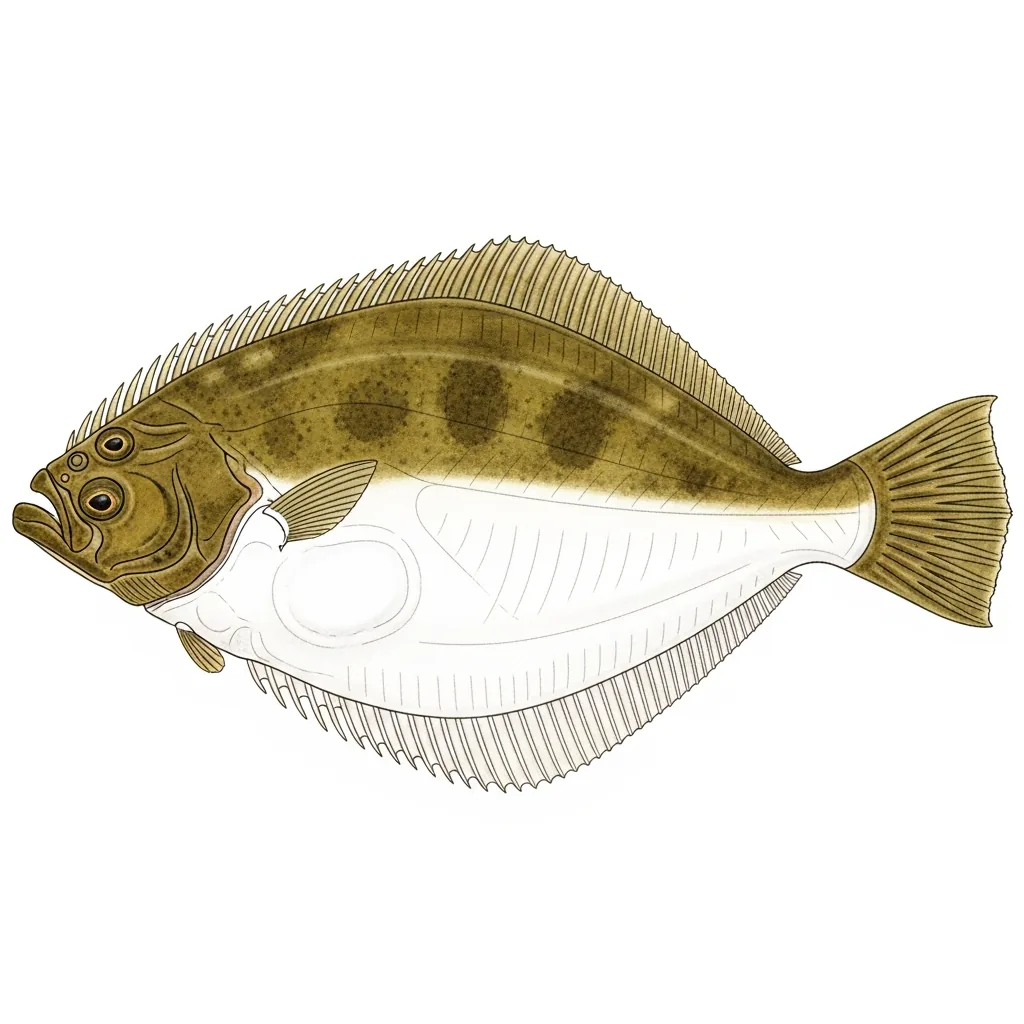

Overview
Different from Pacific halibut, this flatfish lives in shallow coastal waters. Highly sought-after in California.
Identification
- Body
- Flat and asymmetrical body with both eyes on the left side.
- Colouration
- Dark brown color on the upper side and white on the lower side.
- Sexual dimorphism
- Not very evident
- Growth
- Medium, with faster growth in the early years.
Taxonomy
- Family
- Paralichthyidae
- Order
- Pleuronectiformes
- Class
- Actinopterygii
Related species
Habitat & distribution
- Environment
- Coast, Open sea
- Preferred bottom
- Sand, Mud, Gravel
- Geographic distribution
- Found along the coasts of North America, from Alaska to Baja California.
- Micro-habitat
- Prefers sandy and muddy bottoms, often near estuaries and coastal bays.
Adapts well to temperature variations in coastal waters.
Presence by sea area
Diet
- Primary prey
- small fish, mullet, anchovies
- Secondary prey
- crabs, shrimp, squid
- Occasional prey
- sea anemones, small mollusks
- Feeding behaviour
- Aggressive hunter, camouflages on the seabed to ambush prey.
- Natural predators
- sharks, sea lions, humans
Opportunistic predator with a varied diet, depending on availability.
Behaviour
- Activity
- nocturnal
- Social behaviour
- solitary
- Aggressiveness
- low
- Migration
- Resident, with slight seasonal movements for spawning.
- Seasonal behaviour
- Active primarily during warm seasons; moves to deeper waters in winter.
- Juveniles
- Young live in shallower waters and camouflage to escape predators.
- Adults
- Adults tend to live solitarily or in small dispersed groups.
Reproduction
- Spawning season
- April, May, June
- Spawning depth
- between 20 and 60 meters
- Eggs
- Pelagic, transparent, small eggs, dispersed in the water.
- Larval stage
- Larvae are pelagic and develop quickly swimming with the water column.
- Sexual maturity
- 3-4 years
When to catch California Halibut
Activity calendar
Activity by season
Best times
This species shows peak fishing activity in spring, summer and autumn, when the productivity index (FPI) reaches its highest values.
Fishing activity decreases in winter, when conditions are less favourable.
Ideal conditions
Water temperature
Where to catch it
Best spots
Bottom preference
Spot type
Fishing techniques
Recommended
Other applicable
Recommended baits
Baits by pressure
How to really catch it
California halibut looks like a shadow laid across the bottom, almost invisible until it decides to move. It is an ambush predator of shallow coastal grounds, and that quiet nature is exactly what makes it a fish you catch by reading sand, current, and silence.
🐟 Good to know
Like other flatfish, it undergoes a remarkable metamorphosis when young: the body flattens and both eyes end up on the same side, in this species the left. This true asymmetry is a real specialization that lets it live tight to the seabed and camouflage effectively.
🌊 Where & when
Look for it over sand, mud, and mixed bottoms from the coast to open water, often near estuaries, coastal bays, harbor mouths, and sandy reef edges. It is more active in warm seasons, with a peak from March to November; in winter it tends to move deeper. From April to June it makes slight seasonal movements for spawning, between 20 and 60 meters.
🎣 How to really catch it
The most practical way to target it is bottom fishing or drift fishing, keeping the bait working just above the bottom where it waits in ambush. A moderate spinning rod, 15-30 lb braid, 20-40 lb leader, circle hooks, and 20-100 g sinkers let you present live baitfish, squid, or shrimp properly over sand and mud. Once hooked, it often answers with short bursts and tries to get right back to the bottom.
💡 The detail that makes the difference
The detail that often matters most is simple: do not keep the bait too high off the substrate. This fish hunts while camouflaged on the seabed and ambushes prey such as small fish, anchovies, and mullet; because of that, a low, steady presentation close to bottom in travel areas like estuaries and harbor mouths is often the most convincing one.
Catch & handling tips
- Fight
- Shows resistance with sudden bursts and tries to take refuge on the bottom.
- Handling
- Use a glove to avoid losing grip due to slippery skin.
- Release
- Gently release with care for quick recovery, avoid damaging the gills.
Curiosities & culture
- Record catches
- Maximum documented size: up to about 152 cm and 33 kg (source: FishBase). IGFA All-Tackle record: 30.4 kg (67 lb 5 oz), caught by Francisco Rivera off Santa Rosa Island, California (USA), in 2011.
- In the kitchen
- Highly valued for its delicate white meat, used in grilling and fish dishes.
- Cultural notes
- Depicted in many arts from Southern California, a symbol of abundance.
- Historical notes
- Traditional fishing in coastal California communities carried out with artisanal methods.