
Overview
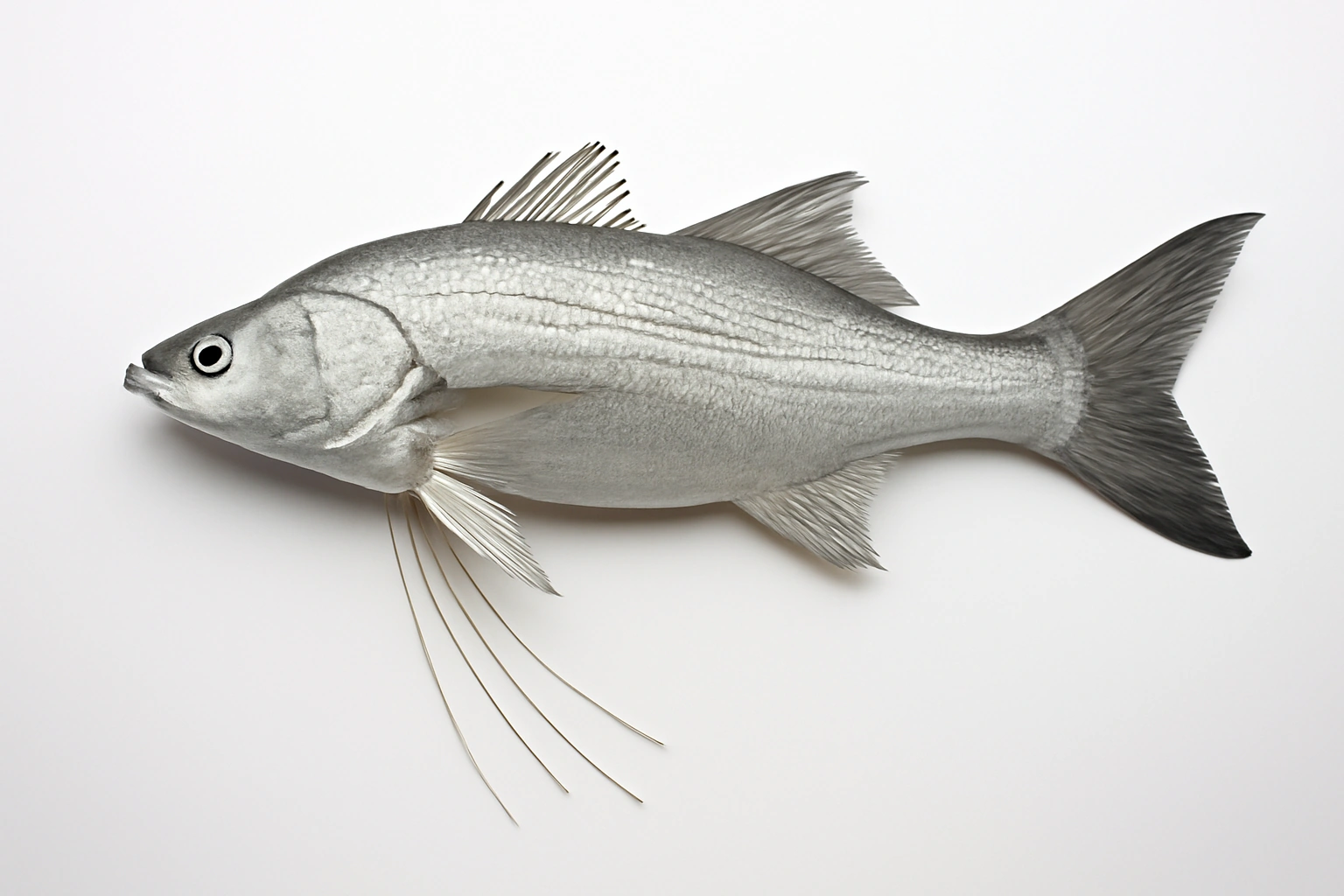
The Threadfin Salmon, also known as 'King Threadfin', is one of the most sought-after fish in northern Australia. With sensory filaments under its mouth, it hunts in turbid waters using touch. Fights hard and has excellent flesh.
Identification
- Body
- The Filamentous Salmon has an elongated, streamlined body, with a prominent head and lower-set mouth.
- Colouration
- It has a silvery coloration with bluish tint along the back and a white belly.
- Sexual dimorphism
- not very noticeable
- Growth
- fast, especially in the early years.
Taxonomy
- Family
- Polynemidae
- Order
- Perciformes
- Class
- Actinopterygii
Related species
Habitat & distribution
- Environment
- Estuaries, Coast, Brackish
- Preferred bottom
- Mud, Sand
- Geographic distribution
- Primarily located in northern Australia, also found along the coastal regions of Southeast Asia.
- Micro-habitat
- Prefers murky, calm waters near river mouths where it can use its filaments for hunting.
Prefers complex habitats with muddy bottoms, where hunting is easier.
Presence by sea area
Diet
- Primary prey
- shrimp, crustaceans, small fish
- Secondary prey
- aquatic insects, mollusks, bivalves
- Occasional prey
- algae, detritus, polychaetes
- Feeding behaviour
- Hunts using its sensory filaments below the mouth to detect prey in the mud and sand.
- Natural predators
- sharks, dolphins, seabirds, crocodiles
Also relies on sensory filaments to locate prey in the substrate.
Behaviour
- Activity
- diurnal
- Social behaviour
- large_schools
- Aggressiveness
- medium
- Migration
- Performs seasonal coastal migrations for spawning.
- Seasonal behaviour
- Increased activity during the rainy season, including inland waters.
- Juveniles
- Juveniles are often found in more brackish, marshy waters, forming schools.
- Adults
- Adults move into deeper waters in larger groups, especially for spawning.
Reproduction
- Spawning season
- November, December, January
- Spawning depth
- between 5 and 20 meters
- Eggs
- Small pelagic eggs with a transparent coating.
- Larval stage
- Very small, pelagic larvae that initially depend on plankton.
- Sexual maturity
- 3-4 years
When to catch Threadfin Salmon
Activity calendar
Activity by season
Best times
This species shows peak fishing activity in spring, summer and autumn, when the productivity index (FPI) reaches its highest values.
Fishing activity decreases in winter, when conditions are less favourable.
Ideal conditions
Water temperature
Where to catch it
Best spots
Bottom preference
Spot type
Fishing techniques
Recommended
Other applicable
Recommended baits
Baits by pressure
How to really catch it
The threadfin salmon is a sleek coastal predator with bright silver flanks, easy to recognize by the sensory filaments beneath its mouth and the three dark bars along its sides. When it moves into the murky water of river mouths, it almost dissolves into the color of the bottom—and that is exactly when it becomes most compelling to target with purpose.
🐟 Good to know
Its most remarkable feature is the set of sensory filaments beneath the mouth, used to locate prey in mud and sand. It is a perfect adaptation for hunting in calm, turbid water, where vision and contrast matter less than bottom contact and close-range sensory cues.
🌊 Where & when
You’ll find it mainly in estuaries, lagoons, and brackish coastal stretches over sand and mud from 1 to 30 meters, especially near river mouths in northern Australia and along Southeast Asian coasts. It is a diurnal species, more active during the rainy season, even into inland waters; from March to November it remains highly targetable, while from November to January adults make seasonal coastal spawning movements and also shift into 5 to 20 meters.
🎣 How to really catch it
To fish it effectively, the key is drift fishing in calm, murky river-mouth water, letting the bait work close to the bottom where the fish searches for shrimp, crustaceans, and small fish. A medium-power spinning rod, 10–15 kg braid, 20 kg fluorocarbon leader, a 3/0 hook, and a 20–30 g sinker let you present live shrimp, crustaceans, or fresh small baitfish properly; jigging, trolling, and fly fishing can also work, but a slow bottom drift is the most grounded approach for this species’ biology.
💡 The detail that makes the difference
The most defensible practical tip is simple: do not keep the bait too high off the bottom. This fish hunts by feeling and detecting prey over sand and mud with the filaments beneath its mouth, so a low, natural, slow presentation in calm areas near the mouth is generally more consistent than moving the bait through midwater.
Catch & handling tips
- Fight
- Fights energetically with quick movements and jumps, making it an exciting catch.
- Handling
- Use a wet towel to avoid damaging the silvery skin.
- Release
- Carefully release into calm waters to aid recovery.
Curiosities & culture
- Record catches
- Maximum documented size: up to about 170 cm and 45 kg (source: FishBase). There is no official IGFA All-Tackle record for this species.
- In the kitchen
- High-quality white meat, used in grills and Asian cuisine.
- Cultural notes
- Valued in Australian culture for its culinary quality and the challenge of catching it.
- Historical notes
- Traditionally fished by coastal communities in northern Australia for its meat and the challenge of catching.