
Overview
One of the fastest and most powerful ocean fish. Migratory pelagic predator of enormous commercial and sporting value.
Identification
- Body
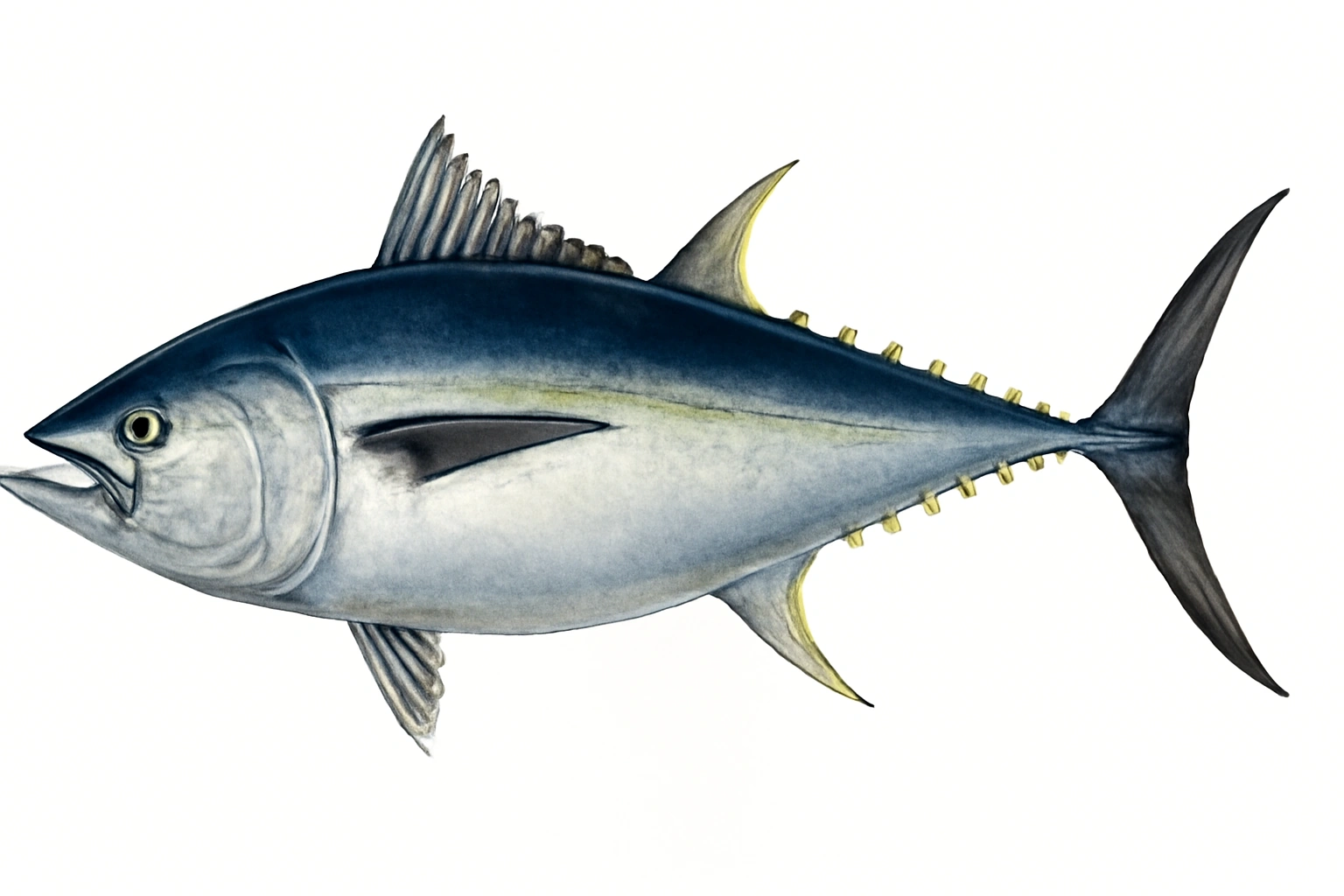
- Sturdy, spindle-shaped body with relatively short pectoral fins.
- Colouration
- Dark blue back with silvery belly, featuring dark bands along the body.
- Sexual dimorphism
- Absent/not very noticeable
- Growth
- Fast, particularly in early years with increases of several lbs annually.
Taxonomy
- Family
- Scombridae
- Order
- Scombriformes
- Class
- Actinopterygii
Related species
Habitat & distribution
- Environment
- Open sea, Pelagic
- Preferred bottom
- Pelagic
- Geographic distribution
- Primarily located in the Pacific Ocean, from the China Seas to California, through Japanese waters.
- Micro-habitat
- Prefers open, pelagic waters at great depths, often migrates following ocean currents.
Prefers open waters with ample space for migration and hunting.
Presence by sea area
Diet
- Primary prey
- anchovies, sardines, mackerels
- Secondary prey
- squid, shrimps, plankton
- Occasional prey
- jellyfish, small cephalopods
- Feeding behaviour
- Opportunistic predator, hunts in groups often chasing schools of smaller pelagic fish.
- Natural predators
- sharks, orcas, swordfish
Diet adapts to the availability of nearby smaller pelagic fish.
Behaviour
- Activity
- diurnal
- Social behaviour
- large_schools
- Aggressiveness
- high
- Migration
- Undertakes lengthy trans-Pacific migrations between feeding and spawning areas.
- Seasonal behaviour
- Migrations are influenced by water temperatures and food availability.
- Juveniles
- Young tend to stay in shallower areas before joining adult schools.
- Adults
- Adults form large schools and migrate in search of food and spawning areas.
Reproduction
- Spawning season
- June, July, August
- Spawning depth
- between 30 and 60 meters
- Eggs
- Pelagic, small, transparent eggs, laid in masses.
- Larval stage
- Larvae are small and transparent, growing rapidly in the first months.
- Sexual maturity
- varies between 4 and 6 years
When to catch Pacific bluefin tuna
Activity calendar
Activity by season
Best times
This species shows peak fishing activity in spring, summer and autumn, when the productivity index (FPI) reaches its highest values.
Fishing activity decreases in winter, when conditions are less favourable.
Ideal conditions
Atmospheric pressure
Actively hunts on surface.
Regular mid-water activity.
Goes deeper.
Goes deeper.
Feeds regularly.
Hunts aggressively on surface.
Water temperature
Where to catch it
Best spots
Bottom preference
Spot type
Fishing techniques
Recommended
Other applicable
Recommended baits
Baits by pressure
How to really catch it
The Pacific bluefin tuna is a great pelagic fish built for the open ocean: fusiform body, dark blue back, and schools moving constantly through currents and bait. When it starts feeding, the sea changes pace, and truly fishing for it means reading open water, depth, and the presence of small pelagics with precision.
🐟 Good to know
It undertakes long trans-Pacific migrations between feeding and spawning grounds. It is a pelagic egg spawner: from June to August it releases masses of small, transparent eggs that remain suspended in the water column, with larvae growing rapidly during the first months.
🌊 Where & when
You find it mainly in the Pacific, from the China Seas to California through Japanese waters, in open and pelagic waters that can be very deep, from the surface down to 500 meters. It becomes more approachable from March to November, especially where currents concentrate sardines, anchovies, and mackerels; in summer the species also enters its spawning phase, with spawning between 30 and 60 meters.
🎣 How to really catch it
The most concrete approach is big game fishing by trolling or drifting in pelagic waters, near schools of small fish or along deep coastal zones where bait gathers. Live bait, sardines, mackerels, and squid match its opportunistic diet perfectly. You need a big game rod, 50-100 lb monofilament, a 100 lb fluorocarbon leader, strong circle hooks, and, when drifting, sinkers to keep the bait in the right layer while the fish makes powerful runs and deep dives.
💡 The detail that makes the difference
The practical edge is not fishing random blue water: look for active water with concentrations of small pelagics, because this tuna often hunts in groups by chasing those schools. If you find tight anchovy, sardine, or mackerel bait, present a bait that matches them in size and profile, and keep working the same current line.
Catch & handling tips
- Fight
- Fights fiercely, with strong runs and deep dives.
- Handling
- Handle carefully using gloves to avoid injury to yourself and the fish.
- Release
- Ensure the fish is fully rehydrated before release.
Curiosities & culture
- Record catches
- Maximum documented size: up to about 300 cm and 450 kg (source: FishBase). IGFA All-Tackle record: 411.6 kg (907 lb 4 oz), caught by Donna Pascoe at Three Kings (New Zealand) in 2014.
- In the kitchen
- Highly prized in Japanese cuisine, especially for high-quality sushi and sashimi.
- Cultural notes
- Considered a delicacy in many sushi and sashimi dishes.
- Historical notes
- Bluefin tuna fishing has a long history, vital to both local economies and the international fish industry.