
Overview
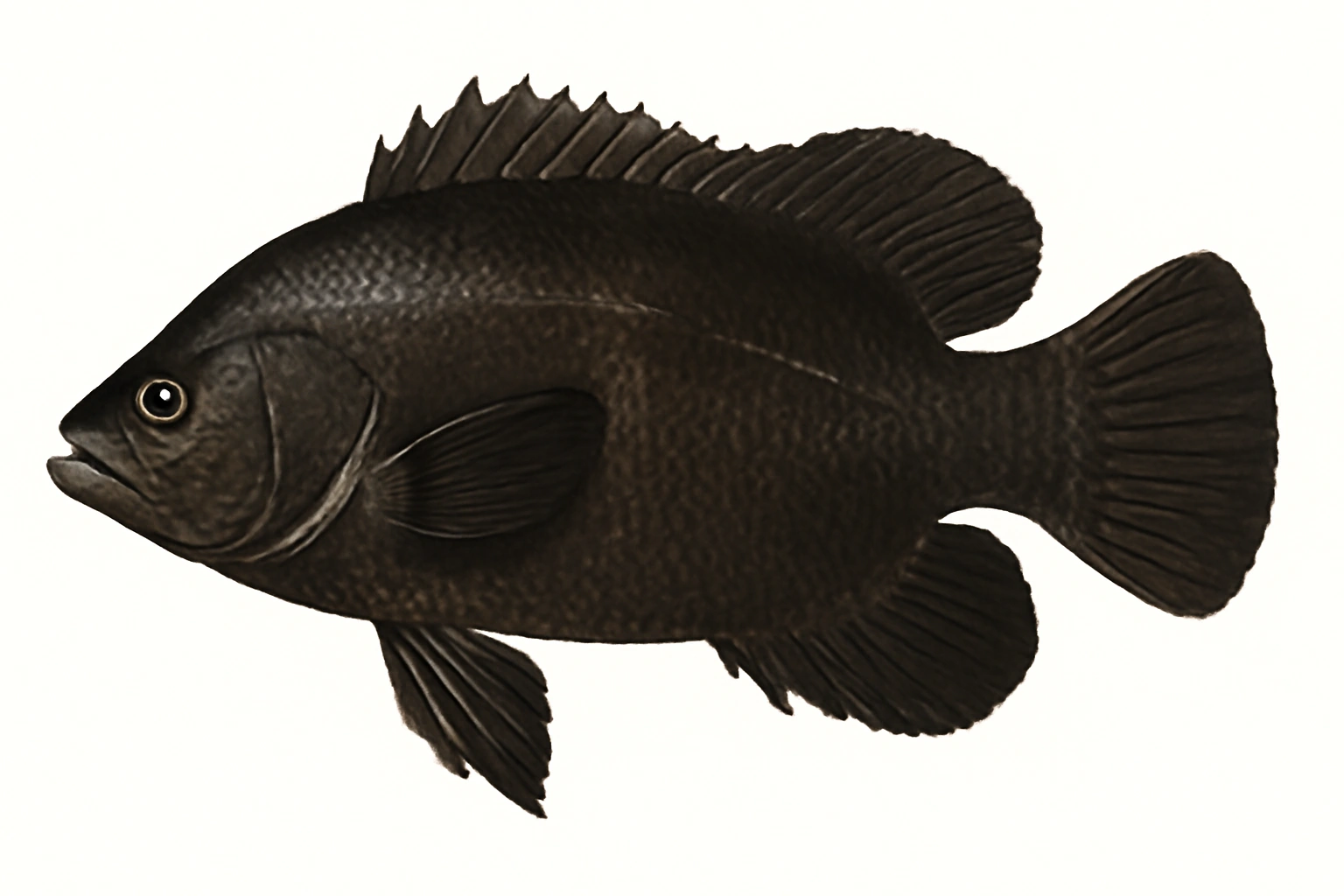
Unique pelagic predator that camouflages by floating on its side near debris and buoys. Excellent meat.
Identification
- Body
- Bulky body compressed laterally with rounded dorsal and anal fins giving a trilobed appearance.
- Colouration
- Variable coloration from dark brown to gray with black spots, becoming darker around rocks and debris.
- Sexual dimorphism
- Not very noticeable
- Growth
- Moderate, with rapid growth in the first years.
Taxonomy
- Family
- Lobotidae
- Order
- Perciformes
- Class
- Actinopterygii
Related species
Habitat & distribution
- Environment
- Coast, Open sea, Reefs
- Preferred bottom
- Reef, Seagrass
- Geographic distribution
- Found in the Atlantic and Indian Oceans, mainly in temperate and subtropical zones.
- Micro-habitat
- Often found near buoys, floating debris, and mangroves where it camouflages to hunt.
Prefers waters rich in floating structures where it can camouflage.
Presence by sea area
Diet
- Primary prey
- small fish, crustaceans, squid
- Secondary prey
- shrimp, jellyfish, octopus
- Occasional prey
- algae, small invertebrates
- Feeding behaviour
- Opportunistic predator, feeds mainly by hunting near the surface or floating next to debris.
- Natural predators
- sharks, large pelagic fish, seabirds
Diet varies considerably based on the availability of pelagic prey.
Behaviour
- Activity
- diurnal
- Social behaviour
- solitary
- Aggressiveness
- medium
- Migration
- Seasonal migrations to warmer areas for spawning.
- Seasonal behaviour
- Approaches the coast more in summer, while moving to deeper waters in winter.
- Juveniles
- Juveniles often shelter among seaweed and surface debris to avoid predators.
- Adults
- Adults tend to remain solitary or in small groups, especially near buoys.
Reproduction
- Spawning season
- June, July, August
- Spawning depth
- between 20 and 60 meters
- Eggs
- Pelagic eggs, small in size, transparent, and capable of floating.
- Larval stage
- Larvae are planktonic and develop rapidly in surface waters.
- Sexual maturity
- 2-3 years
When to catch Atlantic tripletail
Activity calendar
Activity by season
Best times
This species shows peak fishing activity in spring, summer and autumn, when the productivity index (FPI) reaches its highest values.
Fishing activity decreases in winter, when conditions are less favourable.
Ideal conditions
Atmospheric pressure
More active on surface.
Stays near floating structures.
Less visible, goes slightly deeper.
Stays on surface.
Easy to spot near buoys.
More active, feeds.
Water temperature
Where to catch it
Best spots
Bottom preference
Spot type
Fishing techniques
Recommended
Other applicable
Recommended baits
Baits by pressure
How to really catch it
Tripletail is one of those predators that seems to appear from nowhere: a deep, trilobate body hanging motionless beside a buoy or floating debris, then a sudden strike. If you want to catch it for real, you need to read the surface and fish where the sea gathers shade, cover, and prey.
🐟 Good to know
One notable biological feature of tripletail is its early development: the eggs are pelagic and buoyant, and the larvae also live in surface waters as part of the plankton. That link with the upper water column helps explain why this species is so often associated with debris and floating structure.
🌊 Where & when
It lives along coasts, in open sea, and around reefs, from 5 to 100 meters, with a clear attraction to buoys, floating debris, mangroves, and cover-rich edges such as seagrass and rocky structure. It is most worthwhile from March to November; in summer it moves closer to shore, while from June to August it migrates toward warmer waters to spawn, between 20 and 60 meters.
🎣 How to really catch it
The most practical way to catch it is to sight-fish and work around buoys, debris, and mangroves with spinning or light drifting, presenting a natural bait such as sardine, shrimp, or pieces of squid where the fish is holding or ambushing. A medium-heavy rod with 20-30 lb line, a 40 lb nylon or fluorocarbon leader, and 4/0-6/0 circle hooks fits the job well; if you need a little depth, a sliding sinker keeps the presentation clean.
💡 The detail that makes the difference
The tip that really matters is not to insist on the bottom when you are fishing floating structure: tripletail feeds mainly near the surface or while holding beside debris. If your presentation travels in the wrong layer of water, you can fish a perfect spot without ever truly entering its feeding zone.
Catch & handling tips
- Fight
- When hooked, it tends to fight energetically with quick, powerful strikes.
- Handling
- Handle carefully to avoid injury, use a wet cloth if possible.
- Release
- Ensure the fish is lively before release, re-oxygenate in water if needed.
Curiosities & culture
- Record catches
- Maximum documented size: up to about 110 cm and 19 kg (source: FishBase). IGFA All-Tackle record: 19.2 kg (42 lb 5 oz), caught in South Africa in 1989.
- In the kitchen
- Highly appreciated meat for its sweet flavor and firm texture, used in grills and stews.
- Cultural notes
- Appears in several fishing tales as a symbol of good luck and persistence in fishing.
- Historical notes
- Traditionally fished by coastal communities for its culinary value and the ease with which it can be spotted.