
Overview
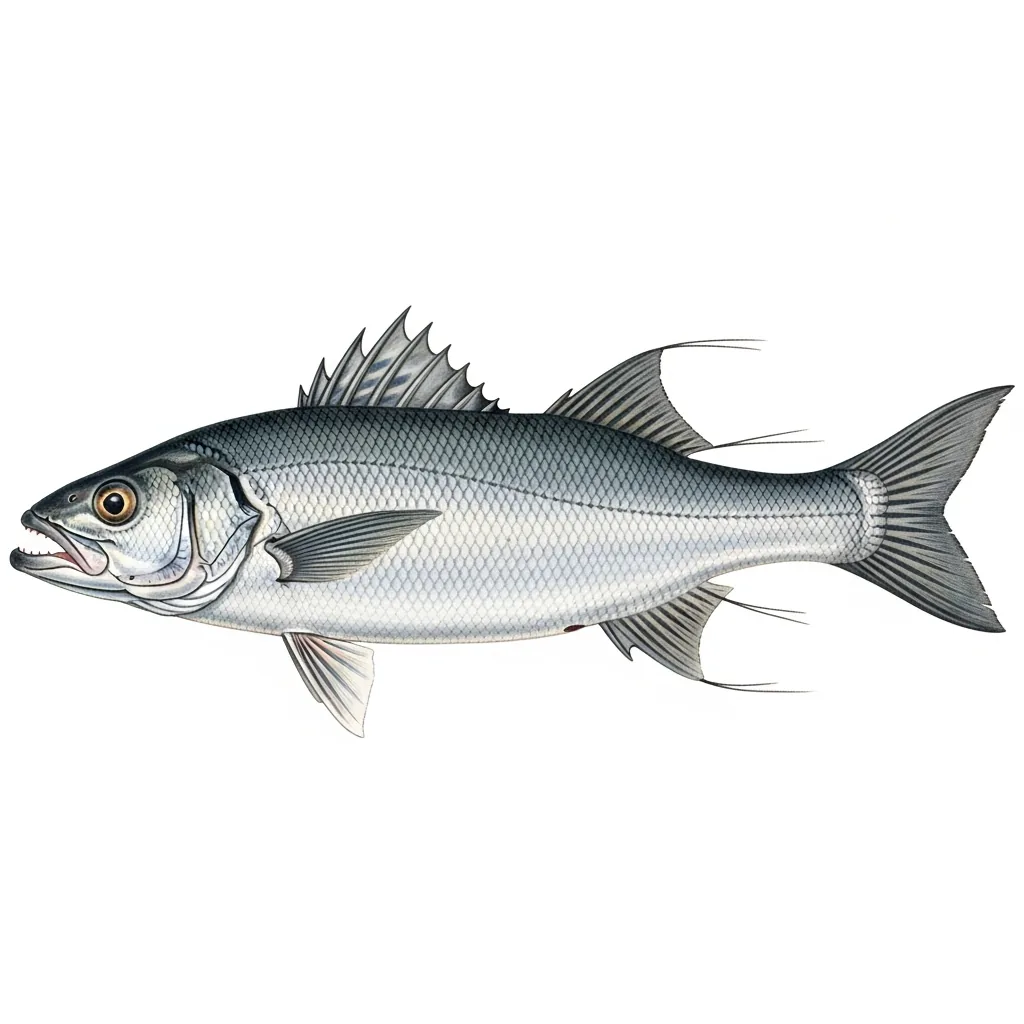
The largest member of the drum family on the Pacific coast. Coveted trophy for all California anglers.
Identification
- Body
- Elongated and sleek body with a large head and a prominent jaw.
- Colouration
- Silver-gray color with dark lateral lines and blue or purple hues.
- Sexual dimorphism
- Absent/not very evident
- Growth
- Medium with steady growth over the years.
Taxonomy
- Family
- Sciaenidae
- Order
- Perciformes
- Class
- Actinopterygii
Related species
Habitat & distribution
- Environment
- Coast, Open sea, Reefs
- Preferred bottom
- Sand, Rock, Reef
- Geographic distribution
- Eastern Pacific coasts from northern Baja California to southern California.
- Micro-habitat
- Hides in coastal waters near cliffs, rocky bottoms, and coral reefs.
Needs clear, oxygen-rich waters to thrive.
Presence by sea area
Diet
- Primary prey
- bluefish, sardines, mullets
- Secondary prey
- crustaceans, squid, octopuses
- Occasional prey
- crabs, cuttlefish
- Feeding behaviour
- Active hunter at dawn and dusk, seeking prey near coral reefs and rocky bottoms.
- Natural predators
- bull shark, bluefish, sea lions
Easily adapts to the availability of different prey, focusing on the most abundant ones each season.
Behaviour
- Activity
- diurnal
- Social behaviour
- small_groups
- Aggressiveness
- medium
- Migration
- Migrates seasonally along the coast for breeding and feeding.
- Seasonal behaviour
- Moves closer to shore for spawning during warm months, retreats to open sea in winter.
- Juveniles
- Juveniles tend to stay near coastal refuges to avoid predators.
- Adults
- Adults form small groups that roam open waters in search of food.
Reproduction
- Spawning season
- June, July
- Spawning depth
- between 20 and 60 meters
- Eggs
- Pelagic eggs, small and transparent.
- Larval stage
- Larvae initially stay near the surface, feeding on plankton.
- Sexual maturity
- 3-4 years
When to catch White Seabass
Activity calendar
Activity by season
Best times
This species shows peak fishing activity in spring, summer and autumn, when the productivity index (FPI) reaches its highest values.
Fishing activity decreases in winter, when conditions are less favourable.
Ideal conditions
Water temperature
Where to catch it
Best spots
Bottom preference
Spot type
Fishing techniques
Recommended
Other applicable
Recommended baits
Baits by pressure
How to really catch it
The white seabass is a large coastal drum with bright silver flanks and a heavy head, the kind of fish that can appear suddenly along cliffs and rocky bottoms. When it moves in to hunt close to shore, especially in the productive months, it offers a clean, powerful encounter that rewards careful fishing.
🐟 Good to know
It belongs to the drum family, a group of fishes known for producing sounds with muscles associated with the swim bladder. In white seabass, beyond the size and prominent jaw, its reproductive cycle also stands out: it releases small, transparent pelagic eggs, and the larvae initially remain near the surface feeding on plankton.
🌊 Where & when
You find it along the eastern Pacific coast, from northern Baja California to southern California, between coastal water, open sea, and reefs, over sand, rock, and mixed bottoms from 5 to 100 meters. In the warm months it moves closer to shore and structure to spawn, with strong fishing potential from March to November; between June and July it spawns in 20 to 60 meters.
🎣 How to really catch it
To really fish for it, the most concrete approach is trolling or drifting around coral reefs, cliffs, river mouths, and rocky areas, focusing on the daylight edges of dawn and dusk, when it actively hunts bluefish, sardines, and mullets. Live sardines and squid are key baits; small artificials and soft plastics are solid alternatives. Use a powerful 15-30 lb rod, 20-30 lb main line, a 30-40 lb fluorocarbon leader, 2/0-4/0 circle hooks, and an egg sinker to keep the bait in the right zone without killing its natural presentation.
💡 The detail that makes the difference
The practical edge is to fish the live side of the structure, not just the structure itself: the face of a cliff, the outflow of a river mouth, the rocky edge where a small group can patrol and push bait. It hunts near reefs and hard bottom, and once hooked it often tries to reach the rocks, so a stout fluorocarbon leader is not overkill but a defensible choice.
Catch & handling tips
- Fight
- Strong and vigorous, often tries to retreat among rocks.
- Handling
- Handle carefully to avoid damaging scales and fins.
- Release
- Release back into the water quickly to minimize stress and increase survival.
Curiosities & culture
- Record catches
- Maximum documented size: up to about 160 cm and 42 kg (source: FishBase). IGFA All-Tackle record: 37.98 kg (83 lb 12 oz), caught at San Felipe (Mexico) in 1953.
- In the kitchen
- The white meat is prized for its delicate flavor; often grilled or fried.
- Cultural notes
- An iconic fish for sport fishermen on the California coast.
- Historical notes
- Traditionally fished by local communities for economy and sustenance.