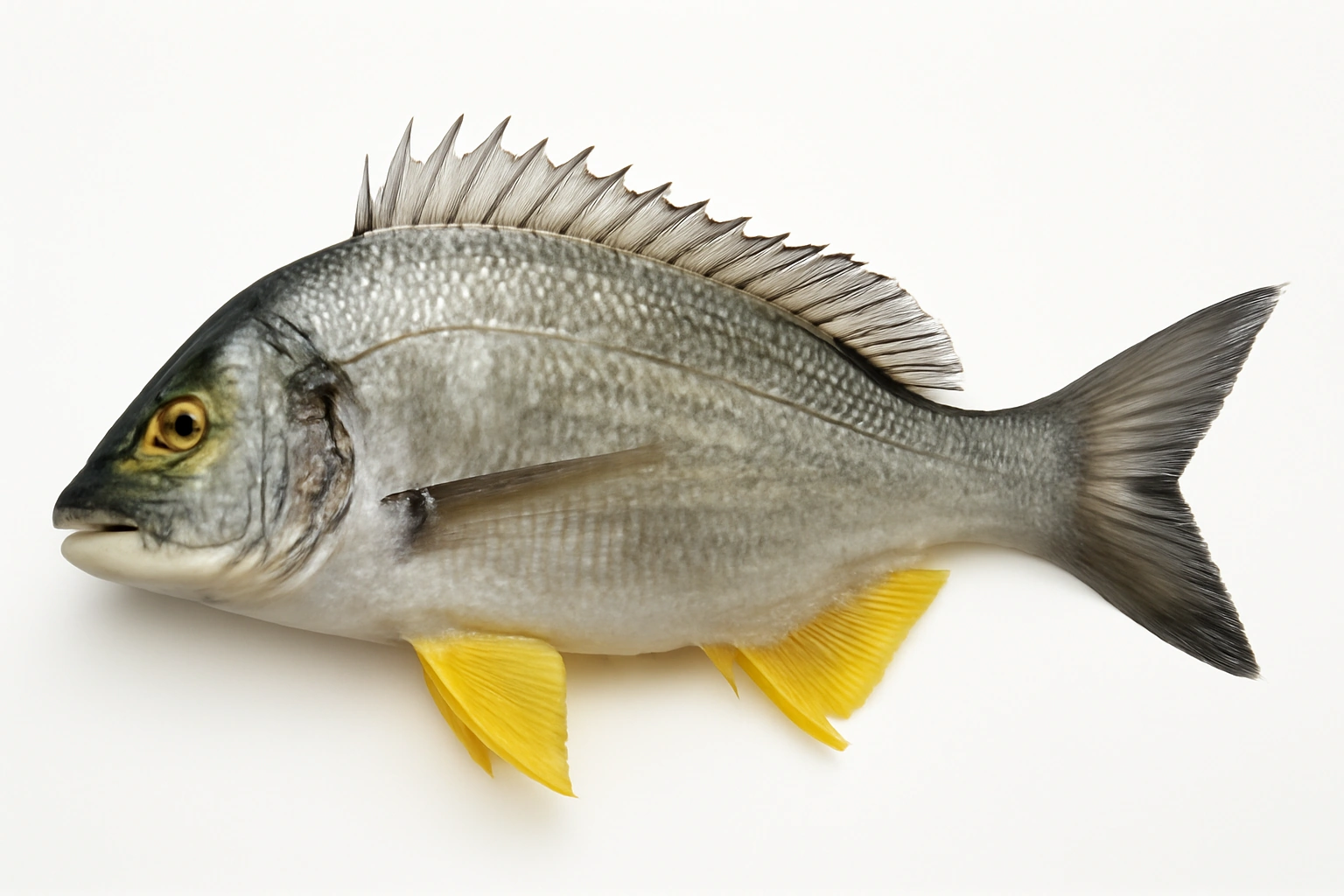

Overview
The Yellowfin Bream is arguably the most iconic Australian recreational fishing species. Cunning and hard-fighting, found everywhere along the east coast - from Sydney Harbour to Queensland mangroves. The number one target for estuary lure fishing.
Identification
- Body
- Oval and laterally compressed body, typical of bottom-feeding fish.
- Colouration
- Silver coloration with golden shades, bright yellow pectoral and dorsal fins.
- Sexual dimorphism
- Absent or not very noticeable
- Growth
- Medium; reaches maturity in 3-4 years.
Taxonomy
- Family
- Sparidae
- Order
- Perciformes
- Class
- Actinopterygii
Related species
Habitat & distribution
- Environment
- Coast, Estuaries, Rew
- Preferred bottom
- Sand, Mud, Seagrass, Estuarine
- Geographic distribution
- Distributed along the eastern coast of Australia, from Queensland to New South Wales.
- Micro-habitat
- Often hides among mangroves and ventures into shallow waters during high tide.
Systematically found among mangroves and seagrass beds.
Presence by sea area
Diet
- Primary prey
- crustaceans, mollusks, marine worms
- Secondary prey
- small fish, algae, organic debris
- Occasional prey
- jellyfish, annelids
- Feeding behaviour
- Often forages on the bottom searching for crustaceans and mollusks, using its powerful jaws to crush shells.
- Natural predators
- sharks, seabirds, dolphins, large barramundi
Frequent in areas rich in debris and organic matter due to the abundant presence of crustaceans.
Behaviour
- Activity
- diurnal
- Social behaviour
- small_groups
- Aggressiveness
- medium
- Migration
- Resident, but makes small seasonal movements for reproduction.
- Seasonal behaviour
- In early spring, it approaches the shore for breeding. In autumn, it returns to deeper channels.
- Juveniles
- The young tend to form large schools and inhabit shallower areas.
- Adults
- Adults prefer small groups and deeper water zones, staying close to the bottom.
Reproduction
- Spawning season
- October, November, December
- Spawning depth
- Between 5 and 20 meters
- Eggs
- Pelagic eggs, small in size, hatch in a few days.
- Larval stage
- Larvae are transparent and pelagic, floating with currents until they develop.
- Sexual maturity
- 2-4 years
When to catch Yellowfin Bream
Activity calendar
Activity by season
Best times
This species shows peak fishing activity in spring, summer and autumn, when the productivity index (FPI) reaches its highest values.
Fishing activity decreases in winter, when conditions are less favourable.
Ideal conditions
Water temperature
Where to catch it
Best spots
Bottom preference
Spot type
Fishing techniques
Recommended
Other applicable
Recommended baits
Baits by pressure
How to really catch it
The Australian yellowfin bream is a practical, bottom-focused fish: silver-bodied, yellow-finned, with jaws built to find food where the seabed gives everything away. When it pushes into shallow water on the tide and noses through sand, mud, and mangrove edges, it becomes a capture built on precision rather than haste.
🐟 Good to know
A notable biological feature of Acanthopagrus australis is its pelagic reproduction: after spawning between 5 and 20 meters, the eggs and then the transparent larvae remain in the water column and are carried by currents before developing further. This stage is important for the species’ dispersal along coasts and estuaries.
🌊 Where & when
It lives along Australia’s eastern coast, from Queensland to New South Wales, in estuaries, sheltered coasts, harbors, sandy and muddy bottoms, and seagrass areas, from 1 to 30 meters. It often holds around mangrove edges and moves into very shallow water on high tide; from early spring it comes closer to shore to breed, while in autumn it returns to deeper channels.
🎣 How to really catch it
The most reliable way to target it is with natural bait, presented close to the bottom where it truly forages. A light spinning rod, 6-10 lb monofilament, a 10-15 lb fluorocarbon leader, size 4-6 hooks, and small ball sinkers are enough to fish shrimp, shellfish, squid, or marine worms in estuary mouths, along mangroves, over sandy areas near shoals, and in harbors. Once hooked, it fights hard and often tries to reach structure.
💡 The detail that makes the difference
The most defensible practical tip is simple: keep the bait as close to the bottom as possible and not far from soft sand, mud, or the edge of seagrass. This species feeds by searching the bottom for crustaceans, mollusks, and worms with a terminal mouth and strong jaws; if the bait sits too high in the water, it leaves the fish’s natural feeding lane.
Catch & handling tips
- Fight
- Strong and tenacious; tends to swim toward obstacles to free itself.
- Handling
- Use a wet cloth to avoid damaging its sensitive skin.
- Release
- Release gently into clean and calm water.
Curiosities & culture
- Record catches
- Maximum documented size: up to about 66 cm and 4.5 kg (source: FishBase). There is no official IGFA All-Tackle record for this species.
- In the kitchen
- Highly valued for its delicate flavor, often grilled or stewed.
- Cultural notes
- Iconic species for Australian recreational fishing, central to local tournaments.
- Historical notes
- It was one of the main sources of sustenance for coastal Aboriginal populations.