
Overview
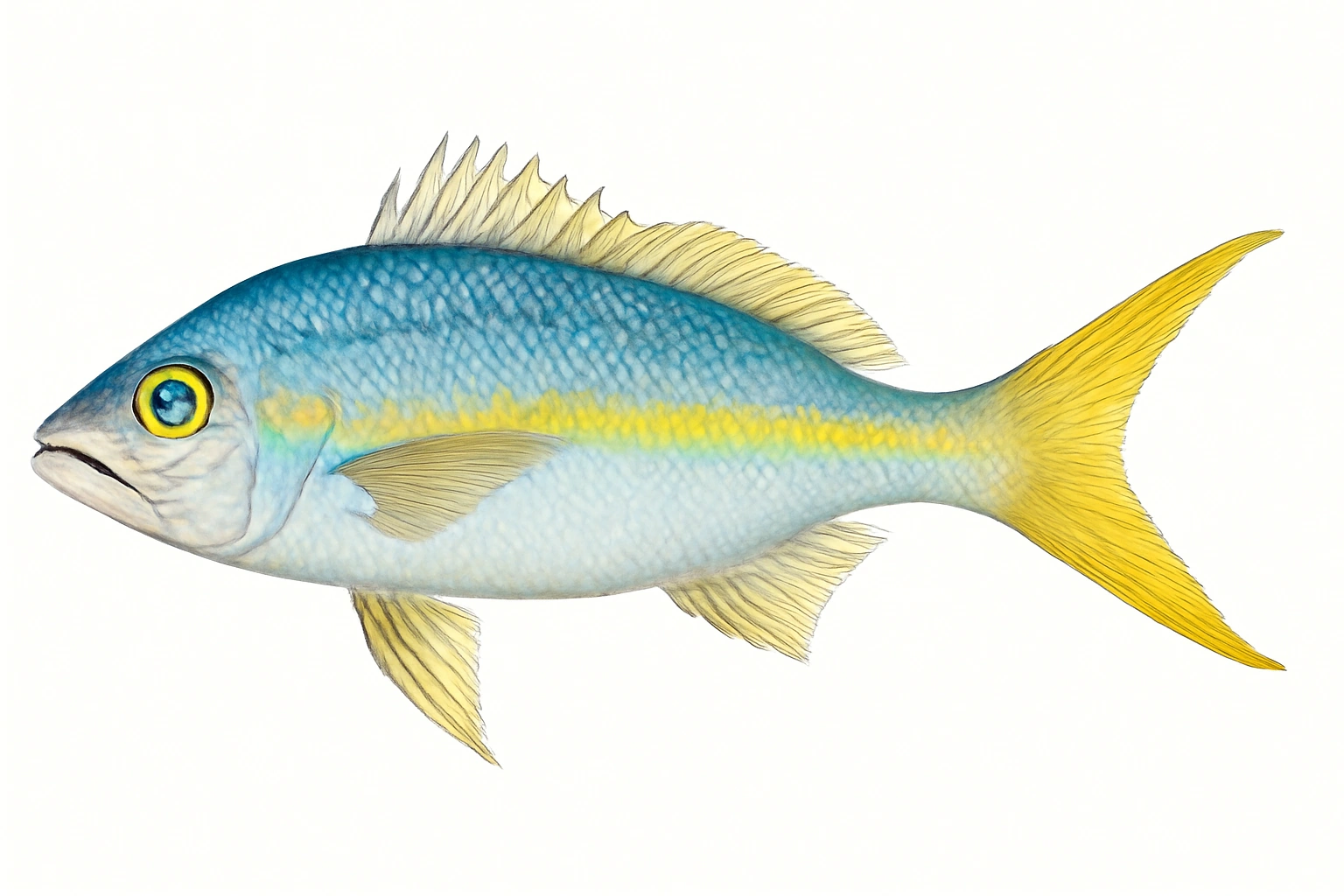
Very colorful reef fish. Feeds at mid-water and is one of the most sought-after in light tropical fishing.
Identification
- Body
- Elongated body, laterally compressed, with a small mouth and sharp teeth.
- Colouration
- Silvery base color with greenish hues on the back; distinctive yellow tail fin and a yellow lateral stripe from snout to tail fin.
- Sexual dimorphism
- Absent/not very noticeable
- Growth
- Average, with faster growth rates in the first years of life.
Taxonomy
- Family
- Lutjanidae
- Order
- Perciformes
- Class
- Actinopterygii
Related species
Habitat & distribution
- Environment
- Reefs, Coast, Open sea
- Preferred bottom
- Reef, Seagrass, Sand
- Geographic distribution
- Primarily found in the western Atlantic Ocean, from the Caribbean to Florida, including Bermuda and the Bahamas.
- Micro-habitat
- Often found above or near coral reefs, where it takes refuge and feeds.
Adaptable to a variety of coastal habitats, particularly associated with coral reefs.
Presence by sea area
Diet
- Primary prey
- small fish, crustaceans, squid
- Secondary prey
- mollusks, plankton, jellyfish
- Occasional prey
- fish eggs, algae
- Feeding behaviour
- Hunts mainly mid-water, staying near coral reefs and using speed and agility to catch prey.
- Natural predators
- barracuda, shark, larger snappers, bluefish, groupers
Feeds in a variety of environments but prefers areas with easy access to small fish and invertebrates.
Behaviour
- Activity
- diurnal
- Social behaviour
- small_groups
- Aggressiveness
- medium
- Migration
- Generally stays in the same area but may move locally for spawning.
- Seasonal behaviour
- May move to warmer waters or seek deeper refuge during colder months.
- Juveniles
- Juveniles often form schools near the surface to avoid predators.
- Adults
- Adults form small groups and tend to stay close to coral reefs.
Reproduction
- Spawning season
- March, April, May
- Spawning depth
- between 20 and 60 meters
- Eggs
- Small pelagic eggs carried by marine currents.
- Larval stage
- Larvae are pelagic and develop in plankton for several weeks before settling on the bottom as young fish.
- Sexual maturity
- 2-3 years
When to catch Yellowtail snapper
Activity calendar
Activity by season
Best times
This species shows peak fishing activity in spring, summer and autumn, when the productivity index (FPI) reaches its highest values.
Fishing activity decreases in winter, when conditions are less favourable.
Ideal conditions
Atmospheric pressure
Very active at mid-water.
Regular activity.
Moves closer to bottom.
Goes towards bottom.
Active schools at mid-water.
Very active on surface.
Water temperature
Where to catch it
Best spots
Bottom preference
Spot type
Fishing techniques
Recommended
Other applicable
Recommended baits
Baits by pressure
How to really catch it
The yellowtail snapper is an elegant, high-strung reef fish, instantly recognized by the bright yellow stripe that seems to glow in blue water. When small groups appear above the reef, flashing through mid-water, you quickly realize that catching it well means reading current, distance, and proximity to structure.
🐟 Good to know
An important biological trait of this species is its pelagic larval phase: after spawning, eggs and larvae drift with the currents and develop in the plankton for several weeks before juveniles settle to the bottom. This helps explain its broad distribution across the western Atlantic.
🌊 Where & when
It lives mainly around reefs, sandy bottoms, and seagrass areas, generally from 10 to 60 meters, along coasts and offshore waters of the Caribbean, Florida, the Bahamas, and Bermuda. Adults stay close to coral reefs and become especially worthwhile from March to November; from March to May they may make local movements կապված to spawning, between 20 and 60 meters.
🎣 How to really catch it
The most reliable way to target it is with live or natural baits near coral reefs, wrecks, buoys, and sandy seagrass edges, letting the bait work in the water layer where it feeds. A medium-light spinning rod, 10-15 lb monofilament, a 20-30 lb fluorocarbon leader, a 2/0-4/0 circle hook, and an egg sinker are enough to present shrimp pieces, squid strips, or small live baitfish properly, while staying ready for its immediate dive toward bottom structure.
💡 The detail that makes the difference
The detail that often makes the difference is not fishing glued to the bottom as you might for many reef species: yellowtail snapper feeds mainly in mid-water while staying close to the reef. If the bait works just above the structure, in open water but under control, it enters the fish’s feeding lane more naturally without giving it instant cover among rocks and coral.
Catch & handling tips
- Fight
- Fights hard and quickly, trying to dive rapidly towards structures on the bottom.
- Handling
- Handle with care to prevent injury from the spiny dorsal fins, use gloves if necessary.
- Release
- Release quickly, ensuring proper recovery in water before release.
Curiosities & culture
- Record catches
- Maximum documented size: up to about 86 cm and 4.1 kg (source: FishBase). IGFA All-Tackle record: 4.98 kg (11 lb), caught in Bermuda in 2004.
- In the kitchen
- Highly valued for its white, flavorful meat; often prepared grilled, fried, or baked.
- Cultural notes
- Highly regarded by sport fishermen for its beauty and fighting ability.
- Historical notes
- Greatly sought after by anglers and recreational fishing enthusiasts in the Caribbean and Florida.