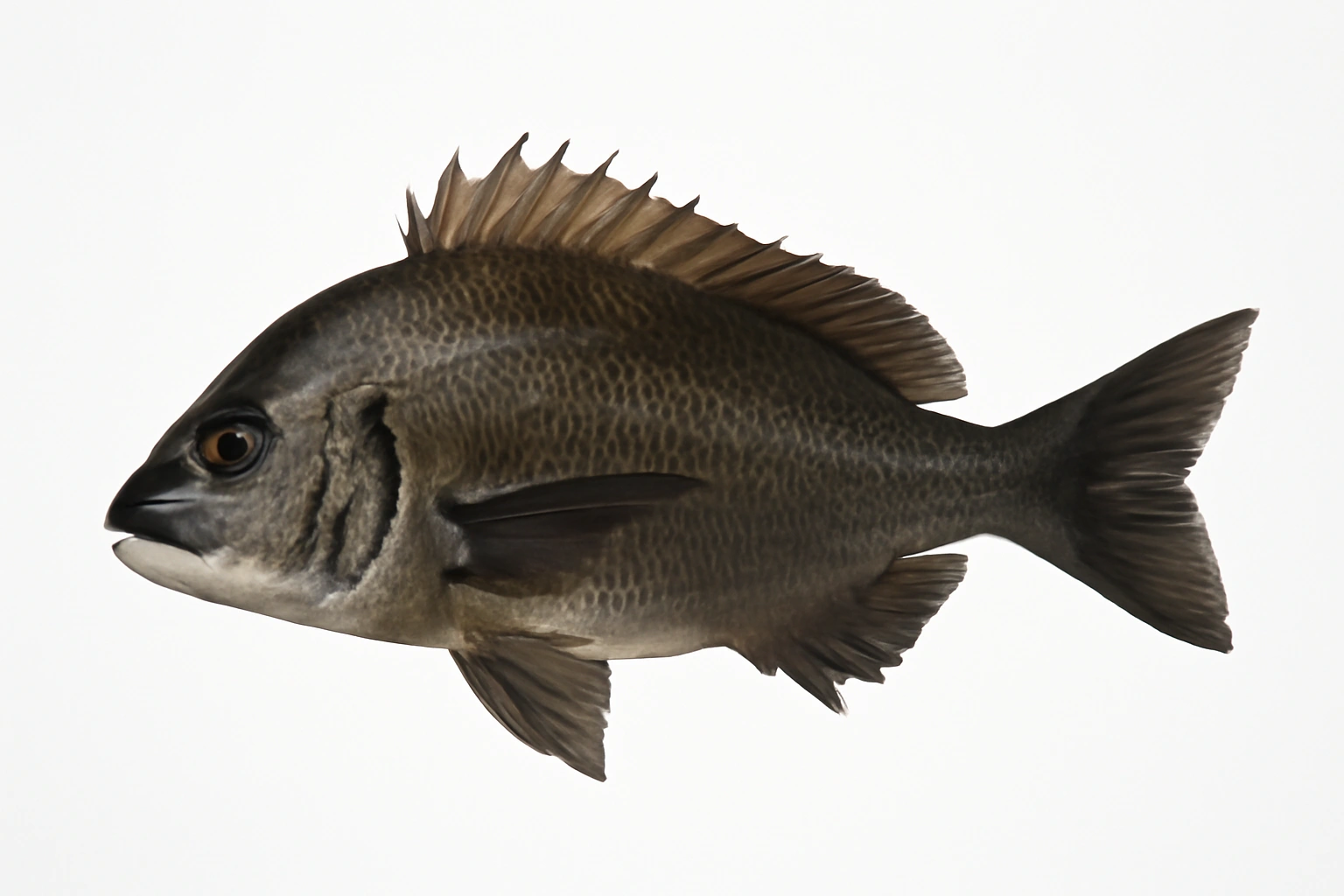

Overview
The Australian Black Bream is endemic to southern Australia, known for its cunning nature and fighting spirit. Lives in brackish and estuarine waters, a prized target in light tackle fishing. Particularly popular in Victoria, South Australia and Tasmania.
Identification
- Body
- Laterally compressed body with a prominent head and a curved back.
- Colouration
- Silvery coloration with darker reflections on the back and fins delicately edged in black.
- Sexual dimorphism
- Absent/not very evident
- Growth
- Medium, depending on environmental conditions and food availability.
Taxonomy
- Family
- Sparidae
- Order
- Perciformes
- Class
- Actinopterygii
Related species
Habitat & distribution
- Environment
- Brackish, Estuaries, Coast
- Preferred bottom
- Mud, Seagrass, Estuarine
- Geographic distribution
- Endemic to southern Australia, mainly found between Victoria, South Australia, and Tasmania.
- Micro-habitat
- Prefers muddy bottoms and areas with submerged vegetation for shelter and hunting.
Preferred habitat offers a wide variety of shelters and prey.
Presence by sea area
Diet
- Primary prey
- shrimp, polychaetes, mollusks
- Secondary prey
- small fish, small crustaceans, algae
- Occasional prey
- jellyfish, insect larvae
- Feeding behaviour
- Primarily forages on the bottom, searching for prey among mud and aquatic vegetation with continuous jaw movements.
- Natural predators
- sharks, large predatory fish, water birds
Diverse and abundant diet in estuaries ensures constant growth.
Behaviour
- Activity
- diurnal
- Social behaviour
- small_groups
- Aggressiveness
- medium
- Migration
- Residential with small seasonal migrations within estuaries.
- Seasonal behaviour
- Moves closer to the coast during warmer months for spawning.
- Juveniles
- Juveniles tend to form small groups closer to shore.
- Adults
- Adults can be solitary or form small groups while feeding.
Reproduction
- Spawning season
- September, October, November
- Spawning depth
- between 1 and 5 meters
- Eggs
- Small pelagic eggs deposited in seagrass meadows.
- Larval stage
- Pelagic larvae that develop rapidly in nutrient-rich shallow waters.
- Sexual maturity
- 2-3 years
When to catch Black Bream
Activity calendar
Activity by season
Best times
This species shows peak fishing activity in spring, summer and autumn, when the productivity index (FPI) reaches its highest values.
Fishing activity decreases in winter, when conditions are less favourable.
Ideal conditions
Water temperature
Where to catch it
Best spots
Bottom preference
Spot type
Fishing techniques
Recommended
Other applicable
Recommended baits
Baits by pressure
How to really catch it
The Australian black bream is a compact, lively bottom fish, with a strong jaw and a silvery body marked by dark reflections, perfectly built to grub through mud and submerged vegetation. Find it in the right place, between brackish water and shallow ground, and it can deliver sharp takes and a spirited fight that immediately commands your attention.
🐟 Good to know
An important biological trait is its close link to southern Australian estuaries: Acanthopagrus butcheri is endemic to this region and makes only small seasonal movements within estuaries. This fidelity to brackish habitats helps explain why certain productive stretches remain reliable over time.
🌊 Where & when
Look for it in estuaries, lagoons, and brackish coastal stretches, especially over muddy bottoms, seagrass beds, and sheltered areas near piers or aquatic vegetation, from 1 to 20 meters. It becomes more approachable from the warmer months through November, when it moves closer to the coast to spawn; from September to November it also uses shallow water between 1 and 5 meters.
🎣 How to really catch it
To truly fish for it, ledgering is the most practical route: a rig with a light running sinker, 0.25 mm monofilament, a 0.30 mm fluorocarbon leader, and small beaked hooks presents natural baits such as shrimp, crab, sea worm, or squid very well. Work the bottom precisely, leaving the bait still or just settled on the mud and along the edges of vegetation, where this sparid searches for food with continuous jaw movements.
💡 The detail that makes the difference
The detail that makes a difference is not casting blindly into open water, but placing the bait on bottom transitions: the edge of mud, pockets inside seagrass, and clean margins beside submerged vegetation. That is where the Australian black bream truly feeds, searching for shrimp, polychaetes, and mollusks on the bottom during its daytime activity.
Catch & handling tips
- Fight
- Fights vigorously, making quick diagonal darting movements and shaking its head.
- Handling
- Handle with care to avoid damaging its fins and scales.
- Release
- Release quickly to avoid long periods out of the water.
Curiosities & culture
- Record catches
- Maximum documented size: up to about 60 cm and 4 kg (source: FishBase). There is no official IGFA All-Tackle record for this species.
- In the kitchen
- Highly valued when grilled or baked, often used in local soups.
- Cultural notes
- Often a highlight in estuary sport-fishing competitions.
- Historical notes
- Historically important for coastal Australian populations as a food source in warmer months.