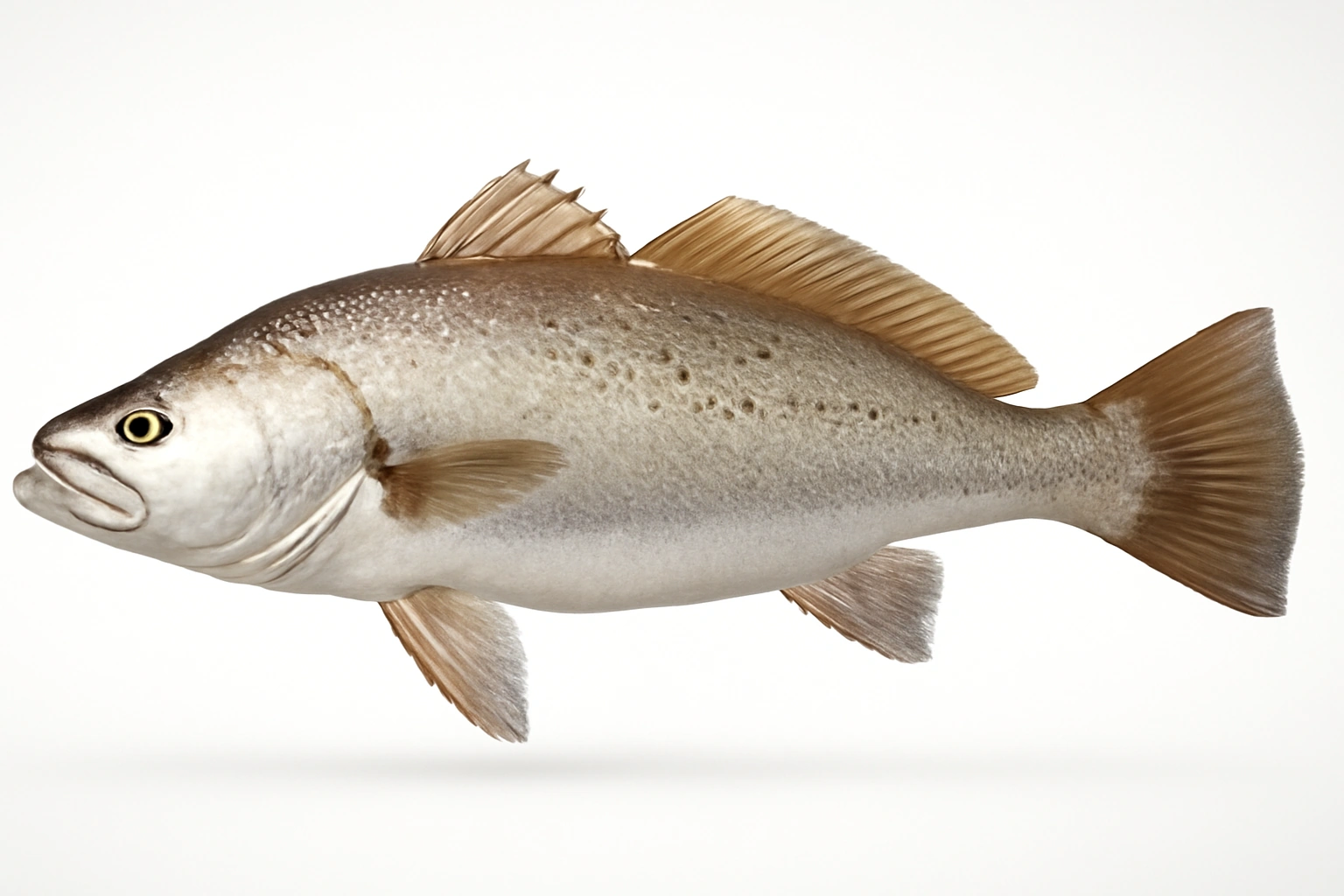

Overview
The Mulloway, also called Jewfish, is Australia's premier estuary predator. Can exceed 30 kg and catching one is considered a milestone for any angler. Hunts mainly at night and during rough conditions. Requires great patience and technique.
Identification
- Body
- The Mulloway's body is elongated and robust, with a well-defined lateral line.
- Colouration
- Silvery color with golden highlights and paler sides, dark fins.
- Sexual dimorphism
- Absent/slightly evident
- Growth
- Moderate, reaching considerable sizes in a few years.
Taxonomy
- Family
- Sciaenidae
- Order
- Perciformes
- Class
- Actinopterygii
Related species
Habitat & distribution
- Environment
- Coast, Estuaries, Ports
- Preferred bottom
- Sand, Mud, Seagrass
- Geographic distribution
- Found along the southern coasts of Australia, also present in parts of Japan and South Africa.
- Micro-habitat
- Often hides near submerged structures or vegetation to hunt prey.
Prefers environments with turbulent waters where murky conditions enhance its predatory abilities.
Presence by sea area
Diet
- Primary prey
- fish, squid, crustaceans
- Secondary prey
- shrimp, cuttlefish, crabs
- Occasional prey
- octopus, mullet
- Feeding behaviour
- Opportunistic predator, mainly hunts at night and during stormy conditions, using its keen vision and senses to locate prey.
- Natural predators
- sharks, seals, dolphins
Adopts an ambush hunting strategy, using vegetation and structures to hide from prey.
Behaviour
- Activity
- nocturnal
- Social behaviour
- small_groups
- Aggressiveness
- medium
- Migration
- Some individuals migrate to deeper waters for breeding.
- Seasonal behaviour
- Primarily active during warmer months, with increased presence in coastal areas.
- Juveniles
- Young tend to stay near estuarine waters where they find protection and abundant food.
- Adults
- Adults may move in small groups or alone, especially during hunting periods.
Reproduction
- Spawning season
- October, November, December
- Spawning depth
- between 20 and 60 meters
- Eggs
- Small pelagic eggs, very numerous.
- Larval stage
- Larvae are transparent with a prominent oil vesicle that ensures buoyancy.
- Sexual maturity
- 4-5 years
When to catch Mulloway
Activity calendar
Activity by season
Best times
This species shows peak fishing activity in spring, summer and autumn, when the productivity index (FPI) reaches its highest values.
Fishing activity decreases in winter, when conditions are less favourable.
Ideal conditions
Water temperature
Where to catch it
Best spots
Bottom preference
Spot type
Fishing techniques
Recommended
Other applicable
Recommended baits
Baits by pressure
How to really catch it
Mulloway is a powerful, mobile predator, with a large head, wide mouth, and a pronounced lateral line that reveals its nature as a coastal hunter. When the sea darkens and the water starts moving, it truly comes alive: that is when it is worth targeting with method and composure.
🐟 Good to know
One lesser-noticed biological detail is that its eggs are pelagic and very numerous, while the larvae are transparent and carry a prominent oil vesicle that helps them stay afloat. It is a reproductive strategy typical of fishes that rely on marine currents to disperse their earliest life stages.
🌊 Where & when
It lives over sand, mud, and seagrass bottoms along coasts, estuaries, and ports, often close to submerged structure or vegetation where it ambushes prey. It becomes especially relevant in the warmer months and remains highly fishable from March to November, particularly at night and in rough water; between October and December some fish also move into deeper water to spawn.
🎣 How to really catch it
For mulloway, surf fishing is the most concrete approach: a sturdy surfcasting rod, 20-30 lb braid, a 40-50 lb fluorocarbon leader, large circle hooks, and a bomb sinker let you present squid, cuttlefish, shrimp, or live fish effectively. Work river mouths, piers, and sandy areas near submerged structure, keeping the bait on the bottom at night or during stormy conditions, when this opportunistic predator is actively hunting.
💡 The detail that makes the difference
The most reliable tip is to think about the path of the prey, not just the spot that looks fishy. Since it hunts near structure and vegetation over soft bottoms, it often pays to place the bait along the edge between open sand or mud and nearby cover: that is where a nocturnal predator finds natural travel lanes and easy chances.
Catch & handling tips
- Fight
- Fights vigorously, using its strength and the current.
- Handling
- Handle with care to avoid injury, especially to the jaws and dorsal fins.
- Release
- Release quickly after oxygenating, avoiding unnecessary trauma.
Curiosities & culture
- Record catches
- Maximum documented size: up to about 181 cm and 75 kg (source: FishBase). There is no official global IGFA All-Tackle record; the largest documented recreational catches exceed 40 kg (Australia).
- In the kitchen
- Mulloway's meat is white and firm, ideal for grilling and stewing.
- Cultural notes
- Mulloway is a highly prized game fish in Australian sportfishing, often linked to tales of large night catches.
- Historical notes
- Traditionally fished by Australian Aboriginal communities, it plays an important role in their food culture and storytelling.