
Overview
Widespread deep-water predator, important commercial species. Hunts at night rising towards the surface.
Identification
- Body
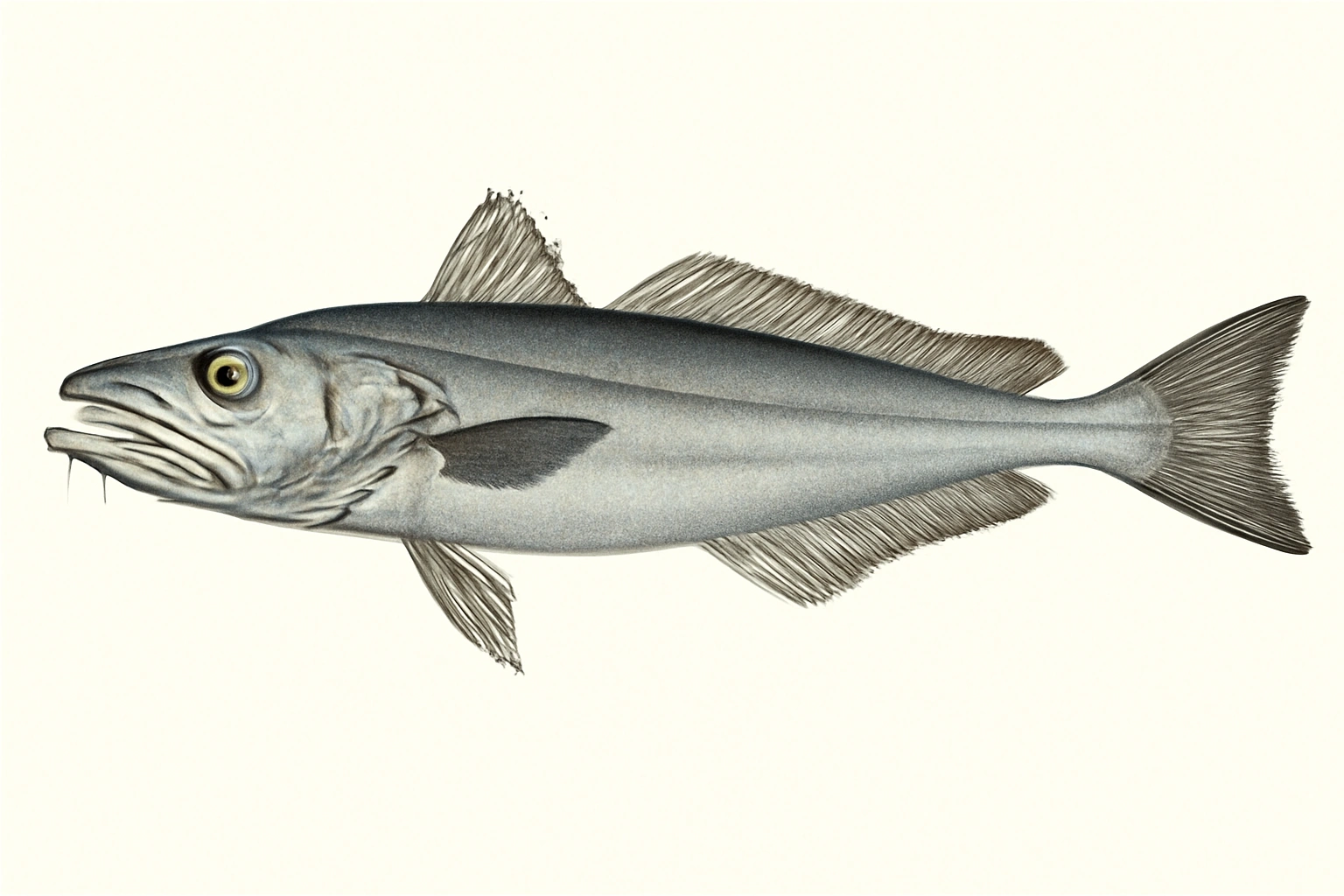
- Sleek and elongated body, with a large head and wide mouth.
- Colouration
- Silvery gray with a lighter belly and a dark lateral line.
- Sexual dimorphism
- Absent or not pronounced
- Growth
- Rapid growth in juvenile stages, slows down thereafter.
Taxonomy
- Family
- Merlucciidae
- Order
- Gadiformes
- Class
- Actinopterygii
Related species
Habitat & distribution
- Environment
- Coast, Open sea, Deep sea
- Preferred bottom
- Mud, Rock, Gravel
- Geographic distribution
- Found in the northeastern Atlantic, from Morocco to Norway and Iceland, including the Mediterranean Sea.
- Micro-habitat
- Seeks shelter near the seabed during the day and moves to shallower waters at night to hunt.
Prefers areas with muddy or rocky substrates that provide shelter and food.
Presence by sea area
Diet
- Primary prey
- small fish, squid, cuttlefish
- Secondary prey
- shrimp, crustaceans, fish larvae
- Occasional prey
- octopus, jellyfish
- Feeding behaviour
- An active predator, hunts at night by moving up to the surface and using surprise to catch prey.
- Natural predators
- tunas, dogfish, swordfish, humans (fishing)
Its diet varies with the temporary availability of prey species.
Behaviour
- Activity
- nocturnal
- Social behaviour
- solitary
- Aggressiveness
- medium
- Migration
- Resident in some areas, migratory in others depending on prey availability.
- Seasonal behaviour
- Changes depth based on season to take advantage of optimal temperatures and prey availability.
- Juveniles
- Lives in shallower waters where there are fewer predators and abundant food.
- Adults
- Inhabits deeper waters and broadens its range of prey.
Reproduction
- Spawning season
- April, May, June
- Spawning depth
- Between 100 and 300 meters
- Eggs
- Pelagic, transparent, small eggs.
- Larval stage
- Pelagic larvae living near the surface before descending to deeper waters.
- Sexual maturity
- Varies between 3 and 4 years
When to catch European hake
Activity calendar
Activity by season
Best times
This species shows peak fishing activity in spring, autumn and winter, when the productivity index (FPI) reaches its highest values.
Ideal conditions
Atmospheric pressure
Rises more towards surface to hunt.
Regular deep-water activity.
Stays on bottom, less active.
Stays deep.
Good nocturnal activity.
Rises to mid-water, more aggressive.
Water temperature
Where to catch it
Best spots
Bottom preference
Spot type
Fishing techniques
Recommended
Other applicable
Recommended baits
Baits by pressure
How to really catch it
The European hake is a bottom predator with a streamlined body, large head, and a wide mouth lined with sharp teeth, built to seize prey in the dark. By day it stays close to the seabed, but when the light fades and the water above fills with small prey, it becomes a fish you truly need to understand.
🐟 Good to know
One notable biological trait of hake is how its habitat changes as it grows: larvae are pelagic and live near the surface, juveniles occupy shallower water, and adults move deeper while broadening their prey range. It is a species that changes depth and ecological role over the course of its life.
🌊 Where & when
You find it over muddy, rocky, or gravel bottoms, along coasts, offshore, and in deep water, often on underwater slopes, near submarine canyons, and in current-swept areas, from 30 to 1000 meters. It is most approachable during peak months in winter, spring, and autumn; at night it rises to hunt, while from April to June it spawns between 100 and 300 meters.
🎣 How to really catch it
For hake, the most concrete approach is a solid, clean deep bottom setup with a medium-heavy rod, 20-30 lb braid, a 0.40-0.60 fluorocarbon leader, and 2/0 circle hooks, weighted with 80-200 g depending on depth and current. Fish natural baits such as small fish, squid, cuttlefish, or shrimp low in the water, in contact with the bottom or just above it, especially along mud, slopes, and edges washed by moving water.
💡 The detail that makes the difference
The practical edge is to think vertically, but at the right time: by day hake holds tight to the bottom, and by night it rises to feed, so it makes sense to search close to the seabed in daylight and a little higher after sunset. Keeping the bait in the layer it actually uses to hunt is more defensible than chasing arbitrary distances or speeds.
Catch & handling tips
- Fight
- Puts up a fight with quick, sudden movements when hooked.
- Handling
- Use gloves to avoid injuries from sharp teeth.
- Release
- Ensure the fish is vital before releasing it and use a barbless hook when possible.
Curiosities & culture
- Record catches
- Maximum documented size: up to about 140 cm and 15 kg (source: FishBase). There is no official global IGFA All-Tackle record; the largest documented catches are around 13 kg.
- In the kitchen
- Highly valued in cooking, especially in dishes like brodetto and grilled hake.
- Cultural notes
- Often mentioned in fishermen's tales for its cunning and hunting skill.
- Historical notes
- Fishing for this species has been practiced since ancient times, documented as far back as medieval manuscripts.