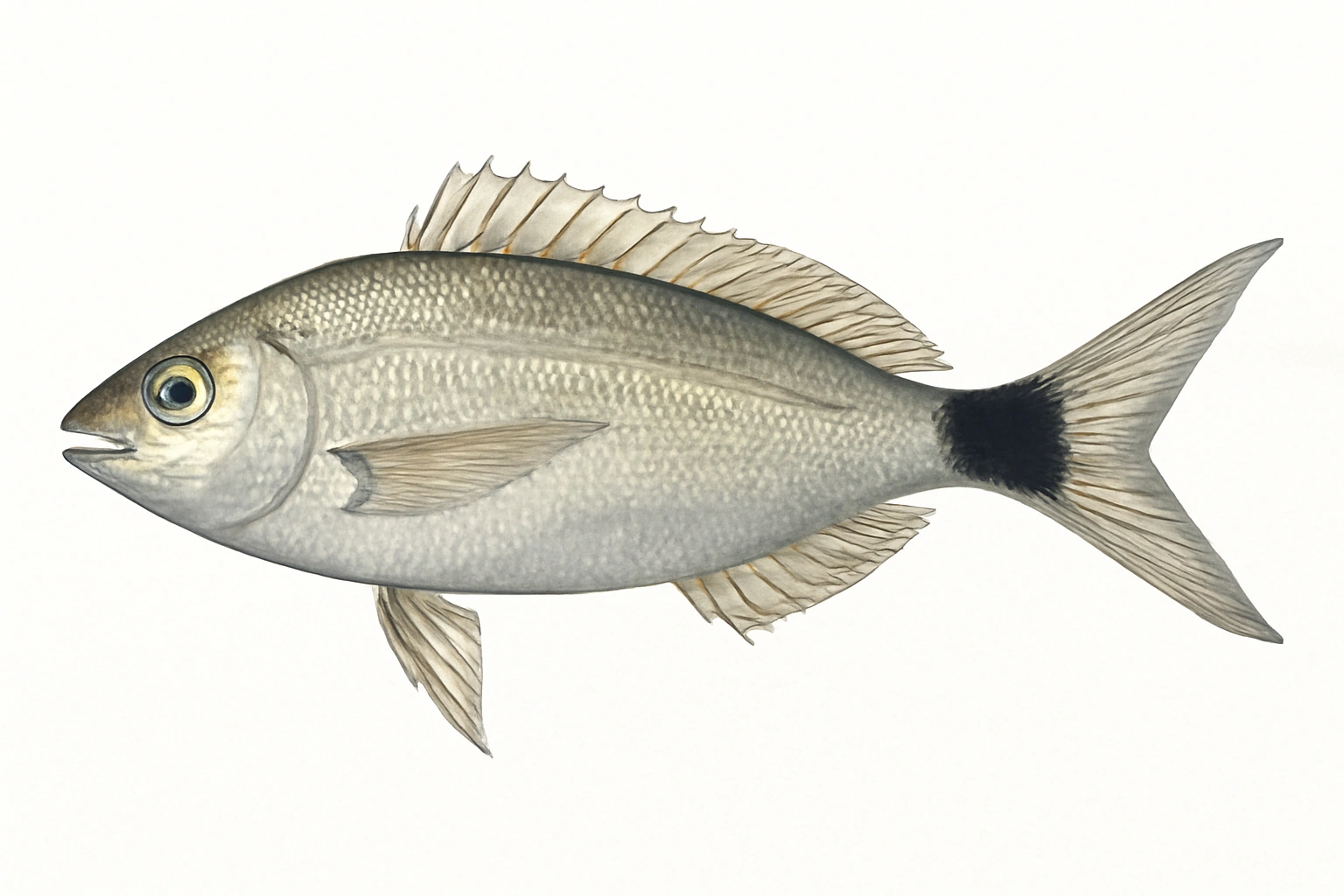

Overview
Very common gregarious Mediterranean fish. Moves in large schools near the surface, often near reefs and piers.
Identification
- Body
- Elongated body with lateral compression.
- Colouration
- Silver-gray with a distinctive black spot at the base of the tail.
- Sexual dimorphism
- Absent/barely noticeable
- Growth
- Fast, grows quickly in food-rich environments.
Taxonomy
- Family
- Sparidae
- Order
- Perciformes
- Class
- Actinopterygii
Related species
Habitat & distribution
- Environment
- Coast, Reefs, Open sea
- Preferred bottom
- Rock, Reef, Seagrass
- Geographic distribution
- Common in the Mediterranean Sea and along the Atlantic coast of North Africa and Southern Europe.
- Micro-habitat
- Often found near reefs and piers, forming large schools swimming near the surface.
Prefers shallow waters near rocky coasts and coral reefs.
Presence by sea area
Diet
- Primary prey
- small crustaceans, gastropods, polychaetes
- Secondary prey
- algae, organic detritus, small fish
- Occasional prey
- plankton, jellyfish
- Feeding behaviour
- Filters food at the surface or scrapes from the bottoms, limiting its movement to rocky or vegetation-rich areas.
- Natural predators
- dentex dentex, epinephelus marginatus, sphyraena barracuda
Diet varies according to local prey availability.
Behaviour
- Activity
- diurnal
- Social behaviour
- large_schools
- Aggressiveness
- low
- Migration
- non-migratory
- Seasonal behaviour
- Minor depth variations according to water temperature, favoring warmer areas in summer.
- Juveniles
- Young form smaller schools and explore low and protected coastal areas.
- Adults
- Moves in large schools for defense, often near reefs or submerged wrecks.
Reproduction
- Spawning season
- April, May, June
- Spawning depth
- between 10 and 40 meters
- Eggs
- Pelagic, small and transparent eggs.
- Larval stage
- Larvae are pelagic and develop rapidly in warm surface waters.
- Sexual maturity
- 3-4 years
When to catch Saddled seabream
Activity calendar
Activity by season
Best times
This species shows peak fishing activity in spring, summer and autumn, when the productivity index (FPI) reaches its highest values.
Ideal conditions
Atmospheric pressure
Active schools on surface, easy to spot.
Regular mid-water activity.
Goes deeper, less visible.
Goes to mid-water.
Active schools on surface.
Very active, feeds voraciously.
Water temperature
Where to catch it
Best spots
Bottom preference
Spot type
Fishing techniques
Recommended
Other applicable
Recommended baits
Baits by pressure
How to really catch it
The saddled seabream is a small coastal pelagic fish with a bright silver body, unmistakable for the black spot on its tail and for the large schools that glide tightly near the surface. It only looks easy when you can see it: to catch it consistently, you need to read light, water, and school movement with precision.
🐟 Good to know
One notable biological trait of the saddled seabream is its very flexible diet: it can feed by filtering at the surface, but also by scraping food from rocky bottoms or among vegetation. That dual strategy explains why it frequents both open coastal water and reefs, seagrass, and piers.
🌊 Where & when
It is common in the Mediterranean and along the Atlantic coasts of North Africa and Southern Europe, from very shallow water down to 50 meters, especially around reefs, piers, rocky ground, and seagrass areas. It becomes most interesting from March to November; in summer it tends to favor warmer areas, and from April to June it spawns between 10 and 40 meters.
🎣 How to really catch it
To really catch it, float fishing and light bottom fishing are the most concrete options around piers and reefs, where the school passes high in the water but stays tied to rock and vegetation. A light spinning rod, 0.20-0.30 monofilament, a 0.25 fluorocarbon leader, size 8-10 hooks, and small pieces of shrimp or sardine work well; 5-15 g sinkers are enough when you only need to drop just below the surface film.
💡 The detail that makes the difference
The practical edge is not forcing the presentation onto the bottom when the school is visibly circling high: the saddled seabream also feeds by filtering near the surface, so a small, natural bait kept in the upper layers or mid-water often outfishes a rig that is too heavy. Once hooked, expect tight circles under the rod tip.
Catch & handling tips
- Fight
- Feisty when hooked, often circles tightly.
- Handling
- Handle carefully to avoid damaging the silvery skin and fins.
- Release
- Gently release back into the water to minimize stress.
Curiosities & culture
- Record catches
- Maximum documented size: up to about 37 cm and 0.5 kg (source: FishBase). There is no official IGFA All-Tackle record for this species.
- In the kitchen
- Greatly valued grilled or baked with local herbs.
- Cultural notes
- Known in literature for its brilliant silvery reflections and common in Mediterranean fishing tales.
- Historical notes
- Fishing for occhiate was known in ancient Rome, where it was prized for its delicate flesh.