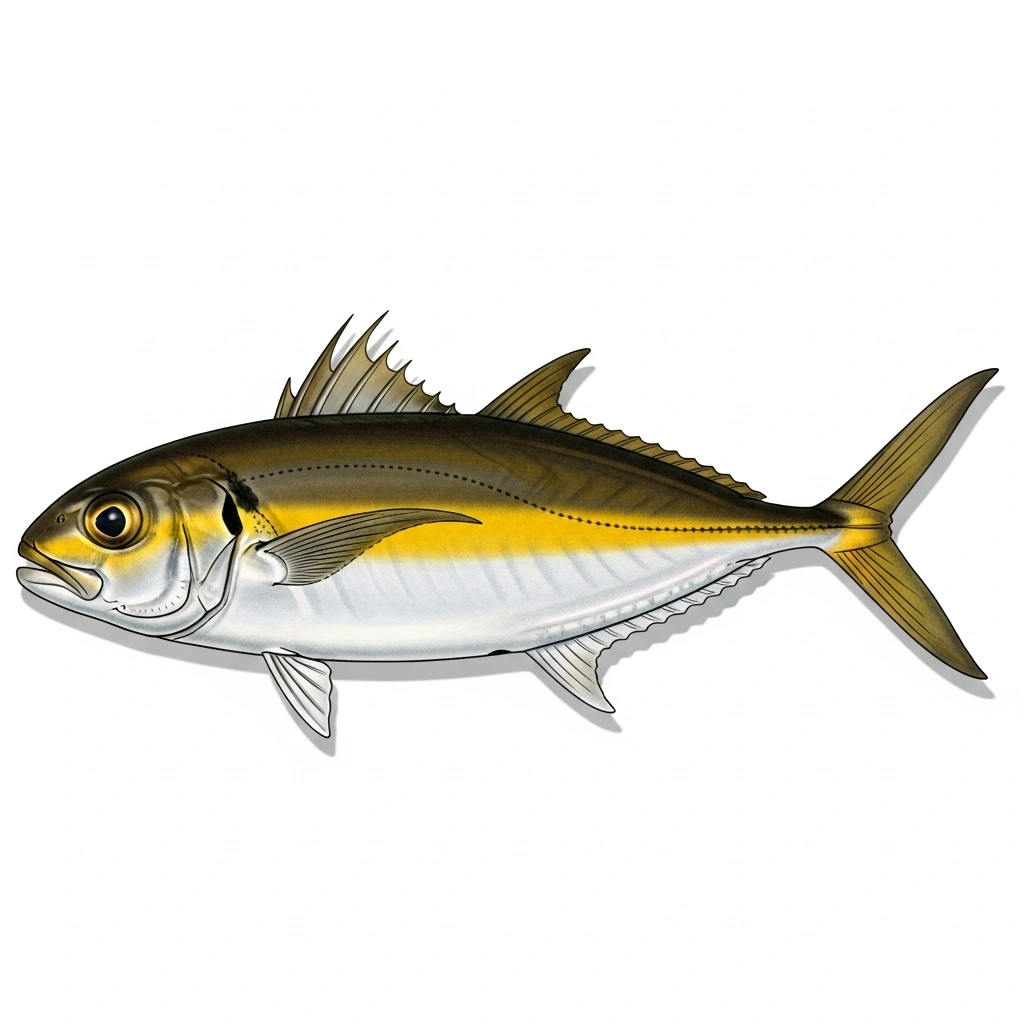

Overview
Powerful pelagic fish of deep Brazilian reefs. Related to amberjack, fights with devastating runs to the bottom.
Identification
- Body
- Has a sturdy, streamlined body with a pointed snout.
- Colouration
- Typically bluish-silver with greenish tones on the back and a white belly, coloration changes with light and age.
- Sexual dimorphism
- Absent/not noticeable
- Growth
- Medium, grows steadily, reaching maturity in a few years.
Taxonomy
- Family
- Carangidae
- Order
- Perciformes
- Class
- Actinopterygii
Related species
Habitat & distribution
- Environment
- Open sea, Reefs, Deep sea
- Preferred bottom
- Reef, Rock, Sand
- Geographic distribution
- Common in tropical and subtropical areas of the western Atlantic Ocean, from the coasts of Brazil to the United States, as well as the Gulf of Mexico and the Caribbean Sea.
- Micro-habitat
- Prefers deep reef areas, often near wrecks and submerged structures.
Requires areas with moderate currents allowing agile movement among prey.
Presence by sea area
Diet
- Primary prey
- pelagic fish, cephalopods, crustacean shells
- Secondary prey
- shrimp, crabs, smaller fish
- Occasional prey
- plankton, marine invertebrates
- Feeding behaviour
- Active predator, hunts aggressively and swiftly, chasing prey along reefs and submerged structures.
- Natural predators
- sharks, marine maro, greater amberjack, sea turtles
Adopts various hunting strategies depending on prey availability.
Behaviour
- Activity
- diurnal
- Social behaviour
- small_groups
- Aggressiveness
- medium
- Migration
- Occasional migrator between feeding and breeding areas
- Seasonal behaviour
- Shows increased activity during warmer months when prey is abundant.
- Juveniles
- Juveniles tend to form schools near the coast or around coral reefs.
- Adults
- Adults form small groups and are more territorial, often found near reef formations.
Reproduction
- Spawning season
- July, August, September
- Spawning depth
- between 20 and 60 meters
- Eggs
- Pelagic eggs, small in size, released in large groups.
- Larval stage
- Larvae are pelagic and transparent, developing rapidly and allowing them to move quickly to safer areas.
- Sexual maturity
- varies between 3 and 5 years
When to catch Almaco jack
Activity calendar
Activity by season
Best times
This species shows peak fishing activity in spring, summer and autumn, when the productivity index (FPI) reaches its highest values.
Fishing activity decreases in winter, when conditions are less favourable.
Ideal conditions
Atmospheric pressure
Rises from the depths to actively hunt.
Responds well to jigging.
Stays on the bottom, less reactive.
Water temperature
Where to catch it
Best spots
Bottom preference
Spot type
Fishing techniques
Recommended
Other applicable
Recommended baits
Baits by pressure
How to really catch it
The Almaco jack is a strong, streamlined pelagic fish built to chase and strike along reefs, wrecks, and submerged structure. When it turns active, especially in the warmer months, it turns deep blue water into a tense hunting ground: that is exactly when it becomes a memorable and far from easy catch.
🐟 Good to know
One solid biological trait of the Almaco jack is its reproduction through small pelagic eggs released in large groups. The larvae are also pelagic and transparent, so in the earliest life stages they remain linked to the water column before associating with more structured habitats.
🌊 Where & when
It occurs across the tropical and subtropical western Atlantic, from Brazil to the United States, including the Gulf of Mexico and the Caribbean, from 10 to 200 meters. It especially favors deep reefs, wrecks, banks, and submerged structures. It is more active from March to November, with a clear push in warmer months; from July to September it also uses spawning depths between 20 and 60 meters.
🎣 How to really catch it
To truly fish for it, the most concrete approach is live bait fishing close to deep reefs, wrecks, and structure. A 20-30 lb stand-up rod, 30-50 lb braid, 40-60 lb fluorocarbon leader, and 3/0-5/0 circle hooks make a coherent setup; with live fish or squid presented near the structure, the strike is often decisive and the fight immediately drives toward the bottom.
💡 The detail that makes the difference
The detail that makes a difference is to work the edge of the structure, not empty water. The Almaco jack is a diurnal predator that hunts by chasing prey along reefs and submerged obstacles, so a presentation tight to those natural lanes is more convincing than a bait set far from cover. Once hooked, control it immediately to avoid giving it the bottom.
Catch & handling tips
- Fight
- Fights vigorously with fast runs and dives, using its strength and endurance.
- Handling
- Use gloves to avoid injuries from sharp fins.
- Release
- Keep the fish moist and release quickly to minimize stress.
Curiosities & culture
- Record catches
- Maximum documented size: up to about 160 cm and 60 kg (source: FishBase). IGFA All-Tackle record: 61.6 kg (136 lb), caught at Ashizuri-Misaki (Japan) in 2020.
- In the kitchen
- Great grilled or in ceviche. Highly sought after in tropical cuisine.
- Cultural notes
- Valued for its fighting power, a prized catch for many sport anglers.
- Historical notes
- Traditionally caught along the Brazilian coasts by artisanal fishermen.