
Overview
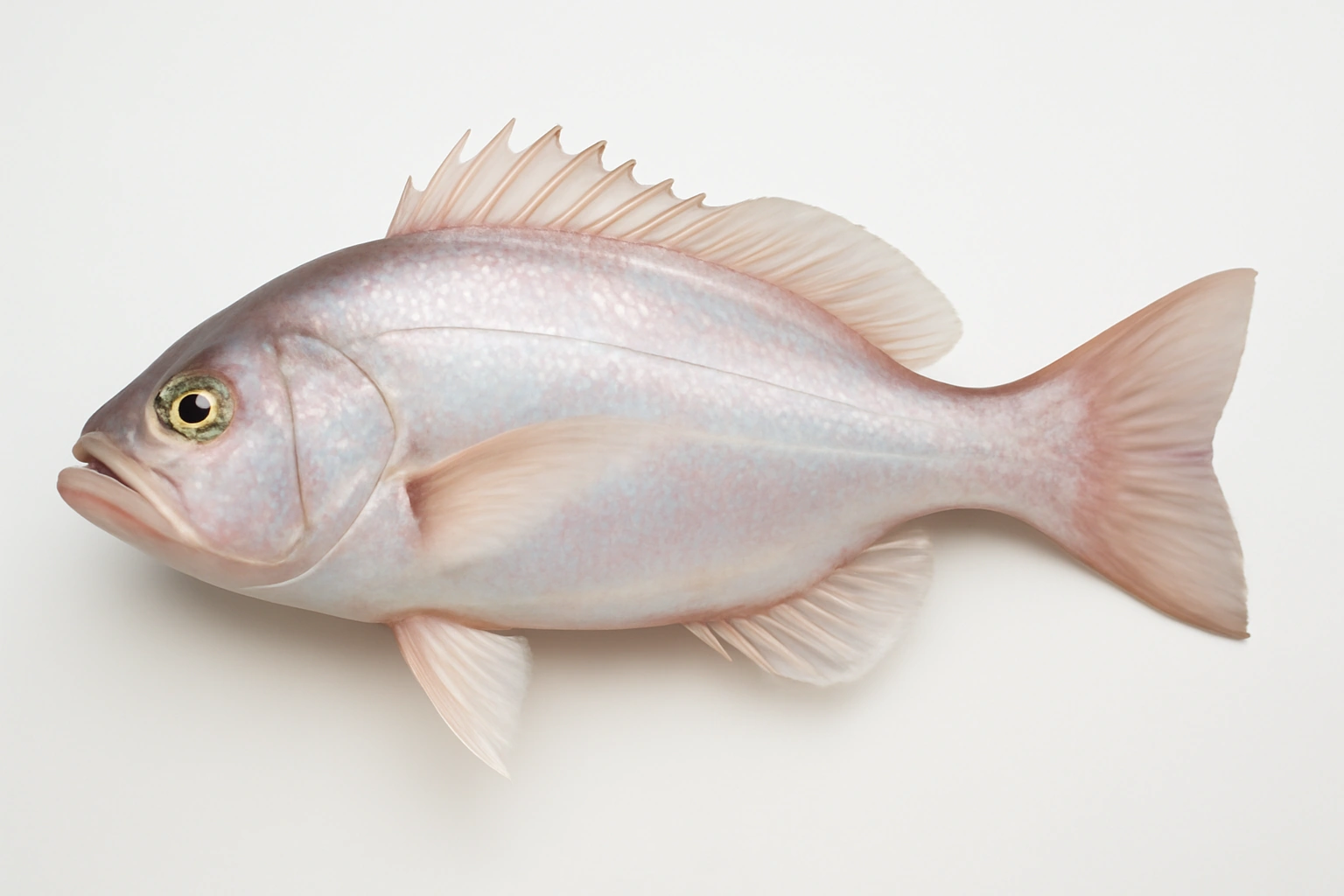
The Pearl Perch is endemic to Australia, found mainly off Queensland and NSW. Considered one of Australia's finest eating fish - sweet, firm and buttery flesh. Fishing occurs in deep water over rocky structures.
Identification
- Body
- Fusiform body with a solid profile and slightly compressed sides.
- Colouration
- Silvery color with pearly reflections, lacking distinctive patterns.
- Sexual dimorphism
- Absent/not obvious
- Growth
- Moderate, often influenced by food availability.
Taxonomy
- Family
- Glaucosomatidae
- Order
- Perciformes
- Class
- Actinopterygii
Related species
Habitat & distribution
- Environment
- Coast, Reef, Deep sea
- Preferred bottom
- Rock, Reef
- Geographic distribution
- Primarily found off the eastern coasts of Australia, especially in Queensland and New South Wales.
- Micro-habitat
- Typically shelters near rocky structures and coral reefs where it finds protection and food.
Prefers deep areas with structures that offer shelter and abundant food resources.
Presence by sea area
Diet
- Primary prey
- crustaceans, cephalopods, small bony fish
- Secondary prey
- polychaetes, shrimps, krill
- Occasional prey
- euphausiids, fish larvae
- Feeding behaviour
- Mostly benthic feeding, predominantly hunting on the sea floor, often in rocky habitats rich in hiding spots.
- Natural predators
- gray shark, blacktip shark, bigeye tuna
Diet varies with age; juveniles feed more frequently on small invertebrates.
Behaviour
- Activity
- diurnal
- Social behaviour
- small_groups
- Aggressiveness
- medium
- Migration
- Resident with limited movements for food search.
- Seasonal behaviour
- Activity can vary with water temperature, generally more active during warmer months.
- Juveniles
- Juveniles often stay close to the bottom, hiding among rocks and corals.
- Adults
- Adults form small groups, displaying territoriality around rocky structures.
Reproduction
- Spawning season
- November, December, January, February
- Spawning depth
- Between 30 and 60 meters
- Eggs
- Small pelagic eggs, dispersed in the water column.
- Larval stage
- Pelagic larvae grow in planktonic environments before settling on the bottom.
- Sexual maturity
- 3-4 years
When to catch Pearl Perch
Activity calendar
Activity by season
Best times
This species shows peak fishing activity in spring, summer and autumn, when the productivity index (FPI) reaches its highest values.
Fishing activity decreases in winter, when conditions are less favourable.
Ideal conditions
Water temperature
Where to catch it
Best spots
Bottom preference
Spot type
Fishing techniques
Recommended
Other applicable
Recommended baits
Baits by pressure
How to really catch it
The pearl perch is a solid, high-strung reef fish, built to live around hard bottom and structure. When you find it in the right place, among blue shadows and submerged relief, it delivers crisp takes and a fight full of sharp jolts that instantly reveal a true bottom predator.
🐟 Good to know
An important biological trait is its early life cycle: it lays small pelagic eggs dispersed in the water column, and the larvae are pelagic as well before settling to the bottom. It is a clear shift from an open, planktonic phase to an adult life closely tied to rocks, reefs, and shelter.
🌊 Where & when
It is found mainly off eastern Australia, especially Queensland and New South Wales, over rocky bottoms, offshore shoals, coral reefs, and submerged ledges from 30 to 150 meters. It is a diurnal, resident species and generally more active in warmer months; the most interesting period runs from March to November, while from November to February it may spawn between 30 and 60 meters.
🎣 How to really catch it
To really fish for it, bottom fishing is the most concrete approach: drop the bait tight to the seabed, right where rocks and structure hold small crustaceans, cephalopods, and fish. A medium-heavy bottom rod, 0.30-0.35 mm monofilament, 0.50-0.60 mm fluorocarbon leader, 1/0-2/0 circle hooks, and a 50-150 g running sinker work well with live shrimp, squid, cephalopod strips, or sardines, keeping the offering natural and close to the substrate.
💡 The detail that makes the difference
The practical edge is simple: work the live side of the structure, not the empty water beside it. Pearl perch feed mainly on the bottom and stay closely tied to rocks and reefs with limited movements; when the bait brushes stone, crevices, and changes in relief, it is truly passing through their feeding lane.
Catch & handling tips
- Fight
- Fights vigorously with strong pulls and sudden bursts.
- Handling
- Use gloves to avoid contact with dorsal spines.
- Release
- Release quickly in water to minimize stress, avoiding damage to fins.
Curiosities & culture
- Record catches
- Maximum documented size: up to about 70 cm and 7.3 kg (source: FishBase). The IGFA All-Tackle record for this species is currently vacant.
- In the kitchen
- Often used in baked fillets, grilled dishes, soups, and foil cooking.
- Cultural notes
- Considered a highly prized fish in Australian cuisine for its delicate flesh.
- Historical notes
- Traditionally fished since the times of coastal Aboriginal communities.