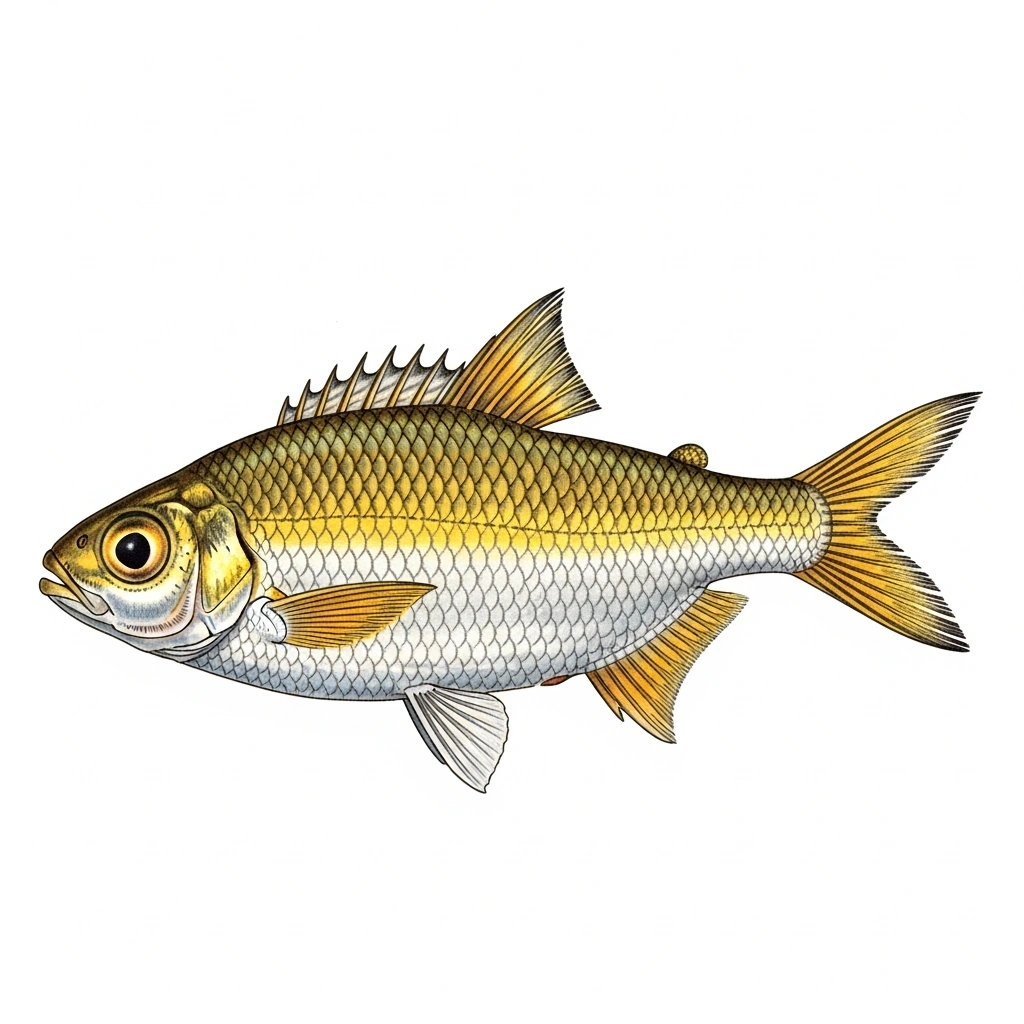

Overview
Coastal predator among the most sought-after in Brazil. Hunts in estuaries and murky coastal waters using the lateral line.
Identification
- Body
- Elongated body and laterally compressed, similar to other weakfish.
- Colouration
- Bright yellow with silvery sheen; sides have darker longitudinal lines.
- Sexual dimorphism
- Absent/not apparent
- Growth
- Rapid, fast-growing species ideal for colonizing variable coastal environments
Taxonomy
- Family
- Sciaenidae
- Order
- Perciformes
- Class
- Actinopterygii
Related species
Habitat & distribution
- Environment
- Coast, Estuaries, Brackish
- Preferred bottom
- Sand, Mud, Estuarine
- Geographic distribution
- Found along the Atlantic coasts of South America, from Venezuela to southeastern Brazil.
- Micro-habitat
- Seeks shelter in murky estuarine waters and hunts near sandy or muddy bottoms.
Prefers sandy or muddy bottom habitats, common in murky water areas.
Presence by sea area
Diet
- Primary prey
- shrimp, small fish, crustaceans
- Secondary prey
- squids, fish larvae, crabs
- Occasional prey
- annelids, mollusks
- Feeding behaviour
- Active predator using lateral line to detect prey in murky waters. Often hunts in small groups.
- Natural predators
- sharks, dolphins, large carnivorous fish
Follows small fish schools along estuaries and coasts, helping control prey populations.
Behaviour
- Activity
- diurnal
- Social behaviour
- small_groups
- Aggressiveness
- medium
- Migration
- Resident but makes small seasonal movements between estuaries and open coasts.
- Seasonal behaviour
- During the rainy season, tends to move towards estuaries forming breeding aggregations.
- Juveniles
- Young individuals generally stay closer to the coast and estuaries, preferring shallow waters.
- Adults
- Adults may venture into deeper waters but tend to remain in coastal areas.
Reproduction
- Spawning season
- November, December
- Spawning depth
- between 16 and 49 feet
- Eggs
- Pelagic, transparent, and small eggs that float on the water's surface.
- Larval stage
- Larvae are transparent and move toward coastal waters and estuaries to feed and grow.
- Sexual maturity
- between 2 and 3 years
When to catch Acoupa weakfish
Activity calendar
Activity by season
Best times
This species shows peak fishing activity in spring, summer and autumn, when the productivity index (FPI) reaches its highest values.
Fishing activity decreases in winter, when conditions are less favourable.
Ideal conditions
Atmospheric pressure
Very active in murky water after rain.
Hunts regularly in estuaries.
Less active, stays on the bottom.
Water temperature
Where to catch it
Best spots
Bottom preference
Spot type
Fishing techniques
Recommended
Other applicable
Recommended baits
Baits by pressure
How to really catch it
The pescada-amarela is a coastal predator that lives where the water turns murky and the bottom becomes sand or mud. It has a large mouth, sharp teeth, and a direct way of striking: if you want to target it properly, you have to think like an estuary hunter.
🐟 Good to know
One decisive biological detail is its well-developed lateral line: in murky water it does not rely on sight alone, but detects the movements and vibrations of prey. This fits its habit of hunting close to the bottom, often in small groups.
🌊 Where & when
You find it along the Atlantic coasts of South America, from Venezuela to southeastern Brazil, especially in estuaries, river mouths, lagoons, and brackish coastal stretches between 1 and 30 meters. It readily shelters in turbid water and becomes especially interesting from March to November; during the rainy season it tends to move into estuaries, where it forms breeding aggregations, with spawning between November and December at 5-15 meters.
🎣 How to really catch it
The most concrete way to fish for it is bottom fishing, keeping the presentation low and clean over sandy or muddy bottoms in estuaries and river mouths. A medium 2.1-2.4 m rod, 15 kg braid, 0.40 mm fluorocarbon leader, size 2/0 to 4/0 hooks, and 20-50 g bottom weights let you present live shrimp, small fish, squid, or crabs effectively. Spinning and light trolling can also work in coastal areas.
💡 The detail that makes the difference
A practical, defensible tip is not to lift the bait too far off the bottom. This species hunts near the substrate and uses its lateral line in stained water: a presentation that stays low, steady but alive, fits its strike zone better than a bait working too high in the water column.
Catch & handling tips
- Fight
- Tends to fight strongly, making quick bursts and short runs.
- Handling
- Handle carefully to avoid losing scales and damaging delicate skin.
- Release
- Release quickly into the water, ensuring it swims away before letting go.
Curiosities & culture
- Record catches
- Maximum documented size: up to about 110 cm and 17 kg (source: FishBase). There is no official IGFA All-Tackle record for this species.
- In the kitchen
- Mainly used in dishes like moqueca and fried after simple marination.
- Cultural notes
- Celebrated at local fairs as a symbol of coastal fishing communities in Brazil.
- Historical notes
- Traditionally fished as a staple food by coastal communities in South America for centuries.